
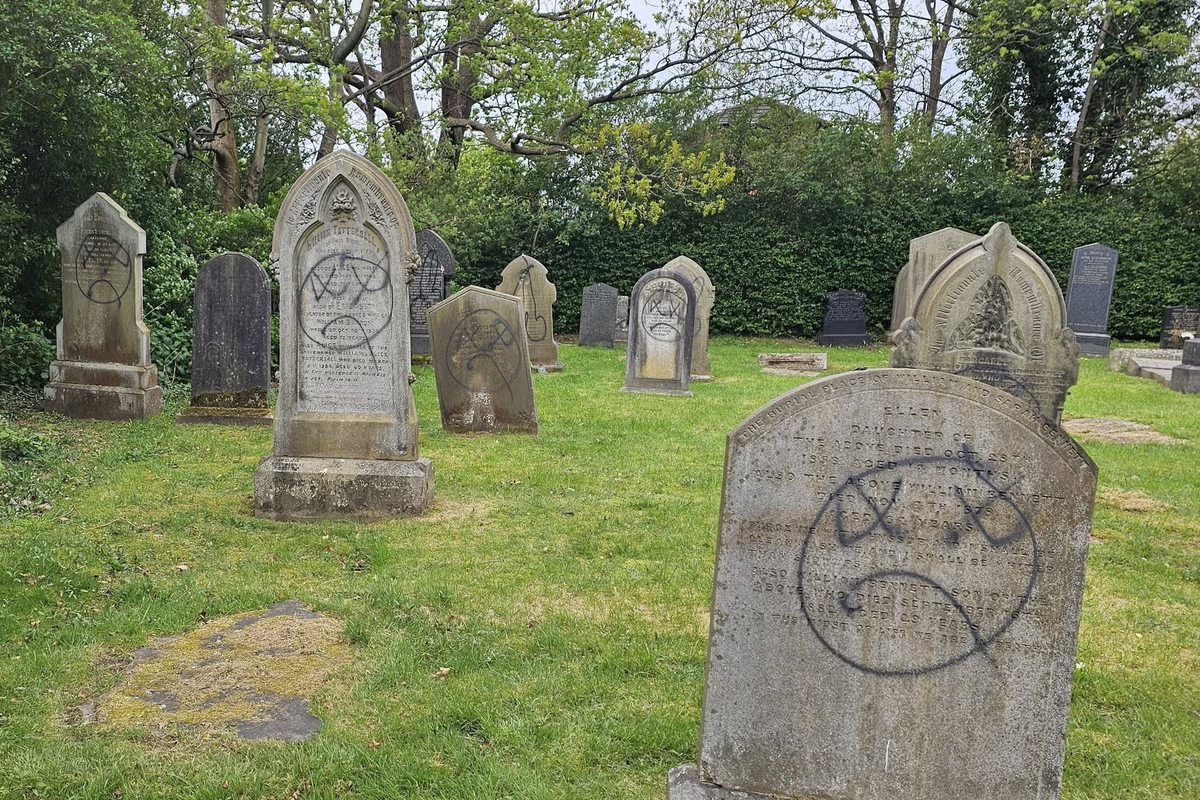
St James Church in Leyland, near Preston, has long stood as a sanctuary for peace, reflection, and worship since its construction in 1855. Nestled in the heart of the community, this Grade II-listed building has witnessed countless baptisms, weddings, and funerals.
But on Good Friday, the tranquil churchyard and sacred walls became the canvas for a heinous act of vandalism. What should have been a solemn day of remembrance and prayer was instead overshadowed by a display of obscenity and hatred.
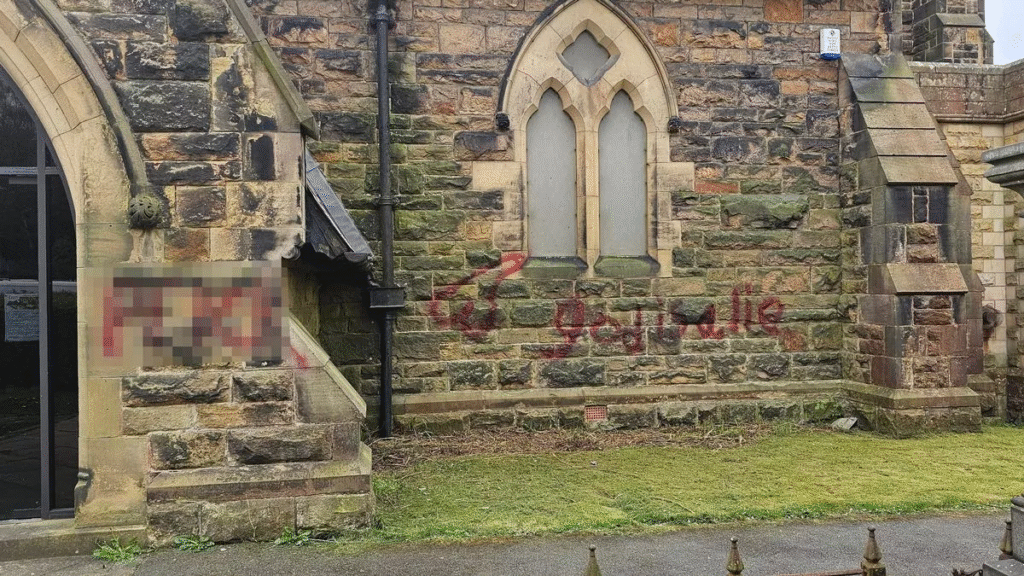
Lewd images, profane language, and blasphemous phrases were spray-painted across the church’s ancient stonework and on nearly forty gravestones in its yard. For the church community, it was a gut-wrenching sight.
The defacement wasn’t just physical; it pierced the emotional and spiritual sanctity of the space. The vile nature of the graffiti was enough to evoke shock and horror, and the timing of the act — on one of the most significant days in the Christian calendar — made it all the more painful.
Reverend Marc Wolverson, the vicar of St James, described his reaction upon seeing the damage as one of disgust and disbelief. Despite the vile intrusion, he made the resolute decision to proceed with the Good Friday service, refusing to let the vandals disrupt the sacred observance. His commitment reflected a powerful message: that faith, unity, and hope can endure even in the face of hatred and defilement.
A Wedding Amidst the Chaos
Only a day after the vandalism, St James Church was set to host a wedding. For the couple and their families, what should have been a joyful and picturesque celebration had been thrown into uncertainty. The church, still marked by offensive graffiti, had to quickly find a way to preserve the sanctity and visual beauty of the ceremony.
In an act of both practicality and creativity, the church decided to use conifer plants and greenery to conceal the worst of the graffiti. The goal was not only to restore a semblance of dignity for the wedding but also to protect the couple’s memories from being marred by the hateful imagery.
Rev Wolverson personally informed the couple of the situation, giving them the option to reschedule or relocate. But just like the congregation that gathered for Good Friday, the couple chose resilience. They went ahead with the ceremony, supported by a church community determined to uphold the sanctity of love and marriage in defiance of the hateful act.
Read : Fellowship Baptist Church Pastor Josh Sullivan Kidnapped at Gunpoint in South Africa
This practical effort to mask the damage with plants wasn’t just about aesthetics. It was symbolic — a way of saying that beauty and grace could grow even in the most defiled spaces. The church became a living metaphor for perseverance. The greenery, strategically placed, served as a quiet form of protest — a testament to faith that endures and a community that refuses to be broken.
Read : Church of England Faces Threat of Split Over Stance on Gay Couples
The wedding was conducted with the dignity it deserved. Photographers worked carefully to frame the joyful moments without capturing the hateful scrawl. Family members, friends, and church staff worked together, united by a common purpose: to reclaim the space, even temporarily, from the grip of desecration.
Outrage and Unity in the Wake of Hate
The community’s reaction was immediate and emotional. People were horrified to learn that their beloved church, a place of peace and spiritual refuge, had been targeted with such deliberate cruelty.
Local councillor Paul Wharton-Hardman, the Labour deputy mayor for South Ribble Borough Council, called the attack “sickening” and “cowardly,” pointing out that this was not some act of mindless vandalism — it was a targeted assault on a place of worship, memory, and hope.
He noted how families come to the church to mourn, to pray, and to find solace. The thought that they would now be greeted by such defilement was beyond offensive — it was, in his words, “evil.”
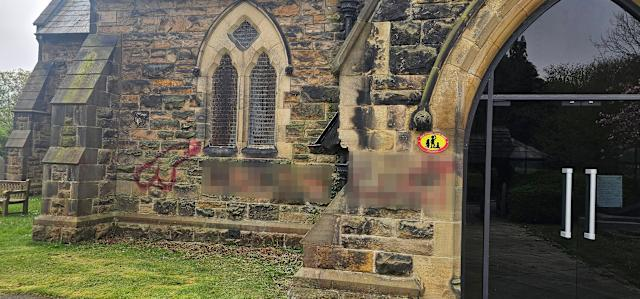
Photographs shared online showed the extent of the damage. Black spray paint scarred gravestones, while bold red lettering shouted blasphemies across the church’s stone walls. These images stirred a deep sense of injustice and sorrow, but they also ignited a wave of solidarity.
Detective Sergeant Lee Jamieson of South CID confirmed that the incident was being treated as a hate crime, emphasizing that the police were taking the matter very seriously.
He urged anyone with information to come forward, noting the community’s role in helping to bring the offenders to justice. The message was clear: acts of hate would not be tolerated — not against people, not against faith, and not against the places that hold communal meaning.
As the investigation unfolded, the church began receiving an outpouring of support. Local residents, council members, and people from neighboring towns reached out with offers of help.
Volunteers arrived with cleaning supplies, while others offered financial support or simply came to lend moral strength. Though the damage was extensive, the spirit of the community was unshaken.
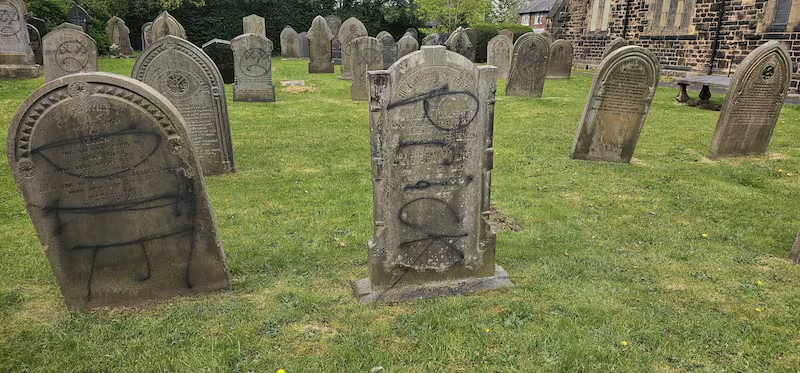
The church is now in consultation with experts and insurers to determine the best way to clean the historic surfaces of the building and gravestones without causing further harm. Given the heritage status of St James, restoration must be done carefully, respecting the structure’s historical significance while removing the hateful graffiti.
From Ashes, A Stronger Community
Despite the pain, something powerful emerged from the incident. The vandalism, intended to instill fear and outrage, instead ignited resilience and solidarity. Rev Wolverson spoke of being overwhelmed by the support the church received.
People who hadn’t attended services in years showed up to help or simply to express their sorrow. The attack became a catalyst for community action, bringing together people of all ages, backgrounds, and beliefs.
In many ways, the vandalism laid bare the depth of affection and reverence the people of Leyland hold for St James Church. What was meant to tear the community apart instead reaffirmed its bonds. The community’s collective determination to clean, protect, and uphold the sanctity of their church sent a resounding message: no act of hatred can silence faith, love, and unity.
The use of plants to shield the vulgarity during the wedding may seem a small gesture, but in context, it carried profound meaning. It was a declaration — that love would not be overshadowed by hate, that sacred ceremonies would continue undeterred, and that the community would always choose light over darkness.
Rev Wolverson and his parish continue to pray, clean, and rebuild. As Holy Week progressed, so did their commitment to healing. The wedding that followed such sorrow became a moment of beauty, not in spite of the vandalism, but as a direct response to it — an embodiment of grace under pressure.
In the weeks and months to come, St James Church will undergo restoration. The offensive graffiti will be scrubbed away, the gravestones cleaned, and the walls blessed once more.
But the emotional scars will remain — not as a source of pain, but as a reminder of the community’s resilience. The story of Easter at St James in 2025 will not just be one of defilement but of defiance, hope, and the reaffirmation of faith.
While investigations continue and justice is sought, the church remains a beacon for its parishioners. Services continue, prayers are offered, and support flows.
The plants that covered the graffiti may wither in time, but the love and unity they represent will not. St James Church stands tall — wounded, perhaps, but unbroken — a living testimony to the power of faith in the face of evil.