
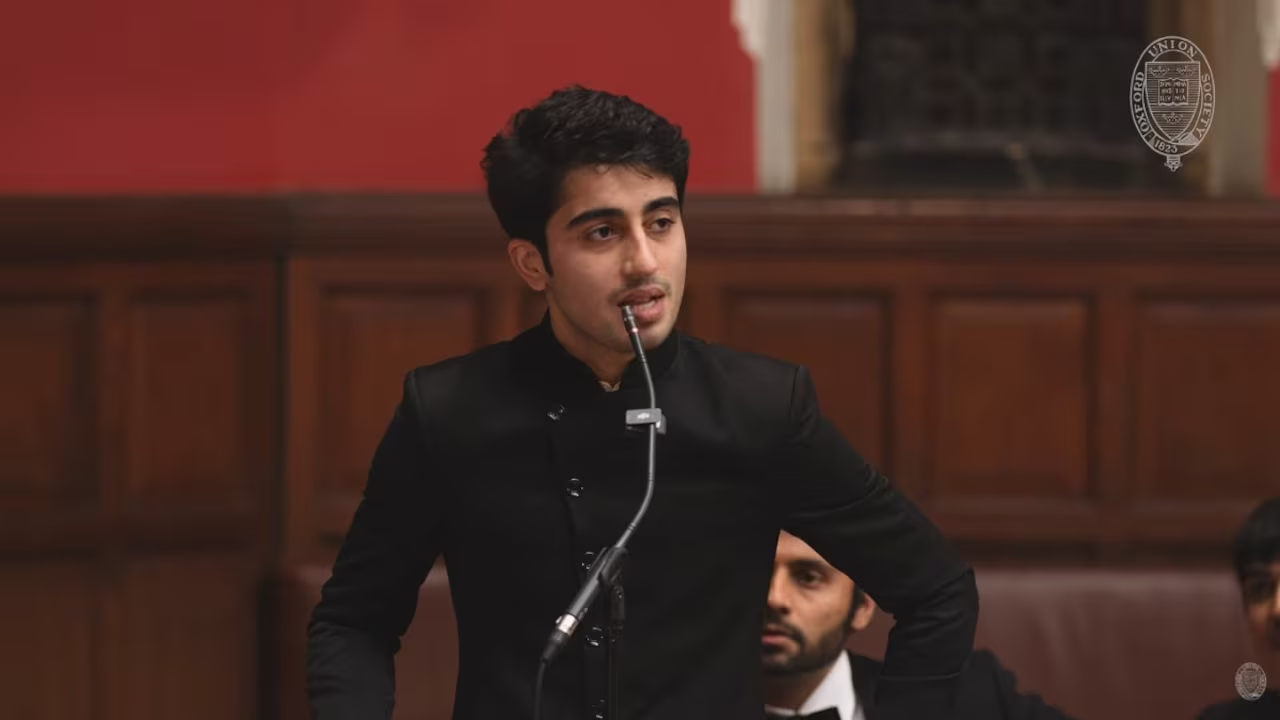
Viraansh Bhanushali, a Mumbai-born law student at the University of Oxford, has emerged as an unexpected global voice in a long-running and deeply sensitive geopolitical debate. His speech at the Oxford Union, delivered during a student-led debate on India–Pakistan relations, has drawn millions of views and ignited widespread discussion across social media, news platforms, and political circles.
What set Viraansh Bhanushali apart was not just the sharpness of his critique of Pakistan’s terror record, but the manner in which he grounded his arguments in personal experience, historical chronology, and institutional restraint rather than nationalist rhetoric. Speaking as someone who grew up in a city repeatedly scarred by terrorism, he framed India’s security posture as a response shaped by lived trauma and policy continuity, challenging claims that it is driven primarily by populism or electoral calculation.
The viral moment came amid controversy surrounding the Oxford Union itself. A planned high-profile debate involving Indian and Pakistani politicians collapsed following allegations that the Union’s Pakistani president, Moosa Harraj, mishandled invitations and later allowed Pakistan to claim a symbolic “victory” in a debate that never formally occurred. Against this backdrop, a separate student debate on the same motion went ahead in November, largely unnoticed at the time.
It was only weeks later, when the Oxford Union released footage of that debate, that Bhanushali’s speech began circulating widely. His remarks, particularly the line “you cannot shame a state that has no shame,” resonated far beyond the university chamber, reflecting a broader frustration shared by many Indians who see international discussions on terrorism as detached from ground realities.
A Mumbai Childhood Shaped by Terror and Memory
Bhanushali’s intervention at the Oxford Union was anchored in his upbringing in Mumbai, a city that has endured multiple major terror attacks over the past three decades. Rather than opening with abstract policy arguments, he began by recounting personal memories from November 2008, when coordinated attacks by Lashkar-e-Taiba terrorists from Pakistan paralysed the city.
One of the key targets was Chhatrapati Shivaji Maharaj Terminus, one of India’s busiest railway stations and a place closely tied to his family’s daily life. His aunt, who routinely passed through the station in the evenings, narrowly avoided the attack by taking a different train that night, escaping the fate of the 166 people killed in the broader assault. He described himself as a schoolboy at the time, watching events unfold on television as Mumbai burned, recalling the fear in his mother’s voice and the visible tension in his father’s silence.
For three nights, he said, the city did not sleep. These recollections were not presented for emotional effect alone but to establish why debates that reduce India’s security policies to populist theatrics feel disconnected from reality to those who lived through such violence. He also referenced the 1993 Mumbai bomb blasts, another formative episode, noting that a railway station near his home had been targeted then as well.
By situating his argument within this continuum of attacks, Viraansh Bhanushali challenged the notion that India’s hard line towards Pakistan is primarily an electoral strategy. He argued that terror in India has followed its own grim calendar, often striking far from election cycles. Referring to the 1993 blasts that killed 257 people, he pointed out that national elections were still three years away at the time. The violence, he said, was not designed to swing votes but to destabilise India’s economic and social fabric, an act he described as war rather than politics.
“This House Believes That India's Policy Towards Pakistan Is a Populist Disguise for Security Policy.”
— Augadh (@AugadhBhudeva) December 22, 2025
Viraansh Bhanushali, a law student from Mumbai at the University of Oxford, delivered a compelling opposition speech in the Oxford Union debate on the motion “This House… pic.twitter.com/RWbAw5MfOv
This emphasis on chronology became a central rhetorical device in his speech. He suggested that to understand India’s security posture, one need not rely on speeches or slogans but on dates, patterns, and institutional responses over decades. By invoking the calendar, he reframed the debate away from ideology and towards causality, arguing that repeated attacks, regardless of which party was in power, shaped India’s strategic thinking. His approach appealed to audiences tired of moral equivalence narratives that, in his view, overlook the persistence of cross-border terrorism.
The Oxford Union Speech and the Argument Against ‘Populist Security’
At the heart of the Oxford Union debate was the motion that India’s policy towards Pakistan is a populist strategy sold as security policy. Viraansh Bhanushali’s rebuttal focused on dismantling this claim by examining state behaviour after major attacks, particularly moments when populism would arguably have demanded maximal retaliation.
He cited the aftermath of the 26/11 attacks as a key example. Public anger, he noted, was overwhelming, and a purely populist government might have responded with immediate and large-scale military action to capitalise on that sentiment. Instead, India exercised restraint, opting not to escalate into open conflict.
According to Viraansh Bhanushali, this restraint did not bring peace dividends. Subsequent years saw further attacks, including those in Pathankot, Uri, and Pulwama. By highlighting these incidents, he argued that India’s choices were not guided by short-term electoral gain but by a calculated assessment of escalation risks and long-term security interests. He framed restraint not as weakness or political opportunism but as a strategic decision made by successive governments under intense domestic pressure.
Read : Who Is Samantha Fulnecky, OU Student at Center of Controversy Over Bible-Based Gender Roles Essay?
He also addressed more recent incidents, including violence in Pahalgam, emphasising that terrorism does not discriminate based on political affiliation or voting behaviour. Victims, he said, were executed without regard to whom they supported at the ballot box, underscoring the futility of analysing such violence through a purely electoral lens. This point reinforced his broader contention that terrorism in India is not a reaction to domestic politics but an external instrument with its own objectives.
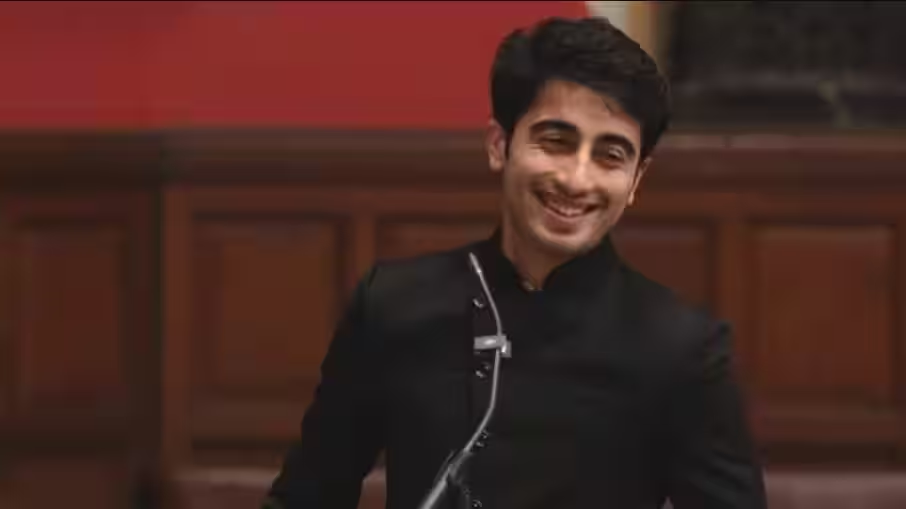
When discussing India’s more assertive responses, such as Operation Sindoor, Bhanushali again rejected the populism label. He described the operation as targeted and limited, aimed at punishing perpetrators without escalating into occupation or invasion. The decision to stop after achieving specific objectives, he argued, reflected professionalism rather than populist bravado.
In his telling, India’s approach combined deterrence with restraint, a balance often overlooked in international debates that focus solely on rhetoric or media narratives. His sharpest critique was reserved for Pakistan’s leadership and state apparatus. He accused the Pakistani establishment of deflecting from domestic governance failures by manufacturing external enemies and symbolic victories.
The line about giving people a circus when bread is unavailable encapsulated this argument, suggesting that anti-India posturing serves as a substitute for addressing economic and social challenges at home. This framing resonated strongly online, particularly among audiences who view Pakistan’s use of militant groups as a longstanding tool of foreign policy rather than a series of isolated incidents.
Why the Speech Resonated Globally
The viral spread of Bhanushali’s speech can be attributed to several converging factors. First, it arrived at a moment of heightened scrutiny of the Oxford Union, an institution historically associated with elite debate but recently criticised for internal controversies. The contrast between a student-led, substantive discussion and the collapse of a high-profile political debate added to the speech’s symbolic weight. Many viewers saw Bhanushali as filling a vacuum left by the absence of elected representatives, articulating a case that combined intellectual rigour with moral clarity.
Read : Hillcrest High School Teacher Tyler Miguel Armistad Arrested for Sexual Contact with Student
Second, his delivery stood out for its tone. While forceful, it avoided the hyper-nationalism that often characterises viral political clips. By foregrounding personal experience and historical evidence, he appealed to audiences beyond India, including those unfamiliar with the full chronology of attacks. His insistence that he did not need rhetoric to win the debate, only dates, positioned him as a credible and measured voice rather than a partisan agitator.
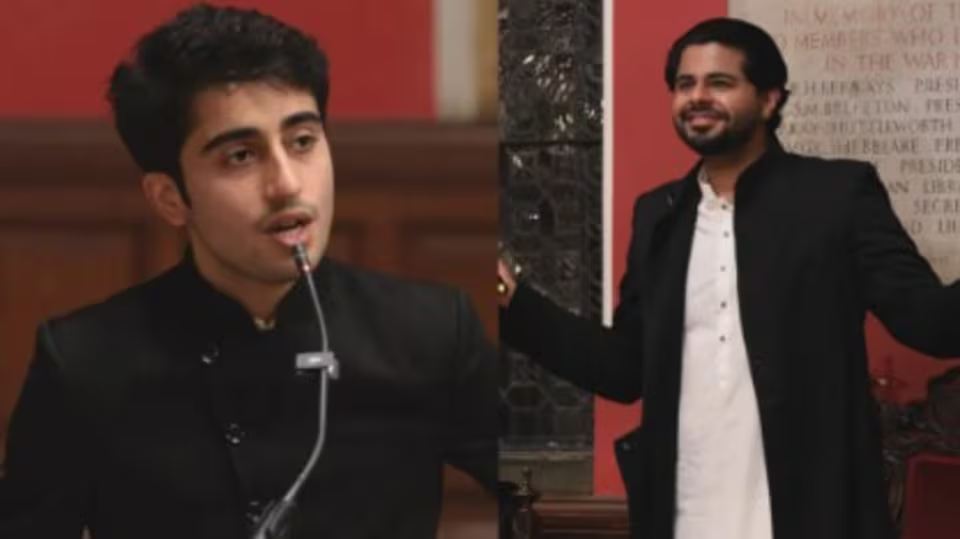
Third, the speech tapped into a broader frustration among Indians regarding how terrorism is discussed in international forums. Many feel that narratives focusing on restraint, dialogue, and moral equivalence can obscure the asymmetry of violence and responsibility. Bhanushali’s assertion that one cannot shame a state that lacks shame captured this sentiment in a concise and provocative phrase, making it highly shareable without losing its underlying argument.
Finally, Bhanushali’s identity as a young law student at one of the world’s most prestigious universities added to the intrigue. He represented a generation shaped by both global exposure and local trauma, comfortable engaging with international institutions while rooted in personal memory. His background challenged stereotypes of diaspora or elite detachment, showing how personal history can inform global advocacy.
In the aftermath of the speech’s viral success, Bhanushali has been widely praised for dismantling Pakistan’s narrative using history rather than invective. While his future path remains to be seen, the episode has already cemented his place in a broader conversation about how young voices engage with geopolitics in elite global spaces. More than a fleeting viral moment, his Oxford Union intervention illustrates how personal memory, historical awareness, and disciplined argument can converge to reshape debates that have long seemed intractable.
Alright, so I stumbled upon mcwcasinobj388 and had a good time. Some cool slots and the live casino wasn’t bad either. Give it a shot if you’re feeling lucky! Link here: mcwcasinobj388