

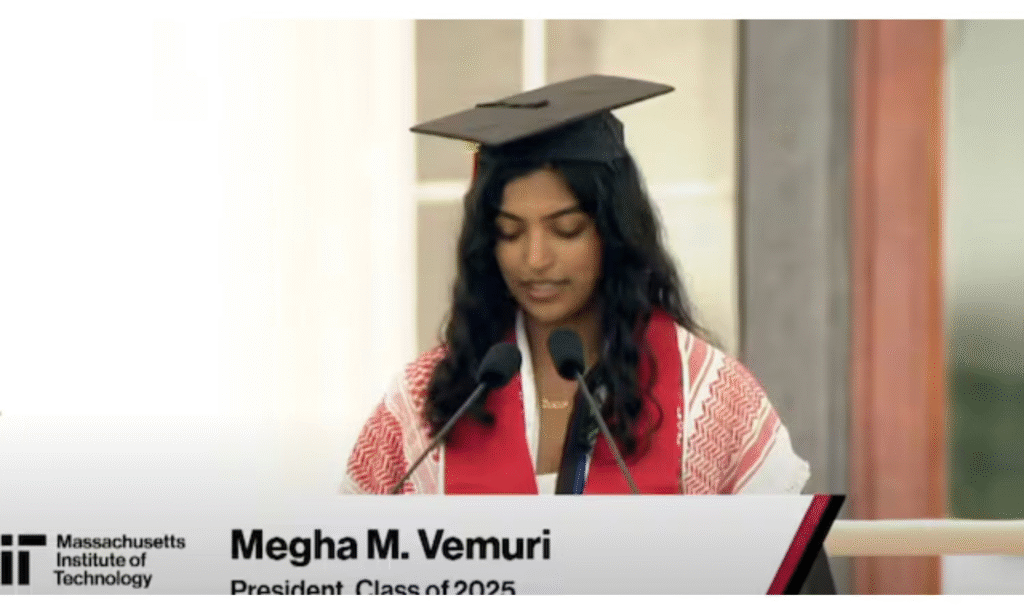
The Massachusetts Institute of Technology (MIT) recently found itself at the center of controversy during its graduation ceremony, when the class president of 2025, Megha Vemuri, took the stage with a politically charged message.
Vemuri, an Indian-American student from Georgia, used her platform not only to congratulate her peers but also to deliver a sharp critique of MIT’s ties with the Israeli military and to denounce Israel’s military actions in Gaza. Her remarks have sparked intense reactions, both in support and opposition, and raised broader questions about free speech, academic responsibility, and the Israeli-Palestinian conflict.
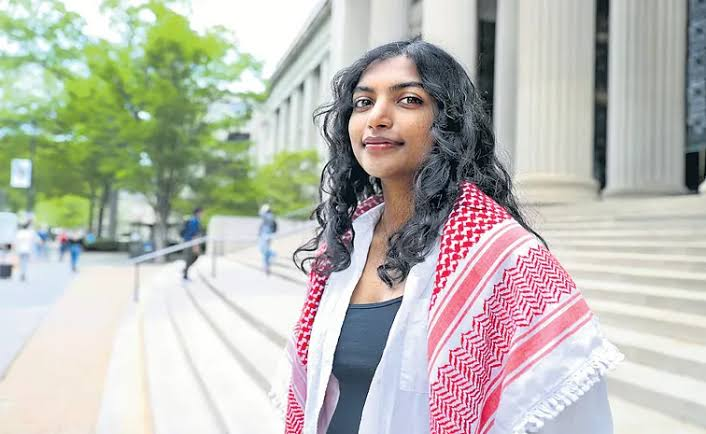
Draped in a red keffiyeh, a symbol of Palestinian solidarity, Megha Vemuri did not shy away from using her moment in the spotlight to make a global political statement. While some hailed her courage for speaking up for a cause they believe is ignored, others criticized her for turning a celebratory moment into a divisive platform, especially by using the term “genocide” in reference to Israel’s military actions. The incident has drawn widespread media attention and intensified discussions around campus activism and political expression.
A Rising Voice from MIT: Who Is Megha Vemuri?
Megha Vemuri was born and raised in Alpharetta, Georgia, and is of Indian descent. She recently completed her undergraduate studies at the Massachusetts Institute of Technology with a rare and ambitious academic combination—computer science, neuroscience, and linguistics. Vemuri quickly made her mark not just in the classroom but also in various advocacy and research circles within MIT.
Vemuri’s academic interests led her to work with the McGovern Institute for Brain Research, a prestigious institute that delves into the mysteries of the human brain. In addition, she played a leading role in the Written Revolution initiative, an advocacy platform focused on raising awareness through writing and dialogue.
These involvements positioned her as a strong voice among the student community, and her leadership qualities culminated in her being elected class president of MIT’s Class of 2025. However, Vemuri was not just an academic or an organizer.
She’s Megha Vemuri, MIT’s class president, and she used her graduation speech to abuse Israel.
— Mr Sinha (@MrSinha_) May 30, 2025
What does the Israel-Palestine conflict have to do with a graduation speech? Has bashing Israel become a fashion statement or a shortcut to fame?
I hope she gets blacklisted and never… pic.twitter.com/4ZTqekxRJK
She emerged as a vocal participant in broader political and human rights discussions, especially concerning the Israeli-Palestinian conflict. Her activism on campus consistently reflected solidarity with Palestinian causes, and she was part of student movements urging MIT to cut its research ties with the Israeli military. Her graduation speech can thus be seen not as an isolated act but as part of a broader pattern of engagement.
The Graduation Speech That Stirred a Storm
During the commencement ceremony, Vemuri began with traditional graduation remarks but swiftly transitioned to a powerful condemnation of Israel’s ongoing military campaign in Gaza. She described the war as a “genocide” and criticized the Israeli Defense Forces, drawing attention to MIT’s alleged research collaborations with the Israeli military.
One of the most striking and emotional moments in her speech was when she contrasted the lives of students graduating in the United States with those of young people in Gaza. “Right now, while we prepare to graduate and move forward with our lives, there are no universities left in Gaza,” she said. This statement was met with both applause and silence—an indication of the divided opinions within the audience.
Read : Four Teen Students of Whitesboro High School Rescue a Family from Their Burning Home
Vemuri also strongly criticized MIT’s administration, accusing the institution of turning a blind eye to student protests and refusing to end its research ties with Israel. According to her, MIT not only ignored student concerns but also attempted to “intimidate, threaten, and suppress” those who protested in solidarity with Gaza.

By wearing a red keffiyeh during her address, Vemuri visually reinforced her message and expressed her alignment with the Palestinian cause. She went on to commend her fellow student activists for taking a stand under difficult circumstances and declared, “You showed the world that MIT wants a free Palestine.”
Her remarks sparked immediate responses, with sections of the audience chanting “Free Palestine,” while others remained silent or appeared uncomfortable. The moment, dramatic and polarizing, was widely circulated on social media and has since become a talking point in both activist and academic circles.
A Divided Campus and Public Reaction
Vemuri’s speech did not go unnoticed by the public, media outlets, and academic communities. The speech quickly became a subject of national and international debate, with opinions split down ideological and political lines.
Supporters of Vemuri praised her courage and moral clarity. For many pro-Palestinian voices, her speech was a much-needed articulation of truths that they believe are too often ignored by elite institutions. They highlighted that Vemuri used her platform responsibly to shed light on the suffering of people in Gaza and to call out what she sees as MIT’s complicity through its collaborations with Israeli defense entities.
On the other hand, critics accused her of hijacking a ceremonial moment for political propaganda and condemned her use of the term “genocide” to describe Israel’s actions. Some considered the speech one-sided and inflammatory, especially in the context of an academic event meant to celebrate the achievements of a diverse student body.
MIT’s administration has so far refrained from commenting on the controversy. This silence has only added fuel to the debate, with some interpreting it as institutional complicity and others as an effort to remain neutral in an increasingly volatile issue. As of now, no formal disciplinary actions or official statements have emerged from the university in response to Vemuri’s speech.
The incident also touched on broader tensions related to campus free speech. In recent years, universities across the United States have become battlegrounds for debates over free expression, safe spaces, and political correctness. Vemuri’s address fits into a long-standing trend where commencement speeches are used to address societal and global issues, sometimes courting controversy.
The Broader Implications
Megha Vemuri’s graduation speech was more than just a moment of personal expression—it was a reflection of how today’s student leaders view their roles in society. Increasingly, young academics are rejecting the notion that education should be divorced from real-world injustices. They see universities not only as places of learning but also as institutions that must be held accountable for their partnerships and investments.
At the same time, the speech highlights the challenges institutions face when navigating politically charged issues. MIT, like many elite universities, is under growing pressure to clarify its positions and relationships with foreign governments, especially those involved in active conflict. Vemuri’s accusations that MIT maintains exclusive research ties with the Israeli military may prompt further scrutiny into the university’s defense research contracts and global alliances.
This incident also reflects a growing wave of student activism centered around Palestine. Over the past year, campuses from Harvard to UC Berkeley have seen student protests, sit-ins, and calls for divestment from companies or governments associated with the Israeli military. These movements are part of a larger shift in public sentiment, particularly among younger generations who are increasingly critical of Israeli policies in Gaza and the West Bank.
Whether one agrees with Vemuri’s message or not, her speech underscores the power of student voices and the complex responsibilities of educational institutions in a politically polarized world. Graduation ceremonies, once simple rites of passage, are now platforms for social change, and student leaders like Vemuri are pushing the boundaries of what those platforms can and should be used for.
As the Israeli-Palestinian conflict continues and as universities grapple with their roles in international research and politics, voices like Megha Vemuri’s are likely to grow louder—and more controversial.