
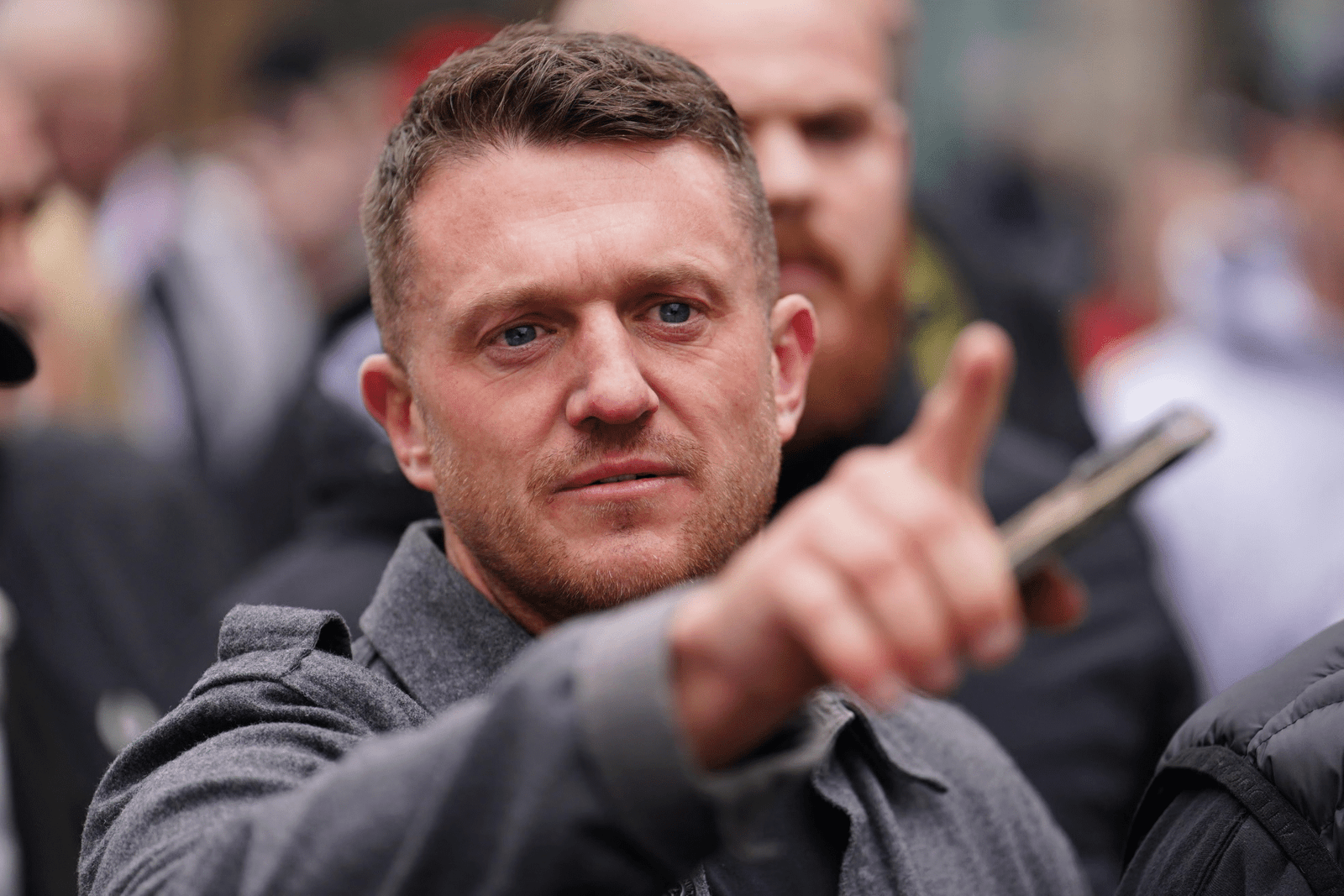
On September 13, 2025, central London became the epicenter of one of the largest political demonstrations in British history. Over 110,000 people gathered for the “Unite the Kingdom” rally, organized by far-right activist Tommy Robinson, whose real name is Stephen Yaxley-Lennon. Billed as a “free speech festival,” the event drew massive crowds chanting for patriotism, stricter immigration controls, and opposition to what Robinson describes as government overreach.
While supporters hailed it as a peaceful show of unity, clashes with police resulted in 26 officers injured and 25 arrests, highlighting the rally’s volatile nature. Counter-protests by groups like Stand Up to Racism, attended by around 5,000 people, underscored the deep divisions in British society. As a prominent voice in the anti-immigration movement, Robinson’s role in mobilizing such numbers raises questions about his background, motivations, and enduring influence.
Early Life and Entry into Activism
Stephen Yaxley-Lennon, better known by his pseudonym Tommy Robinson, was born on November 27, 1982, in Luton, Bedfordshire, England. Raised in a working-class family with an Irish mother and an English father, Robinson grew up in a diverse town known for its multicultural population and occasional social tensions. Luton, home to a significant Muslim community and a hub for airport-related industries, would later become a focal point for his activism. After leaving school, Robinson pursued an apprenticeship in aircraft engineering at Luton Airport. Out of 600 applicants, he was one of only four selected, and he qualified in 2003 after five years of study. However, his early career was derailed by legal troubles.
Robinson’s involvement in far-right circles began in his late teens, rooted in football hooliganism. He adopted the name “Tommy Robinson” from a notorious member of the Luton Town MIGs, a hooligan firm associated with Luton Town Football Club. In 2005, at age 22, he was convicted of assaulting an off-duty police officer during a drunken argument outside a nightclub. This incident led to a 12-month prison sentence, costing him his engineering job and marking the start of a pattern of criminal convictions that would shadow his public life.
Upon release, Tommy Robinson joined the British National Party (BNP), a fascist political party known for its anti-immigration and white nationalist stance, in 2004. He served as a regional organizer but left after a year, citing internal disagreements. By 2009, he had founded the English Defence League (EDL), a street protest movement explicitly aimed at opposing what he called the “spread of Islam” in Britain. The EDL emerged from protests in Luton against Islamist extremists who had disrupted a homecoming parade for British soldiers returning from Afghanistan. Robinson positioned the group as a defender of English culture against radical Islam, attracting disaffected youth, football fans, and those frustrated with multiculturalism.
The EDL quickly gained notoriety for its aggressive demonstrations, which often involved clashes with counter-protesters and police. Tommy Robinson, as co-founder and leader, became the face of the movement, drawing thousands to rallies across the UK. By 2011, the group had prompted authorities to close down town centers for safety, with one Luton event alone requiring a full-day shutdown. However, Robinson’s leadership was marred by violence; he was convicted of leading a brawl involving over 100 football fans in 2011, receiving a 12-month community rehabilitation order.
Read : Astonishing! 40-Year-Old Daniella Hines Gives Birth to 6.3kg Baby Naturally
Despite these setbacks, the EDL’s influence grew, establishing Tommy Robinson as a key figure in the counter-jihad movement—a loose network of activists opposing perceived Islamic threats in Europe. Robinson’s early activism was not without personal challenges. He married Jenna Vowles in 2011, and they have three children. The couple separated in 2023, but Robinson has often invoked his family in his rhetoric, portraying himself as a protector of British children from grooming gangs and cultural erosion.
The liberal elite and legacy media have labelled, everyone, "far right", for simply voicing an opinion that doesn't fit theirs.
— Tommy Robinson 🇬🇧 (@TRobinsonNewEra) September 14, 2025
Those labels don't wash anymore, they massively overplayed their hands and exposed themselves.
Millions of us in London yesterday.
United as one. pic.twitter.com/waDVeDk5Xp
His apprenticeship background and Luton roots are frequently cited by supporters as evidence of his “everyman” status—a relatable working-class voice speaking out against elite indifference. Critics, however, point to his hooligan past and early BNP ties as indicators of a deeper ideological extremism. By the early 2010s, Robinson’s profile had elevated him from local agitator to national, and later international, figure, setting the stage for his evolution into a full-time activist and self-styled journalist.
Rise to Prominence and Legal Battles
Tommy Robinson’s ascent in far-right politics accelerated after the EDL’s formation, but it was intertwined with repeated legal entanglements that both bolstered his martyr narrative and limited his activities. In 2012, he was convicted of using someone else’s passport to travel to the United States, resulting in a 10-month prison sentence.
Undeterred, he continued leading EDL protests, which by then included international offshoots like the European Defence League. His rhetoric focused on high-profile issues like child sexual exploitation cases in places like Rotherham and Rochdale, where predominantly British-Pakistani men were convicted of grooming gangs. Tommy Robinson framed these as evidence of systemic failures by authorities to protect white British girls from Muslim predators, a narrative that resonated with segments of the public disillusioned with multiculturalism.
In October 2013, Tommy Robinson dramatically quit the EDL, citing concerns that the group had become too extreme and infiltrated by neo-Nazis. He announced his departure on the steps of the Palace of Westminster alongside Quilliam, a Muslim anti-extremism think tank, in a move praised by some as a step toward moderation. However, he soon aligned with the British Freedom Party (BFP), serving as joint vice-chairman until 2012. This period saw him attempt to enter mainstream politics, but his past caught up again. In 2014, he pleaded guilty to mortgage fraud, receiving an 18-month suspended sentence.
Tommy Robinson’s legal woes peaked in 2018 when he was imprisoned for contempt of court after livestreaming outside Leeds Crown Court during a grooming gang trial, breaching reporting restrictions. He served nine weeks before being released on bail. This incident galvanized his supporters, who organized “Free Tommy” rallies that drew thousands.
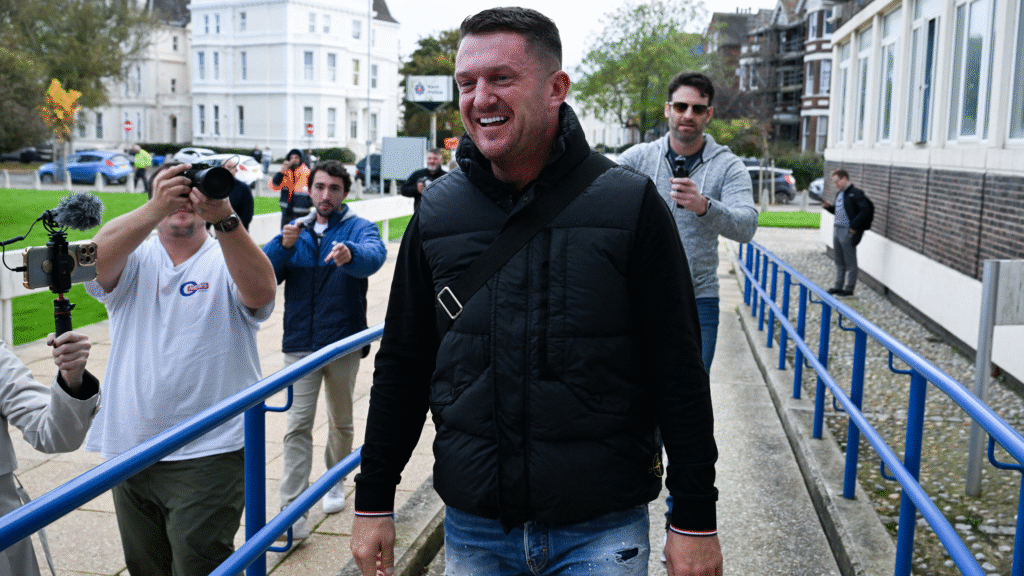
He was rearrested multiple times for similar violations, including another contempt charge in 2019. In October 2024, he was sentenced to 18 months for repeating false allegations against a Syrian refugee who had successfully sued him for libel in 2021. The High Court described it as a “blatant” contempt. Released early in May 2025 after demonstrating a “change in attitude,” Tommy Robinson immediately vowed to host a major free speech event in London.
Throughout these battles, Robinson cultivated an image as a victim of state persecution. He went on hunger strikes in prison, refusing what he believed was halal meat, and claimed to be a “political prisoner.” His bans from social media platforms—Twitter in 2018 for hateful conduct, and Facebook and Instagram in 2019 for hate speech—further fueled this narrative.
Supporters raised funds for his legal fees, and he received backing from international figures, including U.S. conservative media like Fox News and Infowars. Funding from the U.S.-based Middle East Forum, which provided over £600,000 between 2017 and 2018, helped sustain his operations, including documentaries and rallies. Tommy Robinson also joined Pegida UK in 2015, a British branch of the German anti-Islam group Pegida, addressing events against refugee influxes.
His post-EDL career shifted toward online activism and authorship. Books like “Enemy of the State” (2015) detailed his experiences, selling thousands of copies. He positioned himself as a journalist, producing videos on Urban Scoop, a platform he co-founded. Despite convictions for assault, fraud, and contempt—totaling over a dozen arrests—Robinson’s legal troubles amplified his reach. By 2025, with his X account reinstated under Elon Musk’s ownership in 2023, he had over 1 million followers.
Musk publicly supported him, pinning “Free Tommy Robinson” on his profile and advocating for his release from solitary confinement. This digital resurgence allowed Robinson to organize events like the September 2025 rally from afar, even while on bail for an alleged assault at St Pancras station in July 2025, where he fled to Spain before returning. His legal history, far from deterring him, has solidified his status as a resilient icon for the far right, blending personal grievances with broader anti-establishment appeals.
The September 2025 Rally and Lasting Influence
The “Unite the Kingdom” rally on September 13, 2025, marked the pinnacle of Tommy Robinson’s influence, drawing an estimated 110,000 to 150,000 participants—far exceeding police expectations and dwarfing previous far-right events. Starting at 11 a.m. from Stamford Street near Waterloo Bridge, the march proceeded across Westminster Bridge to Whitehall, where a stage hosted speeches.
Robinson described it as “the spark of a cultural revolution,” emphasizing patriotism, borders, and free speech. Crowds, largely white and waving Union Jacks and St. George’s Crosses, chanted “Tommy,” “England,” and anti-Keir Starmer slogans. The event honored the recent death of American conservative Charlie Kirk, shot on a Utah college campus, with attendees carrying crosses inscribed “RIP Charlie Kirk” and a young French supporter paying homage.
High-profile endorsements elevated the rally’s profile. Elon Musk appeared via video link, urging protesters to “fight back or die” amid “uncontrolled migration” and calling for a UK government change and parliamentary dissolution. Other speakers included French far-right politician Eric Zemmour, Danish People’s Party leader Morten Messerschmidt, German AfD’s Petr Bystron, Polish MP Dominik Tarczynski, Belgian activist Filip Dewinter, and British figures like Laurence Fox, Katie Hopkins, and Ant Middleton. Musical performances and a festival atmosphere contrasted with the underlying tensions, including overt Christian nationalism with recitals of the Lord’s Prayer.
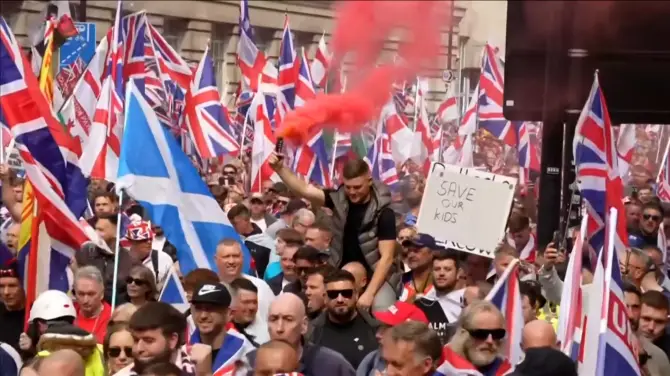
Violence erupted in the afternoon as some supporters threw bottles and breached barriers toward the Stand Up to Racism counter-protest in Russell Square. Police, numbering over 1,000, used batons and shields; four officers were seriously injured. Home Secretary Shabana Mahmood condemned the “wholly unacceptable” attacks, vowing full legal force. Robinson, addressing the crowd, criticized politicians for “parroting” his ideas on immigration while denying him credit. He claimed millions attended—though police estimates were lower—and promised more events. Aerial footage from a helicopter he hired aimed to counter perceived media underreporting.
Robinson’s influence extends beyond this rally. As a counter-jihad pioneer, he has shaped European far-right discourse, attending events in Denmark, Sweden, and Belgium. His EDL legacy persists in networks of football firms and online communities. In UK politics, he indirectly boosts parties like Reform UK, which topped polls in 2025 but distanced itself due to his convictions. Nigel Farage rejected association with “Tommy Robinsons” post-riots, yet internal Reform battles reflect his ideas’ permeation. Internationally, figures like Steve Bannon called him “the backbone of this country,” and U.S. groups like the Proud Boys cite him as inspiration.
Critics, including Hope Not Hate, label the rally a “festival of hate and lies,” accusing Robinson of hypocrisy on child exploitation and exploiting tragedies like Southport stabbings with false claims. His 2025 activities included charging £28 per minute for anti-Islam advice via the Minnect app, earning thousands, and sharing misleading videos that sparked harassment, like a Redcar family targeted over a park video.
Despite bans and arrests, Robinson’s ability to mobilize masses—fueled by social media and allies like Musk—demonstrates his enduring grip on a segment of British society fearful of cultural change. The rally’s scale signals a nationalist resurgence, challenging authorities to address underlying grievances without amplifying division. As Robinson vows more actions, his voice remains a polarizing force in UK’s political landscape.