

The emergence of a remarkable wildlife video from British Columbia has prompted widespread attention, scientific interest, and cultural reflection. The footage, captured through motion-triggered cameras set up by researchers collaborating with members of the Heiltsuk Nation, documents a coastal Wolf Using Rope To Pull Crab Trap to access bait inside.
The behavior, unprecedented in wild wolves, has opened new questions about animal cognition, adaptive responses to human environments, and the deep ecological relationships between Indigenous communities and local species. As the video continues to circulate widely online, understanding the context and implications of this discovery is essential.
The event did not occur in isolation; it is closely tied to conservation challenges, scientific inquiry, and Indigenous stewardship on the central coast of British Columbia. This blog examines how the discovery unfolded, what the research reveals, and why the behavior marks a significant development in the study of animal intelligence.
Discovery of the Sea Wolf’s Unusual Behavior
Members of the Heiltsuk Nation had set crab traps along the coast as part of a conservation effort aimed at controlling invasive European green crabs. These crabs pose a serious ecological threat by destroying eelgrass habitats and severely reducing populations of clams, herring, and salmon, species that the Heiltsuk people have relied upon for generations.
The traps were baited and placed in strategic areas to monitor and mitigate the spread of the invasive species. However, upon returning to the traps, Heiltsuk community members frequently found the bait shredded and removed in ways that seemed inconsistent with the typical interference caused by marine animals. While both bears and wolves were initially suspected, the evidence did not point conclusively to either species.
To identify the culprit, researchers led by Kyle Artelle of the SUNY College of Environmental Science and Forestry and Paul Paquet of the University of Victoria deployed remote cameras triggered by movement. Their goal was to capture clear footage of the animal responsible for tampering with the traps.
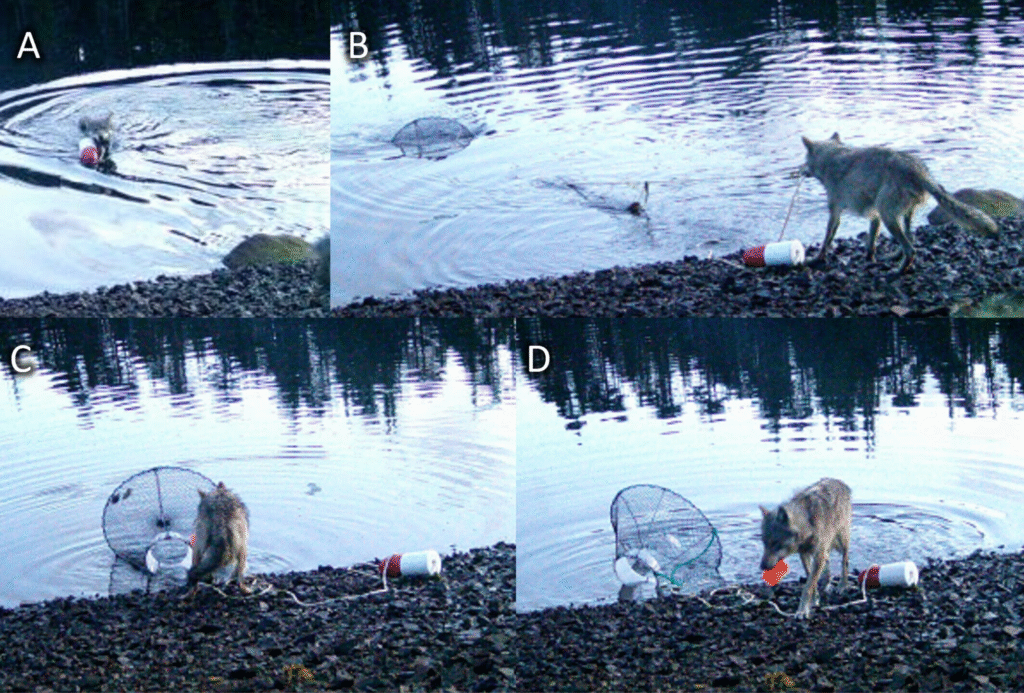
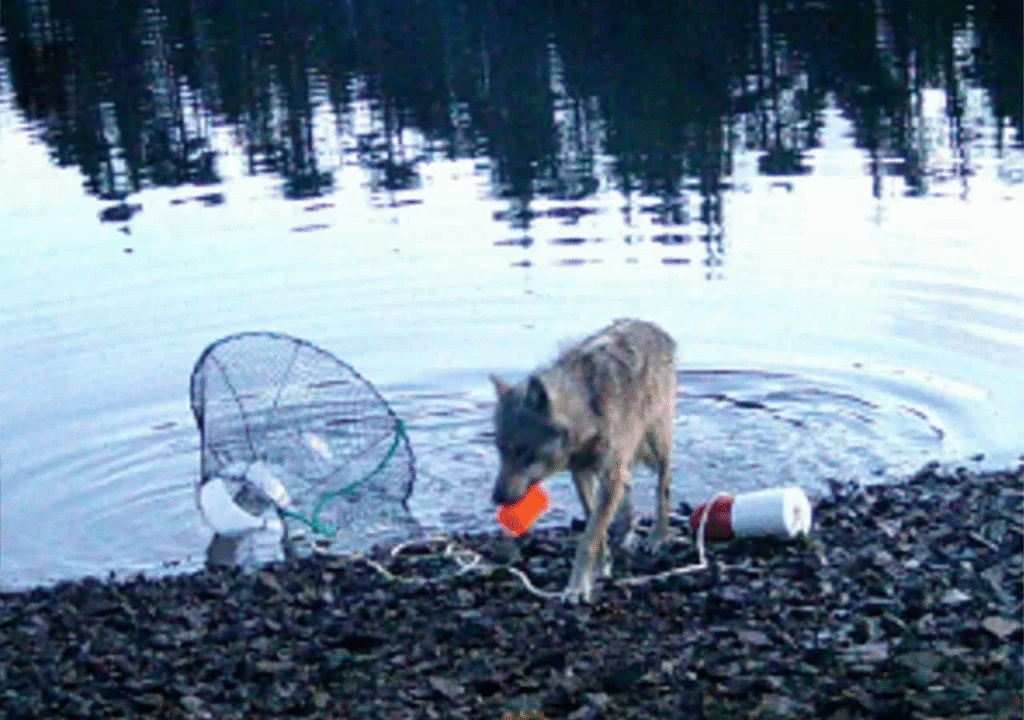
The resulting video revealed a female coastal wolf performing a sequence of actions that surprised even seasoned wildlife biologists: she swam to retrieve the floating buoy, dragged it ashore, and used her teeth to pull on the rope repeatedly until the crab trap surfaced from the water. Once the trap emerged, she accessed the fish bait inside and consumed it. This sequence demonstrated a clear, multi-step understanding of how the buoy, rope, and trap were connected.
Wild wolves using tools? It’s now been documented! 🐺🦀#ProjectCoyote Science Advisory Board Member Marc Bekoff highlights research of #wolves in British Columbia using a rope to pull up a submerged crab trap — a behavior never before recorded.
— Project Coyote (@ProjectCoyote) November 26, 2025
Read: https://t.co/RSwVT5QZVM pic.twitter.com/V9ad4ekLLp
The behavior captured on video challenged assumptions about wolves’ problem-solving abilities, particularly in the context of tool use. While wolves are known for their adaptability and capacity to exploit human-altered environments, the coordinated actions seen in this instance were considered highly sophisticated.
Researchers noted that the wolf’s ability to recognize the relationship between the floating buoy and the hidden bait inside the submerged trap required spatial awareness and an understanding of cause and effect that exceeded typical foraging behavior. This was further reinforced by the careful, repeatable technique she used, suggesting that the behavior was not accidental but deliberate and learned.
Scientific Importance of the First Recorded Tool Use in a Wild Wolf
The captured footage has been described as the first scientific documentation of tool use by a wild wolf. In animal behavior research, tool use is defined as the manipulation of external objects to achieve a goal that would otherwise be difficult or impossible to accomplish. While examples are common in species such as primates, elephants, dolphins, and some birds, tool use in large carnivores has rarely been observed, and never previously confirmed in wolves.
The wolf’s actions met the established scientific criteria for tool use, involving the deliberate manipulation of an object—in this case, the rope connected to the crab trap—to access otherwise inaccessible food. Although wolves are intelligent animals with complex social structures and hunting strategies, documented behaviors demonstrating multi-step mechanical problem solving have been minimal. The study authors emphasized that the wolf’s behavior suggested a level of cognitive flexibility not typically associated with the species.
Read : Wayne Wolff’s Leg Amputated After Knee Surgery Goes Horribly Wrong at UCI Medical Center
The location of the event also plays a crucial role in understanding its significance. Coastal wolves in British Columbia, often referred to as sea wolves, are known for their unique ecological niche. Unlike inland wolves, they rely heavily on marine resources, including salmon, intertidal species, and even whale carcasses. Their environment demands adaptability and diverse foraging strategies, which may foster the development of innovative behaviors.
The wolf’s manipulation of the crab trap rope can be viewed within this broader context of ecological specialization. In an environment where human activity intersects with natural food sources, such behaviors may emerge in response to opportunity and environmental pressure. In addition to its scientific implications, the discovery highlights the importance of long-term, collaborative wildlife monitoring.
The partnership between academic researchers and the Heiltsuk Nation was essential to documenting this behavior. The community’s ongoing conservation efforts to address the spread of invasive green crabs provided the circumstances that made the observation possible. Without the initiative to install motion-triggered cameras, the behavior might never have been witnessed or scientifically acknowledged. The study, published in the journal Ecology and Evolution, acknowledges the role of Indigenous knowledge and stewardship in supporting ecological research and highlights how local communities contribute to broader scientific understanding.
Ecological and Cultural Context Behind the Viral Footage
The viral circulation of the wolf video has drawn widespread fascination, but understanding the broader ecological and cultural context adds depth to its significance. The involvement of the Heiltsuk Nation underscores the longstanding relationships that Indigenous peoples maintain with coastal ecosystems. Their traditional knowledge, combined with scientific monitoring, has shaped effective conservation strategies, including efforts to address invasive species that threaten the region’s biodiversity and food systems.
Read : Yostin Andres Mosquera Guilty of Murdering and Dismembering Couple He Was Staying With
The green crab invasion presents a serious ecological risk. These crabs burrow into and destroy eelgrass beds, which serve as nurseries for countless marine species. The decline of eelgrass habitat can cause cascading impacts on fish populations and marine ecosystems. For the Heiltsuk Nation, whose culture and subsistence practices are deeply intertwined with salmon, herring, clams, and other coastal species, the threat is both ecological and cultural. The traps placed to monitor green crab activity were intended to gather data and reduce the species’ impact. The fact that wolves interacted with these traps reflects the interconnectedness of species within the ecosystem.
Sea wolves themselves occupy a unique place in the region’s ecology. They travel extensively along shorelines, swim across channels, and forage in tidal zones. Their diet includes a substantial portion of marine-derived nutrients, distinguishing them from most other wolf populations. Their adaptability, coastal mobility, and reliance on marine resources make them particularly capable of developing novel behaviors in response to changing environmental conditions.
The wolf’s manipulation of the crab trap rope can be viewed as part of this adaptability. It also highlights how human tools and structures become integrated into the landscape and can inadvertently create new opportunities for wildlife. While the behavior may appear surprising, it is consistent with patterns observed in other intelligent species that interact with human objects. For instance, some bears have learned to open car doors, and certain primates have learned to exploit human trash systems. The difference in this case is the methodical, multi-step process the wolf employed.
The viral spread of the footage has amplified public interest in sea wolves and coastal ecosystems. It underscores the importance of documenting and understanding animal behavior in rapidly changing environments. Climate shifts, invasive species, and expanding human presence along coastlines all contribute to new interactions between wildlife and human-made objects. Observations like this provide insight into how animals innovate and respond to these pressures.
Beyond scientific and ecological implications, the video has also highlighted the value of Indigenous-led research and stewardship. For the Heiltsuk Nation, the discovery reinforces the importance of ongoing monitoring and protection of their lands and waters. The footage serves as a reminder of the fundamental connection between Indigenous communities and wildlife, relationships built on centuries of observation and reciprocal care.
The documentation of the wolf’s behavior adds to the growing body of evidence that animals exhibit a wider range of cognitive abilities than traditionally believed. As research continues, it may prompt further examination of how wolves and other species respond to environmental challenges and opportunities. The video of the sea wolf pulling the crab trap rope represents more than a viral moment; it reflects an intricate ecological story, shaped by conservation efforts, cultural stewardship, and scientific curiosity woven together along the coastal landscape of British Columbia.
Yo, 777bd3 is pretty slick! Games are smooth, signup was quick. Definitely worth checking out if you’re looking for some fun. Check it out here: 777bd3
**mitolyn reviews**
Mitolyn is a carefully developed, plant-based formula created to help support metabolic efficiency and encourage healthy, lasting weight management.