
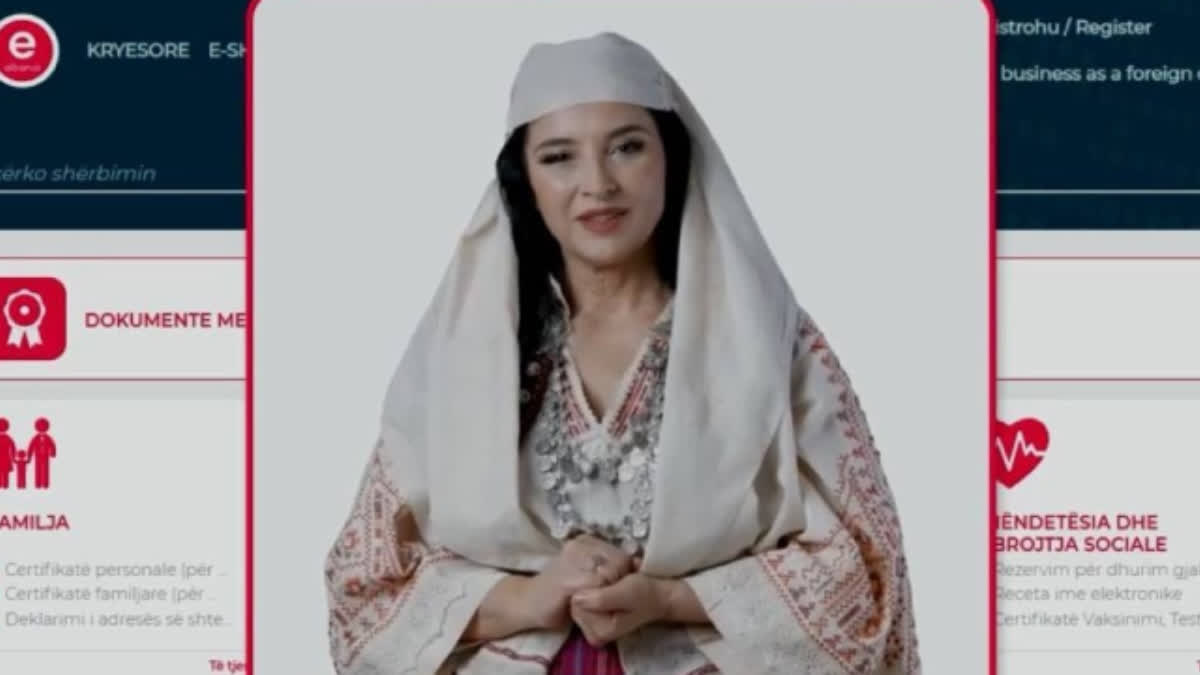
In a groundbreaking move that blends technology with governance, Albania has made history by appointing the world’s first AI-generated minister to its new cabinet. This unprecedented step, announced by Prime Minister Edi Rama, aims to eradicate corruption in public procurement processes, a longstanding issue plaguing the Balkan nation. The virtual minister, named Diella—meaning “sun” in Albanian—represents a bold experiment in using artificial intelligence to enhance transparency and efficiency in government operations. As Albania pushes forward with its European Union accession ambitions, this appointment underscores the country’s commitment to innovative reforms. But is this a genuine revolution in anti-corruption efforts, or merely a symbolic gesture?
The announcement came on September 11, 2025, during a meeting of Rama’s Socialist Party in Tirana, following the party’s decisive victory in the May elections. Rama, who has led Albania since 2013, introduced Diella as the “first cabinet member who is not physically present, but has been virtually created by artificial intelligence.” Diella’s role is specifically tailored to oversee public tenders, ensuring that all decisions on awarding contracts are “100 percent free of corruption” and fully transparent.
According to Rama, every public fund entering the tender procedure will be subjected to AI scrutiny, making the process faster, more efficient, and utterly accountable. This is no abstract concept; Diella has been operational since January 2025 as an AI-powered virtual assistant on the e-Albania platform, helping citizens access over one million digital documents and services.
Diella’s design is culturally resonant, depicted as a woman dressed in traditional Albanian folk costume, providing assistance through voice commands and issuing electronic stamps to reduce bureaucratic delays. To date, she has facilitated the issuance of 36,600 digital documents and nearly 1,000 services, demonstrating her practical utility even before this elevation to “ministerial” status.
Rama emphasized that responsibility for tender decisions would be gradually shifted from human ministries to Diella’s AI systems, in a “step-by-step” process. This integration promises to eliminate human biases, bribes, and undue influences that have historically undermined public procurement in Albania. Experts note that while the appointment is symbolic—Albania’s constitution requires ministers to be human citizens aged 18 or older with mental competency—the underlying AI tools could indeed foster real systemic changes if properly implemented.
Read : Japan’s Prince Hisahito Becomes First Male in His Family to Reach Adulthood in 40 Years
This development is particularly timely as Albania forms its new government under President Bajram Begaj’s mandate. Rama’s fourth consecutive term is focused on accelerating EU membership talks, with a target of concluding negotiations by 2027. Corruption remains a critical hurdle in this journey, as highlighted by the European Commission’s ongoing assessments. By leveraging AI, Albania positions itself as a forward-thinking nation, potentially setting a precedent for other countries grappling with similar challenges. However, the true test will lie in how Diella’s systems are rolled out and whether they withstand legal and practical scrutiny.
The Rise of Diella: From Virtual Assistant to Anti-Corruption Champion
Diella’s journey from a helpful chatbot to a purported cabinet minister is a fascinating tale of technological evolution tailored to national needs. Launched in January 2025 on the e-Albania portal—a one-stop digital platform for government services—Diella was initially designed to simplify administrative tasks for ordinary citizens. Users interact with her via voice or text, receiving guidance on obtaining official documents, paying taxes, or applying for permits. Her name, evoking the warmth and clarity of the sun, symbolizes enlightenment and transparency in a country often shrouded by corruption scandals.
Since her inception, Diella has processed thousands of requests, issuing digital stamps that cut down on paperwork and delays, thereby saving time and resources for both citizens and officials. The decision to “promote” Diella to minister status stems from Albania’s recognition of AI’s potential to disrupt corrupt practices. Public procurement, which involves billions in government spending on infrastructure, healthcare, and education, has been a hotbed for graft.
Read : Albania’s Enchanting Selfie Spots: Top Ten Destinations to Capture the Beauty
Contracts are frequently awarded to politically connected firms, leading to inflated costs, substandard work, and money laundering by organized crime syndicates. Albania, with a population of about 2.8 million, has unfortunately become a known hub for international gangs laundering proceeds from drug and weapons trafficking. Rama’s government has long promised reforms, but implementation has been inconsistent, drawing criticism from both domestic opposition and international watchdogs.

By entrusting tender decisions to Diella, the administration aims to create an impartial arbiter. The AI will analyze bids based on predefined criteria such as cost, quality, and compliance, without room for personal favoritism or external pressures. Rama described this as working with a “brilliant team, which is not only Albanian but also international,” to develop the first full AI model for public procurement. This model will purportedly wipe out any potential influence on biddings, ensuring that processes are not only corruption-free but also accelerated. For instance, what might take weeks or months under human oversight could be resolved in days, with every step logged for audit trails.
Diella’s non-human nature offers inherent advantages: she cannot be bribed, threatened, or swayed by lobbyists. Unlike human officials, who might leak sensitive information or fall into scandals over expenses, Diella operates on algorithms that prioritize data integrity. Her virtual presence also aligns with Albania’s digital transformation push, part of broader e-governance initiatives that have already digitized over 1,000 public services. This appointment is not just about one AI; it’s a signal of intent to integrate technology across government functions, potentially extending to areas like tax collection or judicial processes in the future.
Yet, Diella’s elevation raises intriguing questions about the boundaries of AI in politics. While she lacks physical form, her decisions will have real-world impacts on jobs, infrastructure projects, and economic growth. Developers behind Diella, including experts from the Department of Artificial Intelligence and Cryptocurrency Licensing, have emphasized ethical programming to avoid biases in the training data. As Albania navigates this uncharted territory, Diella’s success could inspire similar innovations elsewhere, proving that code can be a more reliable servant of the public good than flesh-and-blood bureaucrats.
Implications and Skepticism: Can AI Truly Eradicate Corruption in Albania?
The appointment of Diella has sparked a whirlwind of reactions, blending optimism with healthy skepticism. On one hand, anti-corruption advocates see it as a promising tool. Aneida Bajraktari Bicja, founder of Balkans Capital, a financial services firm, acknowledged Rama’s flair for dramatic reforms but noted that the “AI minister could be constructive if it develops into real systems that improve transparency and trust.”
International experts echo this, pointing to AI’s proven track record in detecting anomalies, such as unusual bidding patterns or conflicts of interest, in countries like Estonia and Singapore. For Albania, ranked 80th out of 180 in Transparency International’s 2024 Corruption Perceptions Index, such tools could be transformative. The index measures perceived public sector corruption, and Albania’s score reflects persistent issues since the communist era’s end in 1990.
Proponents argue that Diella addresses core vulnerabilities in procurement. Human ministers are susceptible to pressures from powerful lobbies, family ties, or outright coercion in a nation where organized crime infiltrates high levels. An AI, by contrast, enforces rules uniformly, using machine learning to flag irregularities in real-time. This could lead to cost savings—potentially millions of euros annually—redirected toward public welfare. Moreover, as Albania eyes EU membership by 2030, demonstrating robust anti-corruption measures is essential. The bloc has made judicial reform and graft reduction key criteria for accession, and Diella’s transparent algorithms could provide verifiable evidence of progress.

However, critics are quick to highlight limitations. Opposition leader Gazmend Bardhi of the Democratic Party called the move unconstitutional, arguing that ministers must be human under Albanian law. Legal experts agree that while AI can assist, formal decision-making authority cannot be delegated to a bot without legislative changes. Social media buzz reflects public doubt: one Facebook user quipped, “Even Diella will be corrupted in Albania,” while another lamented, “Stealing will continue and Diella will be blamed.” These sentiments underscore a deeper cynicism rooted in decades of unfulfilled promises. Rama’s history of mixing genuine reforms with theatrics—such as colorful murals in Tirana or quirky policy announcements—fuels suspicions that this is more PR than substance.
Technical challenges abound too. AI systems are only as good as their data; if trained on biased or incomplete Albanian records, Diella could perpetuate existing inequities, favoring certain regions or ethnic groups. Cybersecurity risks are another concern—who controls the code? A hack could manipulate tenders, ironically introducing new forms of corruption. Moreover, while Diella handles procurement, broader graft in judiciary, policing, or politics remains untouched. Albania’s EU bid hinges on holistic reforms, not isolated tech fixes. Economists warn that over-reliance on AI might displace jobs in administrative sectors, exacerbating unemployment in a country with youth migration issues.
Despite these hurdles, the global implications are profound. If successful, Albania could pioneer AI governance, influencing nations from Eastern Europe to developing worlds. Bodies like the United Nations or OECD might study Diella as a model for ethical AI deployment. For Rama, it’s a high-stakes gamble: triumph could cement his legacy as a visionary leader; failure might reinforce perceptions of superficiality. As implementation unfolds, monitoring bodies will watch closely to ensure Diella lives up to her sunny promise.
Broader Context: Albania’s Long Battle Against Corruption and the Road to EU Integration
Albania’s tryst with corruption dates back to its turbulent post-communist transition. After Enver Hoxha’s regime collapsed in 1991, the country grappled with economic chaos, pyramid schemes, and weak institutions. The 1997 civil unrest, triggered by financial scams, left over 2,000 dead and devastated the economy. Since then, successive governments have vowed to clean house, but progress has been uneven. Rama’s Socialists, in power since 2013, have introduced anti-corruption laws, digitized services, and extradited fugitives, yet scandals persist. High-profile cases, like the 2023 arrest of a former minister for embezzlement, highlight entrenched networks linking politics, business, and crime.
Public procurement exemplifies these woes. Valued at around 15% of GDP, tenders often go to insiders, inflating costs by up to 30% according to World Bank estimates. This siphons funds from essential services, fueling inequality in a nation where over 25% live in poverty. Organized crime, including Albanian mafia groups involved in heroin trafficking to Europe, exploits these loopholes for laundering. The U.S. State Department has labeled Albania a “major transit country” for drugs, with corruption enabling impunity.

Diella’s appointment fits into Rama’s narrative of modernization. His administration has invested in tech, launching e-Albania in 2018 to centralize services and reduce bribe opportunities. The platform now handles everything from birth certificates to business registrations, serving millions. Extending this to procurement aligns with EU demands for digital accountability. Brussels has praised Albania’s judicial vetting process, which purged over 100 judges and prosecutors since 2016, but urges more on procurement transparency.
Looking ahead, Diella could accelerate Albania’s EU path. Negotiations opened in 2024, with chapters on justice and fundamental rights advancing. A corruption-free procurement system would bolster Albania’s case, potentially unlocking billions in EU funds. Yet, success depends on complementary efforts: strengthening whistleblower protections, independent audits, and civil society oversight. International partners, including the U.S. and UK, have pledged support for AI initiatives, viewing them as tools against hybrid threats like cyber-enabled graft.
In the global landscape, Albania’s move resonates amid rising AI adoption in governance. The UAE has AI advisors, and Estonia’s e-state model is legendary. But Albania’s focus on anti-corruption sets it apart, offering lessons for corruption-plagued nations like those in Latin America or Africa. Challenges remain—ethical AI use, data privacy under GDPR alignment, and public buy-in—but the potential is immense. As Rama quipped, Diella is “heartless” in the best way: immune to the frailties that doom human officials.
Ultimately, this AI minister is a beacon of hope in Albania’s shadowy fight against corruption. Whether it illuminates a corruption-free future or fades into gimmickry depends on execution. For now, the world watches as a small nation dares to code its way to cleaner government.