

A former police community support officer has been handed one of the longest sentences in recent UK legal history for attempting to create a prohibited firearm using modern 3D printing technology. Zoe Watts, aged 39, from St Helen’s Avenue in Lincoln, was found guilty of attempting to manufacture a lethal weapon after police uncovered a cache of weapons and gun parts in her home.
Her case has drawn national attention not only because of her previous career in law enforcement but also due to the emerging risks posed by 3D printed firearms. The incident stands as both a stark warning about the misuse of new technologies and an insight into the troubling personal trajectory of a once-trusted public servant.
The Attempt to Manufacture a 3D Printed Gun
The events leading to Zoe Watts’s conviction began with a police raid on her property on 11 December, when officers from Lincolnshire Police executed a search warrant. Inside her home, investigators discovered a disturbing collection of weapons and weapon-making materials.
Among the items seized were knives, a crossbow, and components that firearms experts identified as parts of a 3D printed gun. Hidden away in a cupboard was the 3D printer itself — the device prosecutors said she had been using to try to manufacture a semi-automatic rifle.
The prosecution, led by Jonathan Dee, described the intended weapon as a short-range semi-automatic firearm capable of firing 33 rounds in a matter of 10 to 15 seconds. Notably, this was the first time a weapon of this specific type had been uncovered in the UK. While the gun was incomplete and non-functional at the time of seizure, experts confirmed that if assembled correctly, it would have been both prohibited and lethal under UK firearms law.
Read : Horror! Annabelle Doll Missing From Hotel Room Where Paranormal Investigator Dan Rivera Found Dead
Crucially, just two days before the raid, Watts had performed an online search reading, “Has anybody been killed by a 3D printed gun?” For prosecutors, this internet search formed part of a troubling pattern of behavior indicating an unhealthy fascination with weapons and their destructive capabilities.
Despite claiming in court that the project was an attempt to make a “fidget toy” gun as a Christmas present, her explanation failed to convince the jury. In June, she was found guilty of attempting to manufacture a prohibited weapon, a charge that carries severe penalties in the UK due to the potential threat to public safety.
Background, Past Convictions, and the Court’s View
Zoe Watts was not an unknown figure to the criminal justice system. Before this conviction, she had already served a prison sentence in 2021 for possessing banned weapons and creating an improvised explosive device. That earlier case had already painted her as someone with a fixation on dangerous objects and survivalist activities.
Adding to her notoriety, Zoe Watts maintained a survivalist-themed YouTube channel where she shared videos that often revolved around outdoor survival skills, weapons handling, and related topics. This digital footprint, combined with her criminal history, painted a concerning portrait of someone whose life had increasingly revolved around weaponry and militaristic interests.
This was the sort of video former Lincolnshire Police PCSO Zoe Watts used to make. Here he smashes up melons with pictures of feminists on them with his 'LGBT baseball bat' and then advises his viewers to add glass to their bats pic.twitter.com/OiI9BNE7PI
— ripx4nutmeg (@ripx4nutmeg) December 14, 2024
Her prior professional life stood in stark contrast to her criminal behavior. As a former police community support officer (PCSO), she had once been entrusted with upholding law and order in her community. Judge Simon Hirst noted this contradiction during sentencing, acknowledging that Zoe Watts had previously been on the other side of the law but had now fallen into repeated patterns of offending.
In court, Judge Hirst described Zoe Watts as “incredibly courteous and polite” in demeanor, but made it clear that politeness did not mitigate the severity of her actions. He stated plainly, “It is clear from evidence that you have an obsession with weapons.” He also referred to her search history, which contained references to notorious murderers and individuals who had killed using firearms — further evidence of her disturbing interests.
While the court accepted there was no direct evidence she intended to sell or lend the weapon, the seriousness of attempting to create such a firearm could not be downplayed. The judge emphasized that even without clear evidence of intent to distribute, the potential risk was enough to warrant a lengthy sentence.
The court also heard mitigating factors, including her neurodivergence, her transgender identity, and the difficulties she might face in prison given her history as a former police employee. Nonetheless, these did not outweigh the risks posed by her actions.
3D Printed Guns: Legal and Social Implications
Watts’s case is a milestone in British criminal history because it highlights a growing concern for law enforcement worldwide — the rise of 3D printed firearms. These weapons are particularly troubling because they can be manufactured with relative ease using consumer-grade technology, bypassing many of the traditional barriers to obtaining firearms.
In the UK, the manufacture, possession, and distribution of prohibited firearms — whether conventionally made or 3D printed — are criminal offences under the Firearms Act 1968. Even the possession of certain components without appropriate licensing can carry heavy penalties. In Watts’s case, although the weapon was incomplete and non-functional, her possession of key components, combined with the capability to assemble them into a deadly weapon, was enough to secure a conviction.
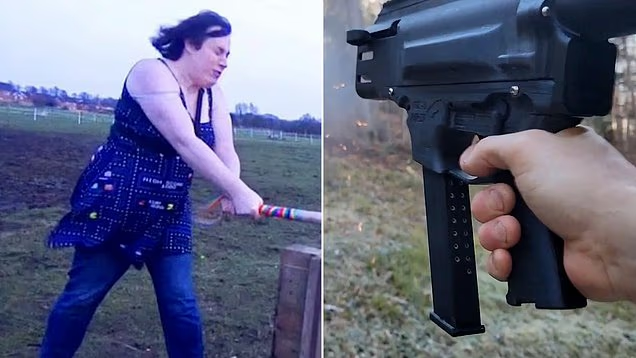
The danger of 3D printed firearms lies in their potential accessibility. In theory, anyone with a 3D printer, access to the correct blueprints, and the necessary materials could produce a functional firearm. The online availability of these designs further complicates regulation. Law enforcement agencies worldwide have expressed concern that such weapons could bypass gun control laws, enabling criminals or extremists to arm themselves with untraceable weapons.
Watts’s case serves as a warning that UK authorities are willing to take a proactive stance in such matters, prosecuting individuals even when the weapon is not yet operational. By imposing a sentence of eight years and six months, the court sent a strong message about the zero-tolerance approach to 3D printed firearms.
Sentencing, Prevention Orders, and Public Reaction
In addition to her prison term, Watts was subjected to a deprivation order, permanently removing her rights to access a 3D printer and associated gun-making materials. She also received a five-year serious crime prevention order, which will place her under strict monitoring upon release. These measures are designed to reduce the risk of reoffending and to ensure that she cannot engage in similar activities in the future.
Watts appeared via videolink for sentencing and delivered an apology — not only to the jury, her family, and her friends, but also specifically to the LGBTQ+ community, expressing regret that her actions might negatively impact public perceptions of the community. Her statement reflected an awareness of the broader societal consequences of her actions, although it did little to mitigate the severity of the punishment.
Public reaction to the case has been mixed. Some have expressed concern about the security risks posed by the ease of manufacturing weapons at home, praising the authorities for their vigilance. Others have debated whether a sentence of over eight years was proportionate given that the firearm was never completed or fired. Still, the prevailing view is that deterrence is crucial in cases involving emerging threats like 3D printed guns.

Broader lessons can be drawn from this case for both law enforcement and society at large. It underscores the need for continued monitoring of emerging technologies and their misuse. While 3D printing has countless positive applications — from medical devices to engineering prototypes — it can also be exploited in dangerous ways. Authorities must stay ahead of such developments, not only through law enforcement but also through public awareness campaigns and international cooperation.
It also illustrates the role of online behavior and digital footprints in modern criminal investigations. Watts’s internet search history was a pivotal piece of evidence, reflecting how online activity can reveal intent, interests, and potential threats long before an action is completed. This reinforces the need for responsible online conduct and for platforms to be vigilant about the sharing of harmful information.
Her case is a reminder that personal struggles and identities, while relevant for understanding an offender’s background, cannot shield individuals from the consequences of dangerous actions. The justice system must balance compassion for individual circumstances with its duty to protect the public from serious harm.
As technology continues to advance, the challenge for lawmakers, police, and the public will be to ensure that innovation does not outpace safety measures. The sentencing of Zoe Watts is both a warning and a precedent — a clear statement that attempts to create prohibited weapons, no matter how incomplete, will be met with the full force of the law.