

The universe has always fascinated humanity with its infinite mysteries, but few celestial bodies have captured our imagination like 16 Psyche. Discovered over 170 years ago, this asteroid has recently become the focus of intense scientific and public interest.
With an estimated value of $10 quadrillion—equivalent to 100 million billion dollars—16 Psyche is considered the most valuable object in our solar system. If its resources could be harvested and distributed equally, every person on Earth could theoretically become a billionaire.
But what makes this asteroid so special? Located between Mars and Jupiter in the asteroid belt, Psyche isn’t just another rock floating through space. Scientists believe it contains vast amounts of nickel, iron, gold, and platinum—metals that are rare and precious on Earth.
Its unique composition and immense value have made it the target of a groundbreaking NASA mission, launched in October 2023, to explore its secrets. This mission promises to reshape our understanding of the solar system and open new possibilities for resource utilization beyond our planet.
The Discovery and Significance of 16 Psyche
16 Psyche was first discovered on March 17, 1852, by Italian astronomer Annibale de Gasparis. He named it after Psyche, the Greek goddess of the soul, reflecting the asteroid’s enigmatic nature.
As the 16th asteroid to be discovered, it is often referred to simply as “16 Psyche.” For many years, it remained just another object in the asteroid belt—until advances in astronomy and technology revealed its extraordinary composition.
Unlike most asteroids, which are made of rock or ice, Psyche is believed to be almost entirely metallic. This led scientists to theorize that it might be the exposed core of an ancient planetesimal—a building block of planets that never fully formed.
Read : The Mystery Behind Falling Stars and the Tradition of Making Wishes
If true, Psyche could provide a rare glimpse into the heart of a planet, offering clues about how planetary cores form and evolve. Understanding these processes could help us unlock the secrets of our own planet’s core and gain insights into the formation of other worlds.
The significance of Psyche extends beyond its scientific value. Its estimated worth of $10 quadrillion has captured global attention, sparking discussions about space mining and the potential economic impact.

To put this figure in perspective, the combined GDP of all the countries on Earth is around $100 trillion. Psyche’s value is 100,000 times greater than that, making it a potential game-changer for the global economy.
NASA’s Psyche Mission: A Journey into the Unknown
In October 2023, NASA launched its Psyche spacecraft with the ambitious goal of exploring this metallic marvel. The spacecraft is expected to reach Psyche by August 2029, after traveling approximately 3.5 billion kilometers through deep space.
Once there, it will spend two years orbiting the asteroid, mapping its surface, capturing high-resolution images, and collecting data to determine its composition.
The mission represents a significant milestone in space exploration. While previous missions have focused on rocky or icy bodies, Psyche is the first mission dedicated to a metal-rich asteroid. The data collected will help scientists confirm whether Psyche is indeed the core of a planetesimal and provide valuable information about the early solar system.
The spacecraft is equipped with advanced instruments, including a multispectral imager, a gamma-ray and neutron spectrometer, and a magnetometer.
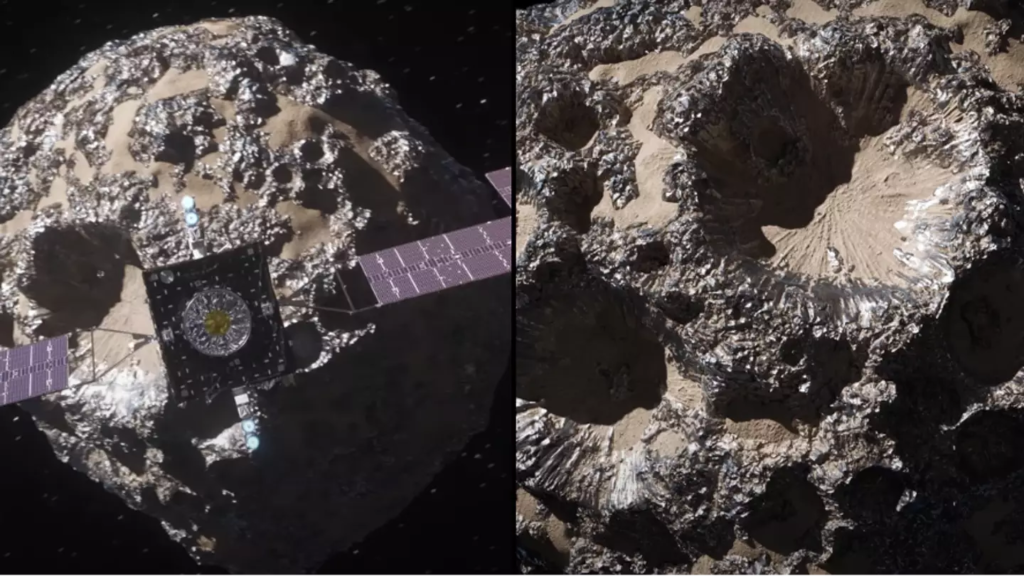
These tools will allow scientists to study Psyche’s surface in detail, analyze its composition, and measure its magnetic field. The mission’s findings could revolutionize our understanding of planetary formation and provide insights into the processes that shaped our own world.
But the journey to Psyche is not without challenges. Traveling billions of kilometers through deep space requires precise navigation, advanced propulsion systems, and the ability to withstand harsh conditions.
The spacecraft must endure extreme temperatures, cosmic radiation, and the vast emptiness of space. Each step of the mission is a testament to human ingenuity and our relentless pursuit of knowledge.
The Economic and Technological Implications of Psyche
The discovery of 16 Psyche’s immense value has sparked discussions about the future of space mining and its potential impact on the global economy.
If we could extract and transport the metals from Psyche to Earth, it would dramatically increase the supply of precious metals, potentially reducing their value and transforming global markets.
The economic implications are complex. On one hand, access to abundant resources could drive technological advancements, reduce manufacturing costs, and enable large-scale projects that were previously unimaginable.
On the other hand, flooding the market with vast quantities of metals could destabilize economies and disrupt industries that rely on their scarcity.
Space mining is still in its infancy, but the Psyche mission could pave the way for future endeavors. Companies are already exploring the feasibility of extracting resources from asteroids, and Psyche could serve as a blueprint for these efforts.
The technologies developed for the mission—such as advanced propulsion systems, autonomous navigation, and resource extraction—could have far-reaching applications, both in space and on Earth.

The potential benefits of space mining extend beyond economic gain. Access to resources in space could reduce our reliance on Earth’s finite resources, helping to address environmental challenges and support sustainable development. It could also enable the construction of space habitats, fuel depots, and other infrastructure needed for future space exploration.
Ethical and Regulatory Challenges
The discovery of such a valuable asteroid raises important ethical and regulatory questions. Who owns the resources in space? International treaties, such as the Outer Space Treaty of 1967, currently govern space exploration and prohibit any nation from claiming sovereignty over celestial bodies. However, these treaties were drafted long before the prospect of space mining became a reality.
As technology advances and interest in space resources grows, there is a pressing need for a global framework to address these issues. Ensuring that space resources are used responsibly and equitably will be crucial. Without clear regulations, there is a risk of conflicts over extraterrestrial resources and exploitation by powerful entities.
There are also ethical considerations to address. The potential wealth from Psyche could exacerbate existing inequalities if it is not distributed fairly.

Ensuring that the benefits of space exploration are shared by all of humanity, rather than a select few, will be a significant challenge. It will require international cooperation, transparent governance, and a commitment to using these resources for the common good.
The Psyche mission represents a bold step into the future of space exploration and resource utilization. It symbolizes humanity’s enduring curiosity and our desire to push the boundaries of what is possible.
The journey to Psyche is not just about uncovering wealth; it is about expanding our understanding of the universe and harnessing its resources for the benefit of all.
As we venture further into space, the challenges and opportunities will continue to grow. The Psyche mission is a reminder of what we can achieve when we combine curiosity, innovation, and determination. It also highlights the importance of addressing the ethical and regulatory challenges that come with space exploration.
The true value of Psyche lies not in its metals but in the knowledge and possibilities it offers. The mission promises to reshape our understanding of the solar system, unlock new technological advancements, and open up a new frontier of economic opportunities.
As we look to the future, Psyche serves as a symbol of our collective potential and the extraordinary things we can achieve when we reach for the stars.