

A confrontation at a well-known riverside restaurant in North Georgia has ignited a nationwide debate over breastfeeding rights, public accommodation laws, and how families with young children are treated in commercial spaces. The incident, captured on a cellphone video that has since gone viral, centers on Aris Kopiec, a Florida mother who says she was ordered to leave Toccoa Riverside Restaurant in Blue Ridge, Georgia, after briefly breastfeeding her infant. What began as a routine family outing quickly escalated into a public dispute that has drawn sharp scrutiny of the restaurant’s management practices and renewed attention to the legal protections afforded to nursing mothers in the United States.
According to Aris Kopiec, she was dining with her husband, their three daughters aged four years, two years, and four months, along with family friends. When her infant began to cry, Kopiec says she latched her baby, covered herself immediately, and ensured she was fully concealed. She maintains that only people seated at her own table could see her and that she was mindful of her surroundings in the restaurant’s enclosed porch area.
Shortly afterward, as she was preparing to take her older children outside, she says she accidentally bumped into either a chair or another guest in the crowded space. That moment, she alleges, marked the beginning of an aggressive encounter with a man she believed to be the restaurant’s owner. Aris Kopiec claims the man approached her and told her she could not breastfeed there, despite the fact that she says she was no longer nursing at that point and was simply holding her baby while managing her other children.
She recalls being told that the restaurant needed to be “protected” and that she should go to a corner. Kopiec says she was not given the opportunity to explain herself and felt immediately singled out. She and a friend then took the older children outside to wait while their spouses remained inside to pay the bill. Kopiec later said that staff apologized to the men in the group, but not to her. When she returned to collect her belongings, Kopiec says the confrontation intensified.
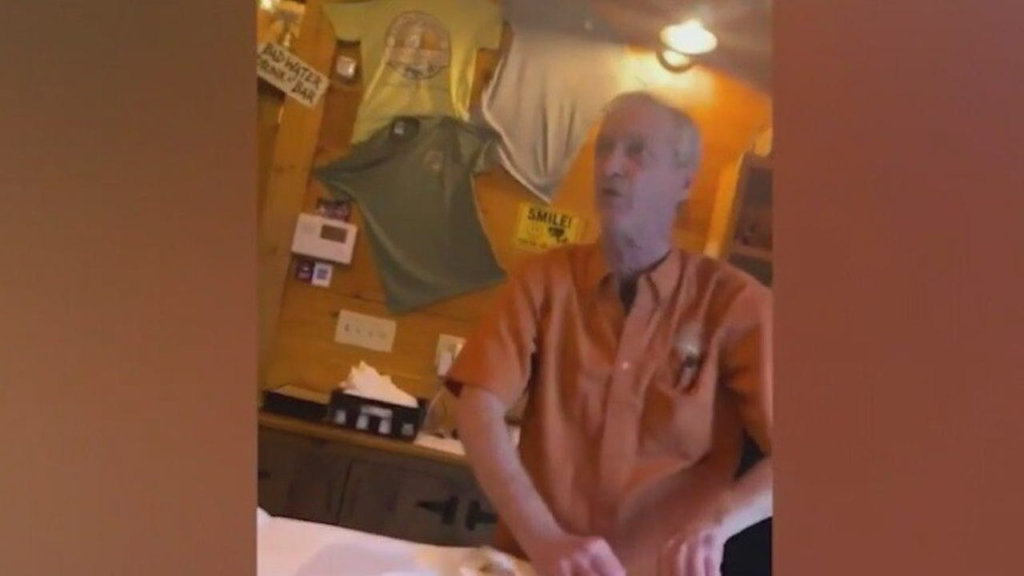
She calmly told the man that Georgia law explicitly protects a mother’s right to breastfeed in public. According to her account, that statement prompted the man to raise his voice and refuse to identify himself. As tensions rose and a friend mentioned having his photograph, Kopiec began recording. The video shows a man behind the counter shouting, “Get on out of here!” as she stands holding her infant. Kopiec later described the tone as aggressive and said her priority at that moment was to remove her children from what she perceived as a hostile environment.
The Incident and the Viral Video
The video shared by Aris Kopiec quickly spread across social media platforms, drawing widespread reaction and sparking renewed debate about breastfeeding in public spaces. Many viewers expressed support for Kopiec, emphasizing that breastfeeding is both natural and legally protected. Others criticized the restaurant’s handling of the situation, particularly the raised voice and public nature of the confrontation. The phrase heard in the video, “Get on out of here,” became emblematic of what critics described as an unnecessary escalation toward a paying customer engaged in lawful behavior.
Public records and local business listings identify 67-year-old Tim Richter as the longtime owner of Toccoa Riverside Restaurant, which has operated for more than three decades. In a phone call with FOX Business, a man identifying himself as the owner declined to confirm whether he was the individual shown in the video. He defended the establishment, stating that the restaurant had accommodated breastfeeding for years and suggesting that the incident had been staged for online attention. Beyond that statement, the restaurant did not provide further comment on the matter.
The lack of a detailed response has done little to quell public criticism. Online commenters have contrasted the tone of the video with previous promotional materials that praised the restaurant’s hospitality. A September spotlight from the Fannin County Chamber of Commerce had described the establishment in positive terms, highlighting its welcoming atmosphere. For many observers, the video appeared to clash sharply with that image, raising questions about how policies are enforced and whether personal discretion by management may have crossed into discriminatory behavior.
Breastfeeder shoots popular Georgia diner kicking out her & baby pic.twitter.com/2YjvikyVuR
— RT (@RT_com) December 15, 2025
For Aris Kopiec, the emotional impact of the incident was immediate and lingering. She said she left the restaurant shaken and momentarily doubting herself, despite knowing she had acted within her legal rights. She described feeling belittled and said her instinct was initially to apologize, a reaction she later reflected was common among women placed in confrontational situations. Ultimately, she said she reminded herself that she had done nothing wrong and that breastfeeding is a protected right, not a privilege granted at the discretion of a business owner.
Georgia Law and Breastfeeding Protections
At the center of the controversy is Georgia law, which explicitly protects a mother’s right to breastfeed in public and private locations where she and her child are otherwise authorized to be. The statute states that a mother may breastfeed “in any location where the mother and baby are otherwise authorized to be,” making it unlawful to remove or restrict a woman for nursing her child. This legal protection aligns with broader national trends, as all 50 states, the District of Columbia, and the U.S. Virgin Islands have laws allowing breastfeeding in public.
Legal experts note that these statutes are designed not only to protect mothers from removal or harassment but also to normalize breastfeeding as a routine aspect of childcare. In many states, breastfeeding is explicitly exempted from public indecency laws, underscoring that it is not to be treated as inappropriate or disruptive conduct. In Aris Kopiec’s case, her assertion that she was fully covered and discreet further complicates any argument that her actions could have reasonably interfered with the restaurant’s operations or atmosphere.

Etiquette expert and author Alison Cheperdak weighed in on the incident, describing the confrontation as raising serious concerns about hospitality standards. She emphasized that breastfeeding is natural and legally protected and that raising one’s voice at a guest is never acceptable. From an etiquette perspective, Cheperdak noted that even if a restaurant desires a quieter or more controlled environment, policies must be enforced with respect and sensitivity. She added that a mother feeding her child owes no apology and that the responsibility lies with the establishment to manage situations calmly and lawfully.
The legal clarity surrounding breastfeeding rights has led many observers to question why such incidents continue to occur. Advocacy groups point out that misunderstandings of the law, personal discomfort, or outdated social norms often play a role. When those factors intersect with authority figures in public spaces, the result can be confrontations that leave mothers feeling isolated or targeted. The viral nature of Kopiec’s video has, for some, served as a reminder that legal protections are only effective when they are understood and respected by businesses and the public alike.
A Restaurant’s Troubled History With Families
The backlash surrounding the breastfeeding incident has also revived scrutiny of Toccoa Riverside Restaurant’s past controversies involving families with children. In 2023, the restaurant drew criticism after reportedly implementing an “adult surcharge” for parents deemed “unable to parent.” The surcharge, which appeared on the menu, was described as applying to adults whose children’s behavior was considered disruptive. The policy quickly gained national attention after parents complained that they and their children had been reprimanded, with some alleging that the owner scolded children directly and made at least one three-year-old cry.
Local Atlanta outlets and national publications such as Food and Wine reported on the controversy, noting that many families felt unfairly targeted. A FOX 5 Atlanta report at the time highlighted claims that the surcharge created a hostile environment for parents, particularly those with young children who may naturally be louder or more restless. Critics argued that the policy blurred the line between maintaining order and shaming families, while supporters said businesses have a right to set standards for behavior.
In the wake of the breastfeeding video, many commenters have connected the two incidents, suggesting a broader pattern in how the restaurant handles interactions with families. While the situations are distinct, both involve allegations of public reprimand and a perceived lack of empathy toward parents managing young children. For Aris Kopiec, learning about the prior controversy reinforced her belief that the confrontation was not an isolated misunderstanding but part of a wider issue.
Aris Kopiec has said that despite the anger and embarrassment she felt, she has chosen not to dwell on resentment. She expressed hope that the attention generated by the video will lead to positive change, both at the restaurant in question and more broadly. Her stated goal, she said, is not punishment but awareness, particularly for nursing mothers who may already feel vulnerable feeding their babies in public. She emphasized that every nursing mother deserves to feel safe and respected and that the law is unequivocal in protecting that right.
As the video continues to circulate, it has prompted renewed discussion about how public spaces accommodate families and how quickly a routine moment of childcare can turn into a flashpoint for cultural debate. For many, the incident serves as a reminder that legal protections exist for a reason and that respect and calm communication are essential in hospitality settings. Whether the controversy leads to changes in policy or practice at Toccoa Riverside Restaurant remains to be seen, but its impact on the broader conversation around breastfeeding in public is already evident.
**mitolyn**
Mitolyn is a carefully developed, plant-based formula created to help support metabolic efficiency and encourage healthy, lasting weight management.