
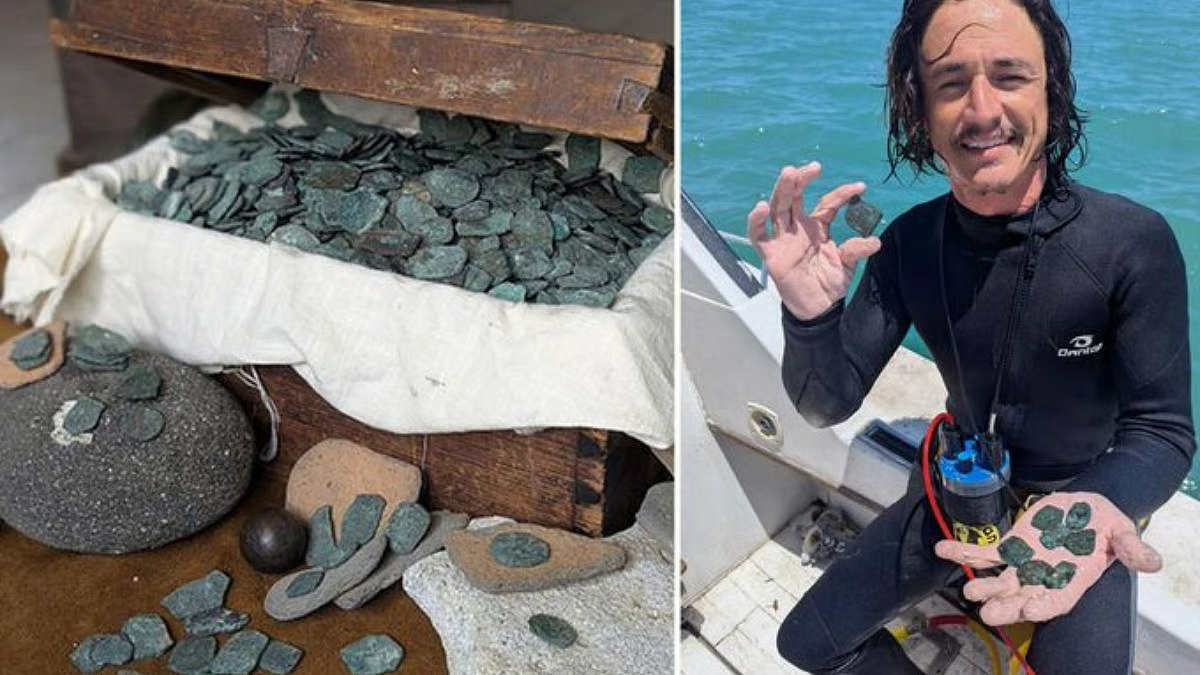
In a remarkable feat of underwater archaeology, a team of professional salvors has pulled more than 1,000 historic coins from the ocean floor off Florida’s east coast, unearthing treasures valued at approximately $1 million. The artifacts hail from the infamous 1715 Spanish Treasure Fleet, a convoy of 11 galleons that perished in a devastating hurricane 310 years ago. This summer’s recovery, announced this week, includes 1,051 silver reales and five gold escudos, along with minor gold items, all meticulously extracted from shipwreck sites along the state’s Treasure Coast. The operation, led by 1715 Fleet–Queens Jewels, LLC, underscores ongoing efforts to reclaim Spain’s lost colonial riches while adhering to strict federal salvage protocols.
The finds represent the latest chapter in a centuries-long saga of maritime disaster and redemption. The fleet, carrying vast shipments of silver and gold from the New World to Europe, met its doom in July 1715 when a ferocious storm scattered the vessels along a 50-mile stretch of Florida shoreline. Modern salvors, equipped with advanced detection gear, have now tapped into that submerged legacy, bringing to light coins that have slumbered beneath the waves for three centuries. As the artifacts await appraisal and conservation, they highlight Florida’s pivotal role in preserving and profiting from its underwater heritage.
The 1715 Fleet Catastrophe: Spain’s Costliest Maritime Loss
The story begins in the sweltering summer of 1715, when Spain’s Tierra Firme Fleet—commonly known as the Treasure Fleet—set sail from Havana, Cuba, bound for Cádiz. This annual convoy was the empire’s lifeline, ferrying immense wealth extracted from mines in Mexico, Peru, and Bolivia. Aboard the 11 ships were an estimated 14 million silver coins, thousands of gold pieces, emeralds, and other jewels, totaling around $400 million in today’s value. The cargo funded Spain’s endless wars and colonial expansions, making the fleet a floating fortune of unparalleled scale.
Disaster struck on July 31, when a massive hurricane slammed into the fleet off Florida’s central coast. Winds exceeding 100 miles per hour drove the wooden galleons onto shallow reefs near present-day Vero Beach and Sebastian Inlet. Ten of the 11 vessels sank within hours, claiming over 1,000 lives, including sailors, merchants, and enslaved Africans. Only the smallest ship, the Grifon, limped back to Cuba with a fraction of the payload. The wreckage scattered coins and cargo across the seabed, earning the region the moniker “Treasure Coast” after beachcombers began unearthing stray pieces in the 20th century.
Survivors’ accounts, preserved in Spanish archives, paint a grim picture of chaos: masts snapping like twigs, hulls splintering on coral, and desperate crews clinging to debris amid shark-infested waters. The loss crippled Spain’s economy, delaying payments to European creditors and fueling pirate raids by figures like Henry Jennings, who scavenged the sites in 1716. Over the decades, sporadic recoveries dotted the timeline—Spanish expeditions in the 18th century, American salvors in the 1960s—but vast portions remain untouched. Today, at least five wrecks lie unidentified, their locations guarded by shifting sands and federal restrictions.
Read : Woman Finds Over 2,150 Middle Ages Silver Coins in Czech Town
This historical backdrop amplifies the significance of the 2025 haul. The recovered coins bear the scars of their watery tomb: corrosion from saltwater immersion, encrustations of marine growth, and faint imprints of burlap sacks that once held them in chests of about 1,000 pieces each. Mint marks from Mexico City, Potosí, and Lima confirm their New World origins, while dates ranging from 1698 to 1714 place them squarely in the fleet’s final voyage. These aren’t mere relics; they are tangible links to an era of imperial ambition and human tragedy, now destined for museums or private collections after legal processing.
Salvage Operations: Precision and Perseverance in Perilous Depths
Fast-forward to summer 2025, and the recovery unfolds as a high-tech ballet beneath the Atlantic’s turquoise surface. The operation falls under the exclusive salvage rights granted to 1715 Fleet–Queens Jewels, LLC, a Florida-based firm with a track record of ethical recoveries since 2016. Led by veteran captain Levin Shavers aboard the M/V Just Right, the team deploys the Mighty Mo, a custom magnetometer-equipped vessel skippered by Mike Perna. Supporting divers Grant Shavers, Ben Perna, and Alex Kalelkar brave 10-to-20-foot depths, where visibility hovers at 20 feet amid gentle currents.
The process is methodical, governed by the U.S. District Court for the Southern District of Florida. Each dive targets known wreck clusters, identified through historical charts, sonar scans, and prior surveys. Divers wield handheld metal detectors to pinpoint anomalies, then use airlifts—underwater vacuums powered by boat compressors—to gently excavate without disturbing the site. Finds are bagged, tagged, and photographed in situ before surfacing, ensuring chain-of-custody integrity. This season’s breakthrough came in May, when the trio unearthed three gold escudos in a single dive: two from Santa Fe de Bogotá and one 1698 Cuzco mint piece, each weighing about a quarter-ounce.
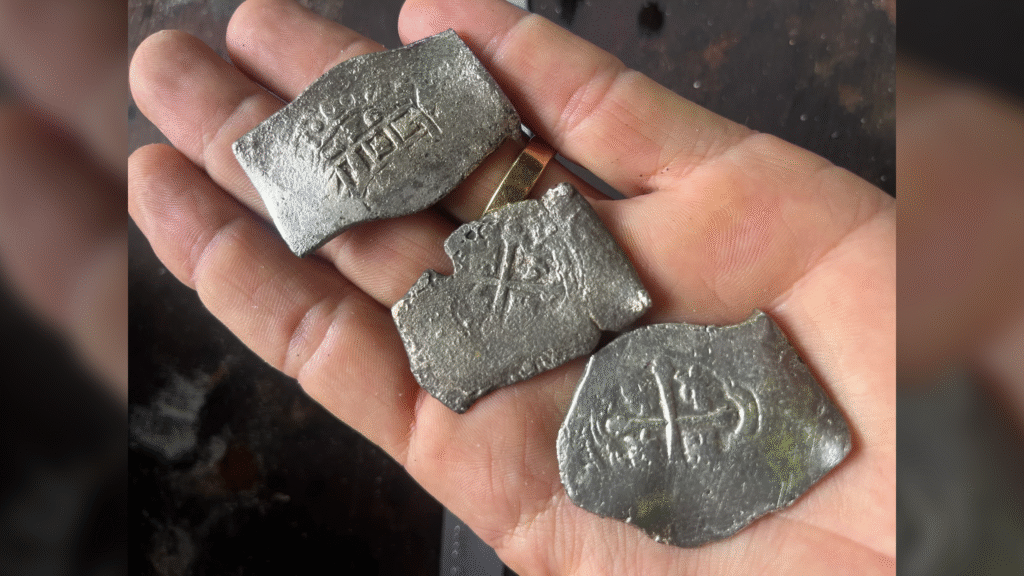
By August, the tally swelled to over 1,000 silver coins, mostly eight-real “pieces of eight” that powered global trade. The team logged hundreds of dive hours, navigating seasonal hazards like summer storms and jellyfish blooms. “It’s painstaking work,” Shavers noted in a statement, emphasizing the blend of intuition and technology. Previous campaigns yielded artifacts like a cocked flintlock pistol and onion bottles, now loaned to state programs, but 2025’s volume marks a peak.
Legal oversight ensures public benefit: The court awards the state up to 20% of proceeds for conservation, with the balance split among salvors. This framework, established in the 1960s, balances profit with preservation, preventing the free-for-all looting of earlier eras. As climate change erodes shorelines and stirs sediments, such operations grow urgent, racing to document sites before they vanish.
The Haul’s Hidden Riches: Valuation, Conservation, and Legacy
At first glance, the $1 million valuation seems modest against the fleet’s fabled billions, but experts caution it’s conservative. Numismatists appraise each coin individually, factoring rarity, condition, and provenance. The silver reales, graded from poor to fine, fetch $100 to $500 apiece due to their encrusted authenticity—burlap fragments evoke the original packing. The gold escudos, rarer and purer (22-karat), command $10,000 to $20,000 each, their intricate royal stamps intact despite corrosion.
Beyond coins, the haul includes gold chain links and navigational tools, hinting at larger caches. Conservation begins immediately: Artifacts soak in freshwater tanks to leach salts, then undergo X-ray and CT scans for hidden details. The Florida Division of Historical Resources oversees this, aiming to display select pieces in exhibits like those at the Mel Fisher Maritime Museum in Sebastian.
Economically, the recovery injects vitality into the Treasure Coast’s heritage tourism, drawing divers and historians. Yet it sparks debate on ethics: Should colonial spoils stay in the Americas, or flow to Spanish claimants? For now, U.S. law prevails, with proceeds funding further searches. As Shavers’ team eyes unfound wrecks, the 1715 Fleet’s secrets persist, promising more jackpots in Florida’s watery vaults.
This discovery reaffirms the ocean’s role as time capsule, yielding not just wealth but windows into lost worlds. With global seas warming and sites degrading, each coin surfacing is a victory for history’s stewards.