
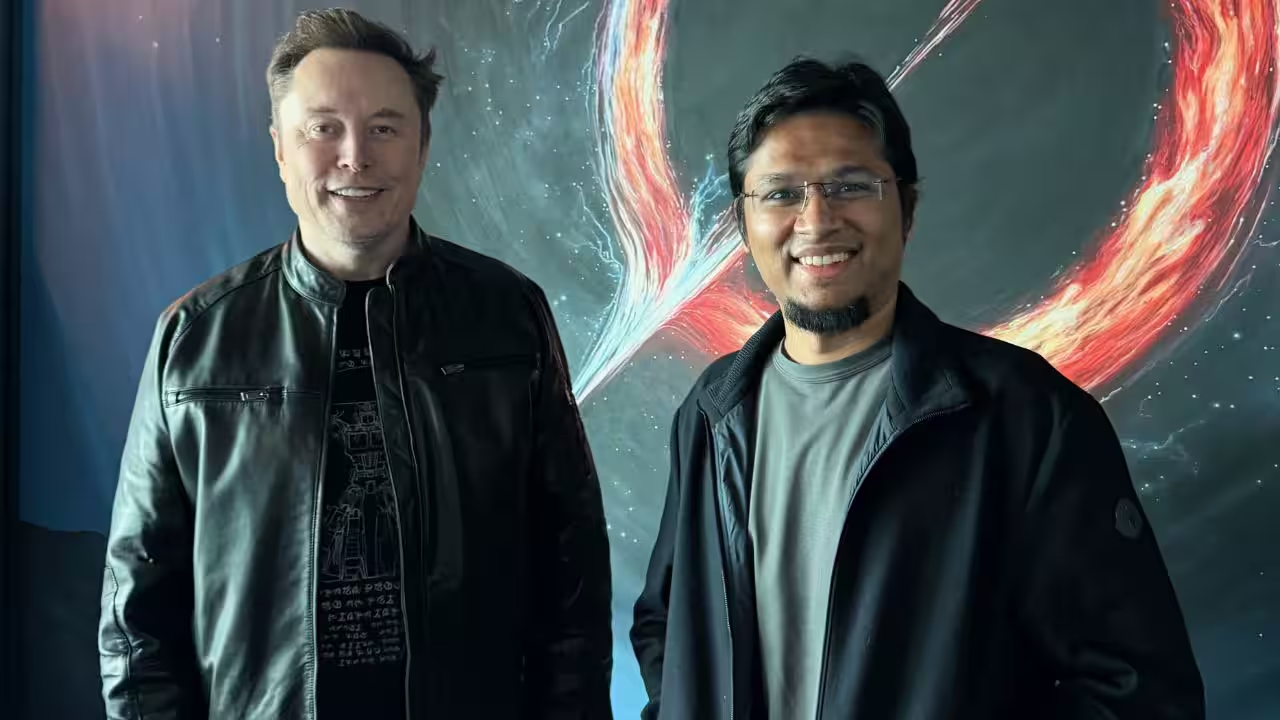
The rapid expansion of artificial intelligence and robotics has created opportunities for researchers capable of bridging digital intelligence with real-world machines. Among the emerging figures in this field is Devendra Singh Chaplot, an Indian-origin scientist whose career has spanned some of the world’s leading AI laboratories and research institutions. Known for his work in machine learning, robotics, and computer vision, Chaplot has now reached a new milestone by joining SpaceX and xAI to work on advanced artificial intelligence initiatives.
His appointment represents a significant step not only in his own professional journey but also in the broader collaboration between robotics research and large-scale AI development. Chaplot announced the move publicly, explaining that his work will focus on integrating AI models with robotics systems capable of operating in both physical and digital environments. The role places him in close collaboration with Elon Musk and teams developing next-generation technologies intended to push the boundaries of machine intelligence.
For Chaplot, the transition reflects years of academic training and research experience that have centered on creating intelligent systems capable of perceiving, navigating, and interacting with complex environments. His background includes elite academic achievements, work with globally recognized AI institutions, and leadership in research competitions that test the capabilities of autonomous systems. These experiences collectively positioned him as a strong candidate for the type of frontier-scale AI development now underway at SpaceX and xAI.
Early Academic Excellence and Educational Journey
Devendra Singh Chaplot’s path into advanced artificial intelligence research began with exceptional academic performance in mathematics and engineering. As a student, he demonstrated early talent in analytical problem-solving, which led him to compete in high-level international academic competitions. One of his most notable achievements during this period was ranking fifth in the International Mathematics Olympiad, a prestigious global competition that identifies outstanding young mathematicians from around the world.
His academic success continued when he participated in the highly competitive Indian Institute of Technology Joint Entrance Examination. Chaplot secured an impressive All India Rank of 25 in the IIT-JEE in 2010, placing him among the top engineering aspirants in the country. This achievement earned him admission to the Indian Institute of Technology Bombay, one of India’s most respected institutions for engineering and technology education.
At IIT Bombay, Chaplot developed a strong foundation in computer science and artificial intelligence. The institution is widely recognized for producing graduates who go on to contribute to global technology industries and research labs. During his time there, Chaplot focused on the intersection of computer science, machine learning, and robotics, areas that would later become central to his research career.
After completing his studies in India, Chaplot pursued further specialization in machine learning by enrolling in a doctoral program at Carnegie Mellon University in the United States. Carnegie Mellon has long been considered a leading center for artificial intelligence research, particularly in robotics, computer vision, and machine learning. The university’s research ecosystem offered Chaplot access to advanced laboratories and collaboration with some of the most influential researchers in the field.
While completing his PhD in machine learning, Chaplot focused on developing AI systems capable of understanding and interacting with real-world environments. His research explored how machines can learn to perceive surroundings, navigate complex spaces, and perform tasks autonomously. These themes would later define much of his professional work and establish his reputation as a specialist in embodied AI—systems where artificial intelligence operates within physical or simulated environments.
Read : Harvard Study Found Signs of Alien Living Among Us Disguised as Humans
The combination of rigorous mathematical training, engineering education at IIT Bombay, and advanced AI research at Carnegie Mellon provided Chaplot with a rare blend of theoretical knowledge and practical expertise. This academic foundation became the launchpad for a career that would span multiple global research organizations and technological frontiers.
Research Career in Artificial Intelligence and Robotics
Following his doctoral research, Devendra Singh Chaplot began contributing to some of the most influential organizations in artificial intelligence development. One of his notable professional roles was with Facebook AI Research, widely known as FAIR. The research division has been responsible for significant advancements in machine learning, natural language processing, and computer vision. At FAIR, Chaplot worked on projects related to machine learning and robotics, focusing on the development of intelligent systems capable of understanding visual environments and making decisions based on sensory input.
Such work often involves training AI models to interpret images, recognize objects, and navigate environments in ways that resemble human perception and reasoning. His research contributions also extended to computer vision and embodied AI, areas that seek to integrate perception, learning, and action within autonomous systems. This work has become increasingly important as robotics moves beyond controlled laboratory settings into real-world applications such as autonomous vehicles, household robotics, and industrial automation.
Chaplot later joined Mistral AI as a founding researcher. The company, which has gained attention for its work on advanced AI models, focuses on developing large-scale machine learning systems capable of performing complex reasoning and language tasks. Being part of the founding team placed Chaplot at the center of early research and development efforts, where he helped shape the direction of AI model design and experimentation. During his research career, Chaplot also participated in and led teams competing in several global AI competitions that test the performance of intelligent agents in simulated environments.
These competitions often serve as benchmarks for progress in robotics and machine learning, pushing researchers to create systems capable of solving complex challenges. One such achievement involved the CVPR 2019 PointNav Challenge, which focused on teaching AI agents to navigate unfamiliar environments and reach specific points using minimal information. Chaplot’s team performed strongly in this competition, demonstrating advanced capabilities in navigation algorithms and perception systems.
He was also involved in the CVPR 2020 ObjectNav Challenge, where AI agents were tasked with locating objects within simulated environments. This challenge required systems to combine visual recognition with spatial reasoning, highlighting the importance of integrating multiple AI capabilities into a single framework. Further accomplishments came through the NeurIPS 2022 Rearrangement Habitat Challenge, which focused on robotic systems capable of interacting with objects and rearranging them within environments. Such tasks require not only perception and navigation but also planning and manipulation abilities.
Chaplot’s research teams also achieved success in the Visual Doom AI Competition in 2017, where AI systems compete in simulated first-person environments inspired by video games. These competitions test how well AI agents can perceive surroundings, make strategic decisions, and respond dynamically to changing situations. Collectively, these achievements reflect Chaplot’s focus on embodied intelligence—AI systems that operate within environments rather than purely digital contexts. His work aims to enable machines to understand space, objects, and movement in ways that allow them to perform meaningful tasks in real-world scenarios.
Joining SpaceX and xAI to Build Advanced AI Systems
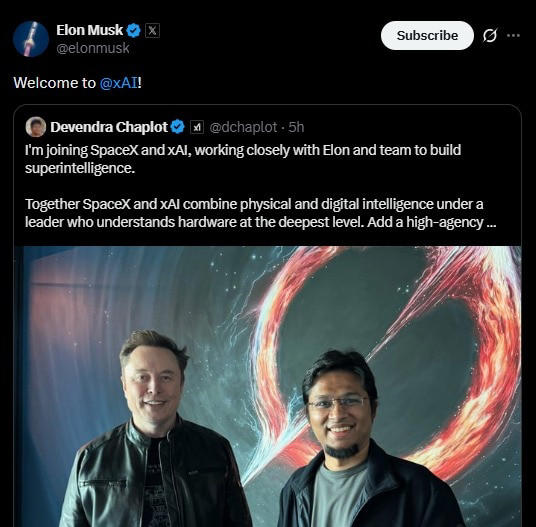
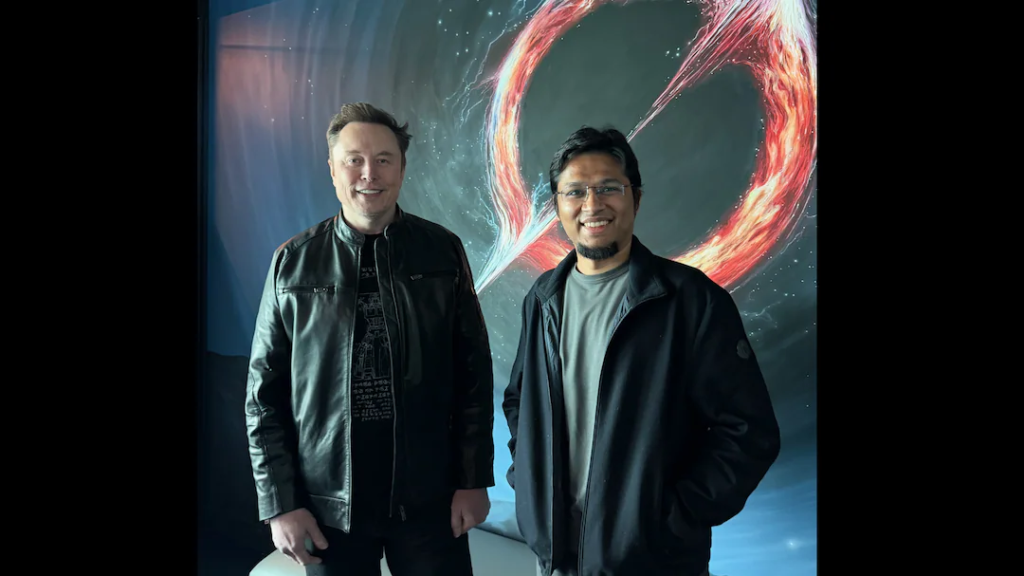
Devendra Singh Chaplot’s latest career milestone came with his announcement that he will be joining SpaceX and xAI, two organizations associated with ambitious technological projects led by Elon Musk. In a public message shared online, Chaplot described the move as an opportunity to contribute to the development of what he called “superintelligence.” According to Chaplot, the collaboration between the two organizations offers a unique environment for advancing artificial intelligence.
SpaceX is known for its work in aerospace engineering, including reusable rockets and satellite networks, while xAI focuses on building advanced AI models designed to push the limits of machine reasoning and understanding. Chaplot explained that the combination of these efforts creates a platform where physical and digital intelligence can be developed together. In this framework, robotics systems may benefit from powerful AI models, while large-scale AI research can incorporate real-world hardware and operational environments.
He emphasized that working within a high-agency culture with access to significant technological resources could enable the development of systems that would otherwise be difficult to build. The scale of projects undertaken by SpaceX and xAI suggests that the integration of robotics and artificial intelligence may extend into areas such as space exploration, autonomous systems, and advanced computational platforms. Chaplot described the moment as deeply meaningful in his personal career journey.
For years, his research interests have focused on the convergence of robotics and artificial intelligence. Joining organizations capable of pursuing large-scale technological experimentation represents an opportunity to apply those ideas in ambitious new contexts. He also reflected on the experiences that prepared him for this role, including his work with research teams at Mistral AI and other institutions. These collaborations, he noted, played a key role in shaping his approach to building intelligent systems from the ground up.
In closing his announcement, Chaplot expressed gratitude to mentors, colleagues, and collaborators who supported him throughout his academic and professional journey. He also conveyed enthusiasm about beginning this new stage of his work, highlighting the potential impact of the technologies he will help develop. His arrival was acknowledged publicly when Elon Musk reshared Chaplot’s message and welcomed him to xAI. The brief response signaled recognition of Chaplot’s expertise and the importance of his contributions to ongoing AI research efforts.
As the fields of artificial intelligence and robotics continue evolving, researchers like Devendra Singh Chaplot represent a generation of scientists working to merge theoretical advances with real-world applications. His journey from competitive mathematics and engineering education in India to leadership roles in global AI research reflects the growing international influence of scientists contributing to next-generation technologies.