
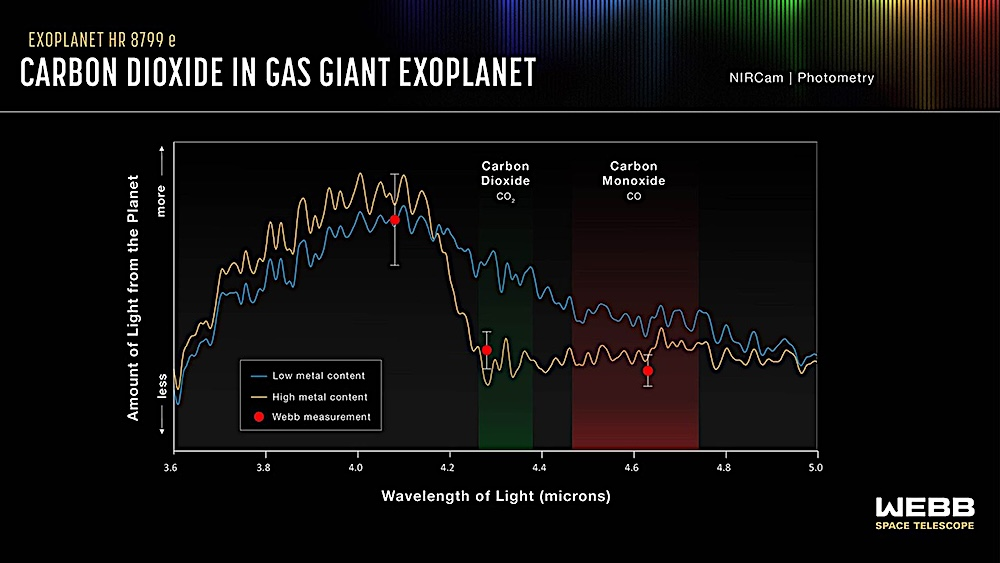
The James Webb Space Telescope (JWST) has once again expanded our understanding of the universe by capturing First Direct Images of Exoplanet Carbon Dioxide. This breakthrough provides valuable insights into planetary formation and the chemical composition of distant worlds beyond our solar system.
By using its powerful instruments, JWST has made an unprecedented discovery that sheds light on how planetary systems evolve and whether they share similarities with our own. While the gas giants studied in this research are not habitable, the presence of carbon dioxide suggests that similar methods can be used to analyze more Earth-like planets in the future.
Revolutionary Discovery in the HR 8799 System
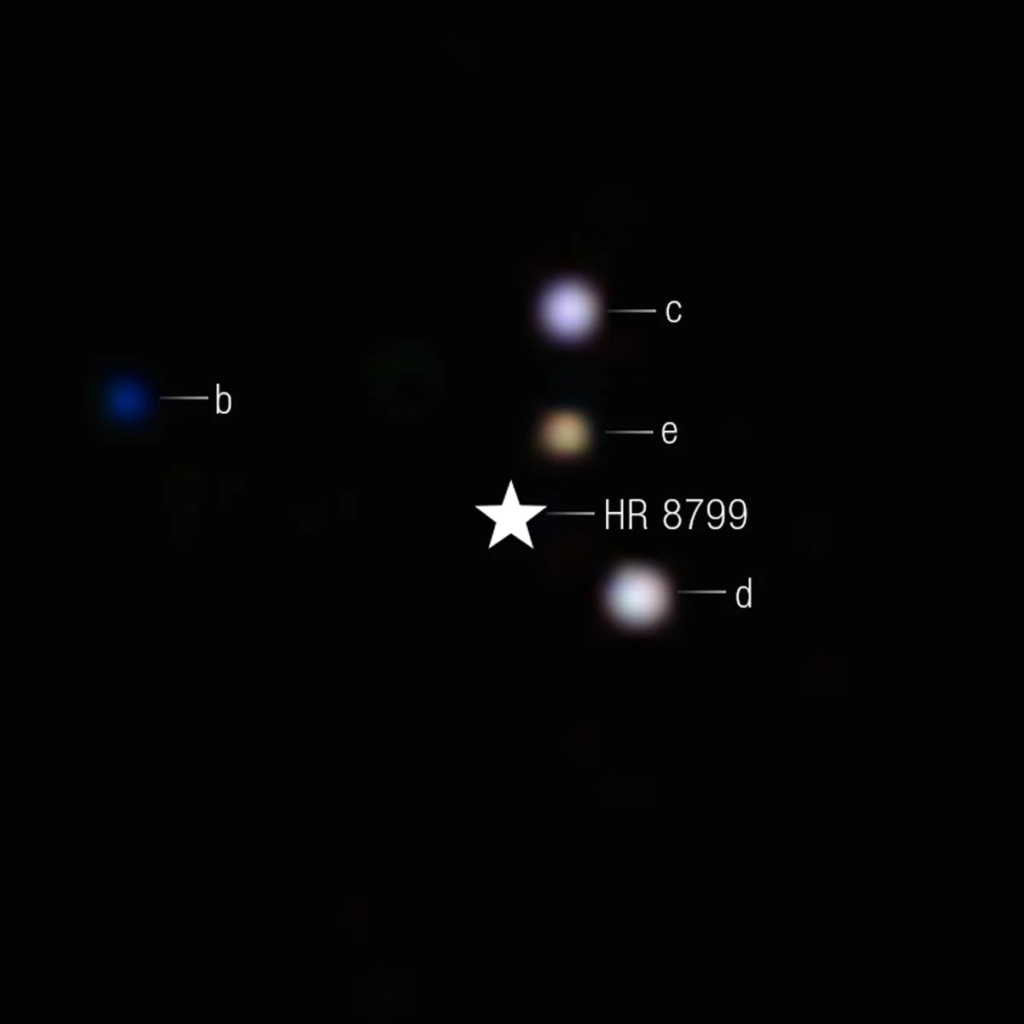
Scientists focused their observations on HR 8799, a planetary system located 130 light-years from Earth. Unlike our solar system, which is over 4.6 billion years old, HR 8799 is relatively young, estimated to be around 30 million years old.
This system features four known gas giant planets, each of which was analyzed for chemical composition using JWST’s state-of-the-art instruments. The key discovery was the presence of carbon dioxide in their atmospheres, marking the first time this essential molecule has been directly detected outside of our solar system.
This breakthrough was made possible by JWST’s coronagraph, a tool that blocks out the intense light from stars, allowing astronomers to directly observe the planets themselves.
Previously, exoplanetary atmospheres were studied using the transit method, where planets are detected by observing how their light dims when passing in front of their host star. This new technique is a major leap forward, as it allows scientists to study planetary atmospheres more directly and in greater detail.
Read : Webb Telescope Finds CO2 and Hydrogen Peroxide on Pluto’s Largest Moon Charon
The study, published in The Astrophysical Journal, highlights how JWST’s capabilities far exceed those of previous telescopes. The detection of carbon dioxide is crucial because it is a key component in understanding planetary formation. Carbon dioxide in the deep cold of space condenses into tiny ice particles, playing a vital role in planet formation.
Read : NASA Creates Telescope That Could Find Aliens by 2050
By identifying its presence in the HR 8799 planets, researchers have gathered evidence that these gas giants may have formed similarly to Jupiter and Saturn in our own solar system, through the gradual accumulation of icy materials that later attracted massive amounts of gas.
The Significance of Carbon Dioxide Detection
Carbon dioxide is an essential molecule for life on Earth, making it a crucial target for astrobiologists searching for habitable planets. Although the gas giants in the HR 8799 system are unlikely to host life, their moons could offer possibilities for habitability.
In our solar system, moons such as Europa and Enceladus have subsurface oceans that may be capable of supporting microbial life. If the same conditions exist in the HR 8799 system, it raises intriguing questions about the potential for life beyond Earth.
Additionally, the presence of carbon dioxide in these exoplanets offers a glimpse into the broader process of planetary formation across the universe.
Scientists have long debated whether planets primarily form from the accumulation of icy particles or through other mechanisms. The discovery in HR 8799 supports the idea that the “bottom-up” formation process, where tiny ice particles gradually build up into a solid core before attracting gas, is a common method of planet formation.
This finding aligns with previous studies of Jupiter and Saturn, which are believed to have formed in a similar way. However, understanding whether this process is universal across all planetary systems remains a significant challenge.
More observations of exoplanets with varying compositions and ages are needed to determine how typical our solar system is compared to others in the universe.
The Future of Exoplanet Research and Challenges Ahead
Despite these groundbreaking findings, scientists acknowledge that the next step in exoplanet research will be much more challenging. So far, nearly 6,000 exoplanets have been discovered, but most are large gas giants, and none are known to be habitable. The next major leap forward in planetary science will require studying smaller, Earth-sized exoplanets that could potentially support life.
NASA’s upcoming Nancy Grace Roman Space Telescope, scheduled for launch in 2027, will build upon JWST’s findings by using a coronagraph to study Earth-like planets more effectively. This telescope is expected to provide detailed images of smaller exoplanets, allowing scientists to analyze their atmospheres for signs of habitability.
However, funding challenges may hinder progress. Recently, the Trump administration dismissed NASA’s chief scientist, signaling potential budget cuts that could impact future space exploration efforts.

Scientists like William Balmer, the lead author of the HR 8799 study, have expressed concerns about the availability of resources needed to continue this line of research. Without sufficient funding, efforts to explore exoplanetary systems and uncover the secrets of planetary formation may slow down significantly.
Despite these uncertainties, the discovery of carbon dioxide in the HR 8799 system represents a major milestone in space exploration. As telescopes become more advanced and scientists refine their techniques, the dream of finding an Earth-like planet capable of supporting life grows ever closer.
By studying the chemical compositions of distant worlds, researchers hope to answer one of the most fundamental questions in science: Are we alone in the universe?
The ability to directly observe carbon dioxide in exoplanet atmospheres is just the beginning. With continued research and technological advancements, the study of exoplanets will pave the way for an even deeper understanding of our place in the cosmos.
Whether life exists beyond Earth or not, the discoveries made by the James Webb Space Telescope remind us of the vast and complex nature of the universe we inhabit.