
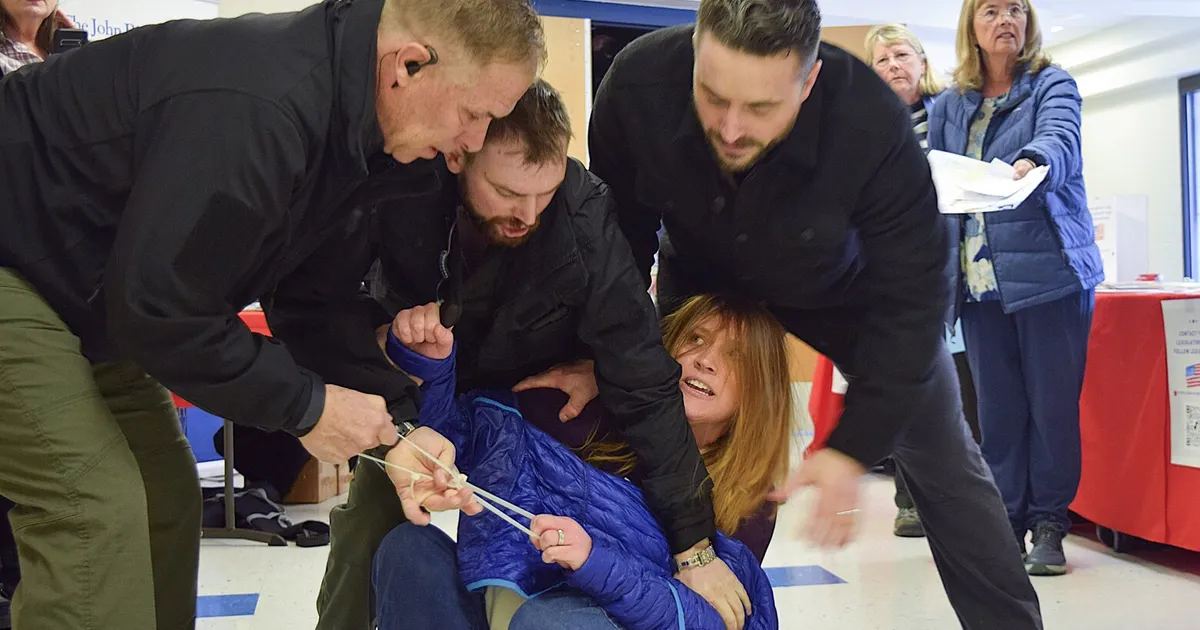
On February 22, 2025, a legislative town hall hosted by the Kootenai County Republican Central Committee in Coeur d’Alene, Idaho, descended into chaos when Teresa Borrenpohl, a former Democratic state legislative candidate, was forcibly removed from the event.
The incident, captured on video and widely shared online, has sparked national outrage, leading to criminal charges against six men and a $5 million tort claim filed by Borrenpohl. This blog post delves into the details of the altercation, the legal repercussions, and the broader implications for free speech and public discourse at political events.
The Incident: A Town Hall Turned Tumultuous
The Kootenai County Republican Central Committee’s town hall, held at Coeur d’Alene High School, was attended by approximately 450 people. The event aimed to foster dialogue between state legislators and constituents but quickly became contentious. Teresa Borrenpohl, known for her vocal opposition to certain Republican policies, was among the attendees.
According to police reports and video footage, Teresa Borrenpohl interrupted speakers multiple times, shouting remarks such as, “Is this a lecture or a town hall?” and jeering at the emcee and legislators. While her statements were brief—often one sentence—and did not significantly disrupt the event’s flow, they provoked strong reactions from the audience and organizers.
The situation escalated when Kootenai County Sheriff Robert Norris, who was off-duty but wearing his badge, approached Borrenpohl. Video evidence shows Norris introducing himself, asking her to leave, and warning her that she would be escorted out if she refused.
When Teresa Borrenpohl did not comply, Norris stepped back, began recording on his cellphone, and directed a group of men in plainclothes to remove her. These men, later identified as employees of Lear Asset Management, a private security firm, descended on Borrenpohl.
Read : Latrance Battle Arrested After Impersonating ICE Official to Arrest Her Ex-Boyfriend’s Wife
Without identifying themselves, they grabbed her by the arms and feet, pulled her from her seat, and dragged her out of the auditorium as the crowd jeered, with some shouting, “Bye, Teresa” and “Remove the trash.” Borrenpohl alleges she suffered physical injuries, including scratches and bruising, as well as emotional distress from the ordeal.
This Teresa Borrenpohl incident really pissed me off, & more & more each time I come across it. What has me soo heated about this is, nearly 300 ppl, mostly men, sat by & watched this woman get mishandled & assaulted, & not one man intervened.
— Cₕₑᵣₑₗₗₑ bₑ ₜₐₗₖᵢₙ ₛₕᵢₜ! 🏴🇲🇽 🇺🇸 (@DFiosa) February 26, 2025
White men are embarrassingly weak! pic.twitter.com/iJkgznWKRo
The video of her removal went viral, drawing widespread attention to the heavy-handed tactics used by the security team and raising questions about the role of private security at public political events. The incident also prompted scrutiny of Sheriff Norris’s involvement, as he appeared to orchestrate the removal while failing to intervene as the situation grew violent.
Legal Repercussions: Charges and a $5 Million Claim
In the weeks following the incident, the Coeur d’Alene Police Department conducted an investigation, recommending criminal charges against the individuals involved. On April 17, 2025, prosecutors filed misdemeanor charges against six men: five employees of Lear Asset Management—Paul Trouette (the firm’s CEO), Alexander Trouette, Christofer Berg, Russell Dunne, and Jesse Jones—and one unaffiliated individual, Michael Keller.
The charges include battery, false imprisonment, and violations of security agent duties, such as failing to wear identifiable uniforms. Alexander Trouette was listed as an accessory, as no footage showed him physically touching Teresa Borrenpohl. Keller faced a battery charge for allegedly pushing a woman who was attempting to approach Borrenpohl during the altercation.
The investigation revealed additional troubling details. One police report noted that a woman recording the incident was pushed by Paul Trouette, who attempted to zip-tie her hands and touched her inappropriately.
Another attendee, Gregg Johnson, reported being physically removed by Norris without prior warning or explanation, despite not engaging in disruptive behavior. These accounts suggest a pattern of excessive force and disregard for attendees’ rights. Notably, the police investigator emphasized that Borrenpohl’s interruptions were less disruptive than the audience’s cheers, challenging the narrative that her behavior justified such a forceful response.
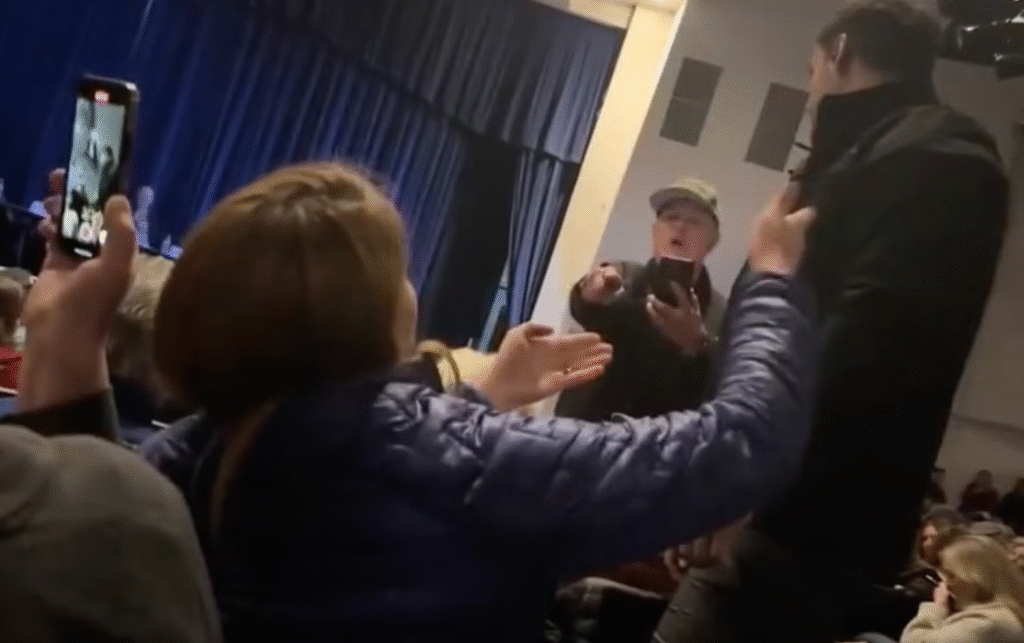
In addition to the criminal charges, Teresa Borrenpohl took legal action. On April 21, 2025, she filed a tort claim against Sheriff Norris, Kootenai County Republican Central Committee Chair Brent Regan, Lear Asset Management, and the five charged security guards.
The claim, a precursor to a civil lawsuit, seeks $5 million in damages for violations of her constitutional rights, physical injuries, and emotional distress. Borrenpohl’s attorney, Wendy Olson, a prominent Idaho First Amendment lawyer, stated, “Today is the first step in the civil legal system for pursuing justice for Teresa and holding Lear Asset Management and Sheriff Norris responsible for the disturbing events that happened at the town hall event.”
Teresa Borrenpohl herself asserted, “Town halls are intended to foster conversation and discourse across the aisle, which is why I am deeply alarmed that private security dragged me out of the public meeting for simply exercising my fundamental right of free speech.”
The fallout extended beyond legal consequences. The city of Coeur d’Alene revoked Lear Asset Management’s business license for violating ordinances related to security agencies, further underscoring the severity of the firm’s misconduct. A GoFundMe campaign in support of Borrenpohl’s case has raised over $330,000, reflecting significant public sympathy for her cause.
Broader Implications: Free Speech and Public Safety at Political Events
The Coeur d’Alene town hall incident raises critical questions about the balance between maintaining order at political events and protecting attendees’ rights to free expression. Town halls are traditionally spaces for robust debate, where constituents can challenge elected officials and voice dissenting opinions.
Teresa Borrenpohl’s removal, particularly the violent manner in which it was executed, has fueled accusations that Republican organizers sought to silence opposition. The involvement of plainclothes security guards who refused to identify themselves further erodes public trust, as attendees may feel intimidated or unsafe expressing their views.
This incident is not isolated but part of a broader trend of heightened tensions at political gatherings. As noted in a CNN report, Republican lawmakers across the country have faced vocal backlash from constituents at town halls, prompting some to limit or avoid such events altogether.
The Coeur d’Alene case highlights the risks of outsourcing security to private firms, which may lack the training or accountability of law enforcement. The fact that Sheriff Norris, a public official, directed the removal but did not intervene to de-escalate the situation raises concerns about the misuse of authority and the prioritization of political agendas over public safety.
Public reaction on platforms like X reflects a polarized sentiment. Some users, such as @TheDemCoalition, celebrated the charges as a step toward accountability, framing Borrenpohl as a victim of overreach.

Others, including those aligned with the Kootenai County Republican Central Committee, argued that Borrenpohl’s disruptions justified her removal, accusing her of being a Democratic activist intent on derailing the event. These differing narratives underscore the challenges of navigating free speech in politically charged environments.
The incident also prompts a reevaluation of security protocols at public events. Lear Asset Management’s failure to comply with uniform requirements and the guards’ aggressive tactics suggest a need for stricter regulations governing private security firms.
Additionally, law enforcement officials like Sheriff Norris must be held to a higher standard when managing public gatherings, ensuring that their actions uphold constitutional protections rather than suppress them. Kootenai County Undersheriff Brett Nelson has promised a complete and independent investigation by an outside agency, which may shed further light on these issues.
The forcible removal of Teresa Borrenpohl from a Republican town hall in Coeur d’Alene has reverberated far beyond Idaho, igniting debates about free speech, public safety, and the role of security at political events. The misdemeanor charges against six men, coupled with Borrenpohl’s $5 million tort claim, signal a demand for accountability in the face of excessive force.
As the legal proceedings unfold, this case will likely serve as a flashpoint for discussions about how to preserve open discourse while maintaining order in an increasingly polarized political landscape. For now, Borrenpohl’s story stands as a stark reminder of the fragility of democratic norms and the importance of safeguarding the right to dissent.