
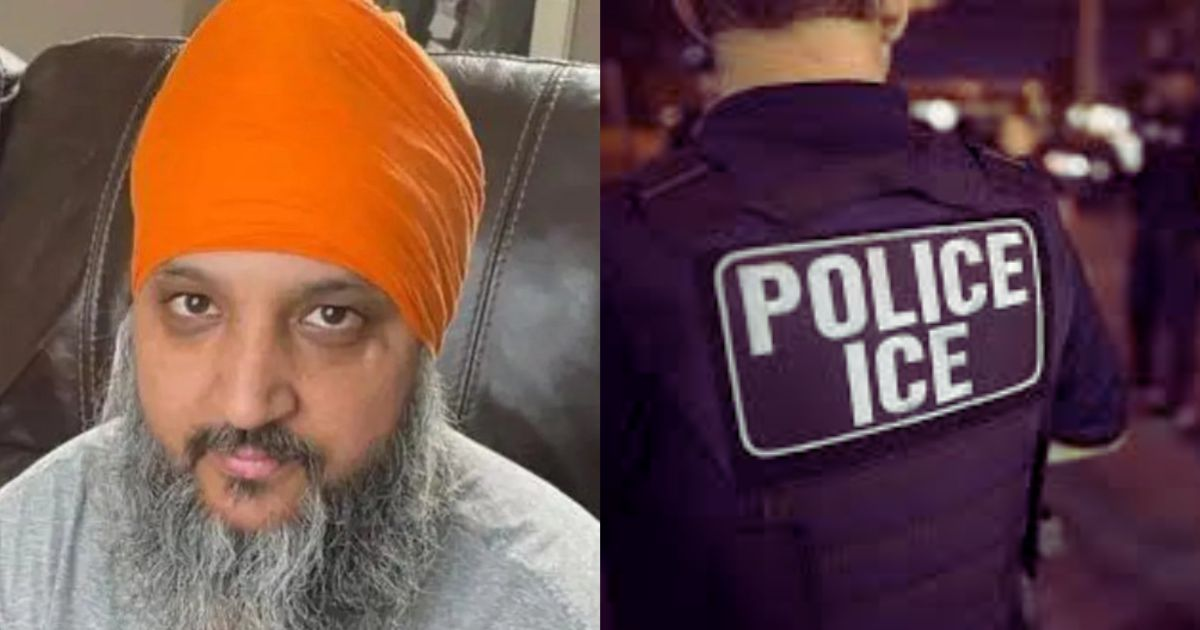
For more than two months, a 48-year-old Sikh man named Paramjit Singh, a long-term US green card holder and resident of Indiana, has been held in the custody of the US Immigration and Customs Enforcement (ICE). His detention, which began upon his return from India in late July, has raised serious questions about the treatment of immigrants with medical conditions and the legal justification for his continued confinement.
According to his family, Mr Singh—who suffers from a brain tumour and a heart condition—has been denied proper medical care during his detention, causing growing distress for his wife, children, and relatives. His case highlights not only the bureaucratic rigidity of immigration enforcement but also the human cost of policies that appear to disregard humanitarian considerations.
A Sudden Detention at Chicago Airport
Paramjit Singh’s ordeal began on 30 July, when he landed at Chicago O’Hare International Airport after visiting India. A lawful permanent resident of the United States since 1994, Mr Singh has lived in Indiana for decades, where he and his family own and operate a chain of gas stations. His wife, Kirandeep Kaur, and their two children are US citizens. According to relatives, Mr Singh’s travel history has never previously posed an issue; he has routinely visited India and returned without any immigration complications. However, this time, immigration officials detained him shortly after his arrival, citing two decades-old legal cases as grounds for custody.
Mr Singh’s niece, Kiran Virk, told the BBC that the family waited anxiously for seven hours at the airport before learning that he had been detained. Officials informed them that the detention was connected to a 1999 case involving the use of a public telephone without payment—a minor offence for which Mr Singh had already served 10 days in jail and paid a fine of $4,137.50. Court records confirm that this sentence had been fully discharged, though it has continued to hinder his path to US citizenship. Despite this, Mr Singh was reportedly held at the airport for five days, after which he was transferred to a Clay County detention centre in Indiana.
ICE detains man needing emergency surgery for brain tumor—for using a payphone without inserting 35¢ in 1999.
— LongTime🤓FirstTime👨💻 (@LongTimeHistory) September 19, 2025
Family only found out where he was when received bill from hospital emergency room—after 5 days in detention.
He has a valid green card—having immigrated 30 years ago… pic.twitter.com/z2GSgBh0qa
Family members allege that immigration authorities have exaggerated or misrepresented the details of the 1999 case to justify prolonged detention. They further claim that ICE officials stated during a hearing that Mr Singh still had a one-and-a-half-year sentence pending, with only 10 days credited for time served—an assertion the family disputes as completely unfounded. Mr Singh’s lawyer, Louis Angeles, has publicly questioned the validity of the government’s claims and criticised what he describes as an “unethical” attempt to detain a gravely ill man on outdated and resolved charges.
Disputed Criminal Allegations and Legal Challenges
Adding to the controversy is the emergence of another alleged offence cited by immigration authorities: a 2008 forgery conviction in Illinois. Mr Singh’s family vehemently denies that any such case exists. They assert that the ICE’s records are mistaken and may pertain to another individual with the same name. To substantiate this claim, the family hired a private investigator, who reportedly found no criminal records matching Mr Singh in Illinois state databases. Despite this evidence, ICE has used the purported forgery case to block his release on a $10,000 bond, which had been granted by an immigration judge.
The contradiction between the official record and the family’s findings has deepened concerns that Mr Singh’s detention is not only unjust but also legally flawed. His attorney, Mr Angeles, told the BBC that he intends to challenge the detention in federal court, arguing that both the 1999 and 2008 cases cited by ICE are either resolved or non-existent. “We are also taking legal steps to block him from being deported from the US,” Angeles stated, adding that his client’s deteriorating health demands immediate humanitarian consideration.
This legal dispute underscores a recurring problem in immigration enforcement: reliance on outdated, incomplete, or inaccurate records to justify detention or deportation. For long-term residents like Mr Singh, such administrative errors can lead to devastating personal consequences. Although immigration law grants ICE wide discretion in detaining non-citizens with criminal histories, it also imposes obligations to ensure that such detentions are justified and that detainees’ rights—including access to medical care—are protected. In Mr Singh’s case, both his family and his lawyer argue that these obligations have been neglected.
The family’s frustration has been compounded by the opaque communication practices within the detention system. Ms Virk reports that they face severe difficulties in maintaining contact with Mr Singh due to limited access to phones and his fragile health condition. “It is almost impossible to talk to him,” she said. “He is weak, and the facility allows very little time for phone use.” These barriers have made it increasingly difficult for the family to monitor his health or provide him with the emotional support he needs as he awaits his hearing.
Health Concerns and Humanitarian Implications
At the heart of the case lies an urgent humanitarian issue. Mr Singh’s family reports that he has undergone prior surgery for a brain tumour and was scheduled for a second operation, which has now been delayed due to his detention. He also suffers from a heart condition that requires regular monitoring and medication. Despite these critical health concerns, ICE authorities have allegedly failed to provide adequate medical care. According to his lawyer, Mr Singh receives only occasional check-ups rather than the continuous treatment his condition demands.
“Paramjit Singh is not getting the medical help he needs,” Angeles told the BBC. “He is only getting medical check-ups.” Such statements raise troubling questions about the standard of healthcare provided in immigration detention facilities—an issue that has drawn repeated scrutiny from human rights organisations and legal advocacy groups. In previous years, watchdog agencies and investigative reports have documented multiple cases of medical neglect within ICE facilities, some of which have resulted in severe health deterioration and even death.
Mr Singh’s family describes a growing sense of helplessness as they watch his condition decline from afar. Ms Virk emphasised that the family’s appeals to authorities have gone largely unanswered. “We have tried everything—calling officials, writing letters—but no one listens,” she said. “He has served his time, paid his fines, and lived an honest life for decades. Now he is being treated as if he were a criminal, and his health is suffering.”
The situation has ignited broader outrage among Sikh and immigrant communities across the United States. Many view Mr Singh’s case as emblematic of a system that too often disregards due process and humanitarian principles. Advocates argue that the detention of a gravely ill permanent resident with long-standing community ties serves neither justice nor public safety. They contend that ICE should exercise discretion and release Mr Singh on medical and humanitarian grounds while his legal matters are reviewed.
As of mid-October, Mr Singh’s case is scheduled for a hearing on the 14th, where his attorney plans to request his immediate release and the dismissal of the unsubstantiated charges. However, the outcome remains uncertain, and the family continues to fear that deportation proceedings may proceed despite the lack of credible evidence and the risk to his health.
The controversy unfolds against a larger backdrop of intensifying immigration enforcement in the United States. Under the administration of President Donald Trump, ICE expanded its detention and deportation operations, vowing to remove what the president described as the “worst of the worst.” However, critics have pointed out that many of those targeted have minor or decades-old infractions—or, as in Mr Singh’s case, none at all. Legal scholars and immigrant rights groups argue that such cases reveal the blurred line between legitimate enforcement and punitive overreach.
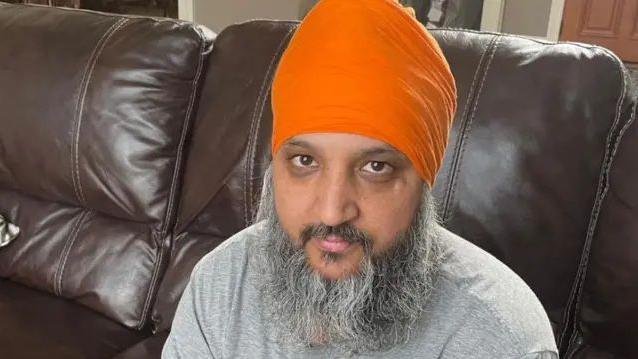
One particularly alarming precedent occurred in September, when Harjit Kaur, a 73-year-old Sikh grandmother who had lived in the United States for over thirty years, was deported to India. Her removal, which took place despite her deep family and community ties, provoked widespread condemnation from Sikh organisations and immigrant advocates. Mr Singh’s detention has rekindled these concerns, raising fears that vulnerable individuals are being swept up in a system that prioritises enforcement over fairness.
Beyond the legal and political dimensions, Mr Singh’s story sheds light on the human toll of detention. Behind every case number and court document is a person with family, history, and health concerns that cannot be put on hold. His wife, Kirandeep Kaur, a US citizen, has expressed anguish at her husband’s absence and deteriorating condition. The couple’s two children, who grew up in Indiana and consider America their home, now face the emotional strain of uncertainty about their father’s fate.
For immigrant communities, particularly those from South Asia, the case has also revived longstanding anxieties about profiling and unequal treatment within immigration systems. Sikh organisations have pointed out that individuals from their community often face added scrutiny due to cultural and religious visibility, such as wearing turbans or maintaining beards. Although no explicit link between Mr Singh’s Sikh identity and his detention has been alleged, community leaders note that the perception of unequal treatment deepens mistrust between minority groups and federal authorities.
As Mr Singh’s hearing approaches, his family continues to appeal for compassion and justice. They insist that his decades of lawful residence, business ownership, and community contribution should carry weight in assessing his case. For them, the question is not just legal but moral: whether a nation built on principles of fairness and due process will allow a man battling life-threatening illnesses to suffer behind bars over alleged offences that may no longer even exist.
If the court upholds the detention, Mr Singh could face deportation to India—a country he has not lived in for over three decades. His family fears that such a move would be catastrophic for his health, given the need for ongoing medical treatment and the support network he has in the United States. His attorney’s efforts to block deportation are therefore not only a legal challenge but a fight for his survival.
As the public awaits the court’s decision, Mr Singh’s case stands as a stark reminder of the intersection between immigration enforcement and human rights. It calls into question the adequacy of safeguards meant to protect vulnerable detainees and the accountability mechanisms governing federal detention practices. For now, one family in Indiana continues to hope that compassion and justice will prevail over procedural rigidity—before it is too late for the man at the centre of their struggle.
کراتین ایوژن، یک مکمل غذایی باکیفیت است که به طور خاص برای بهبود عملکرد ورزشی و حمایت از رشد عضلانی طراحی
شده.