

In a tragic incident that has sent shockwaves through the mountaineering community, a 31-year-old hiker identified only by the surname Hong plummeted to his death from Mount Nama in China’s Sichuan Province. The fatal accident occurred on September 25, 2025, when Hong untied his safety rope to take photographs near the summit. The event, captured on video and widely circulated on social media, underscores the perilous risks of high-altitude trekking, particularly when safety protocols are disregarded. Authorities have launched an investigation, revealing that the hiking group failed to secure necessary permits, highlighting ongoing concerns about unregulated expeditions in remote mountainous regions.
Mount Nama, a sub-peak of the imposing Gongga Mountain, stands at 5,588 meters in the eastern Tibetan Plateau. Known for its breathtaking icy vistas and challenging terrain, the peak attracts avid climbers seeking adrenaline-fueled adventures. However, its steep snow-covered slopes, crevasses, and extreme weather conditions demand rigorous preparation and adherence to safety measures. Hong’s group was navigating these hazards during their ascent when the mishap unfolded, turning a routine photo opportunity into a fatal error. The incident serves as a stark reminder of the fine line between capturing memories and courting disaster in such unforgiving environments.
As details emerge from official reports and eyewitness accounts, the focus has shifted to the immediate aftermath and the human cost of this avoidable tragedy. Local rescue teams responded swiftly, but the remote location and treacherous conditions complicated recovery efforts. Hong’s body was eventually transported to Gongga Mountain Town for family arrangements, leaving behind a grieving community and sparking national discussions on mountaineering regulations. This event not only claims one life but also prompts a broader examination of how adventurers balance thrill-seeking with personal responsibility.
The Incident: A Fatal Slip Captured on Video
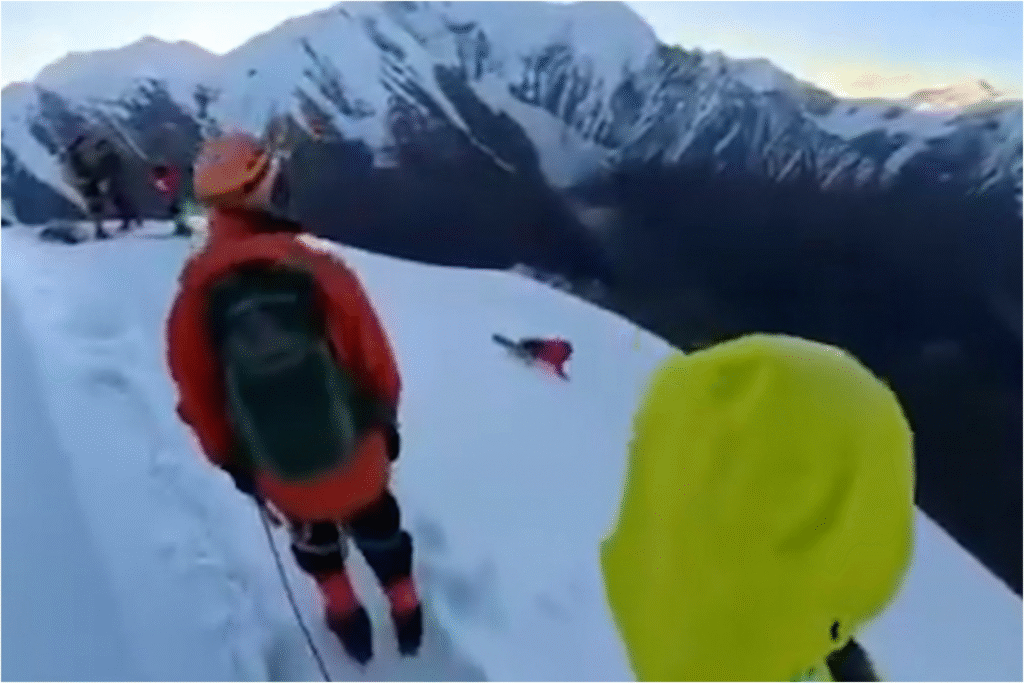
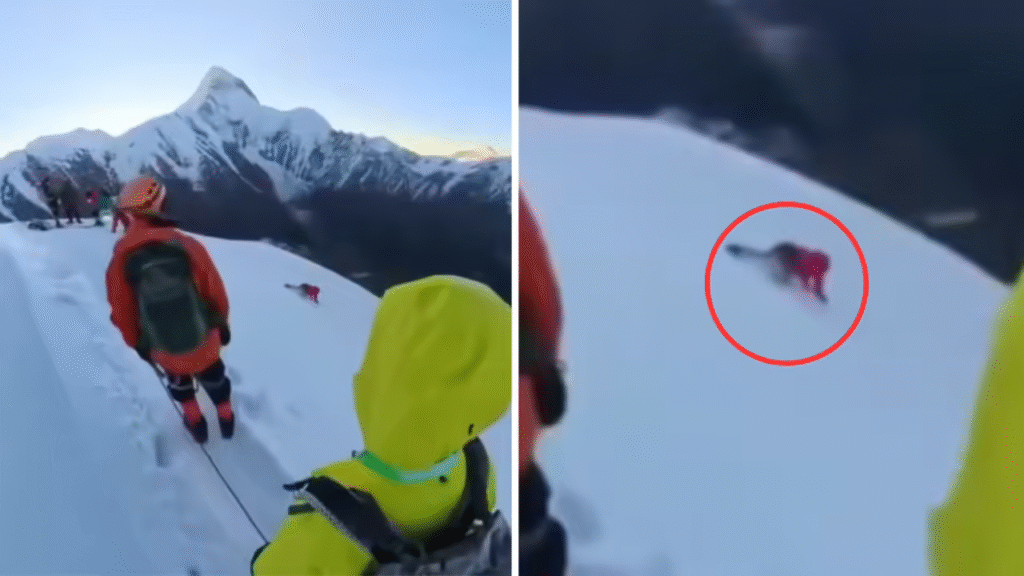
The sequence of events leading to Hong’s death began on the morning of September 25, as his hiking group approached the summit ridge of Mount Nama. According to reports from Chinese media outlet Red Star News, Hong, a resident of Xiaojin County, was assisting fellow hikers by positioning himself to photograph them against the snow-draped backdrop. To achieve a better angle, he unclipped his safety rope—a critical lifeline tethering climbers to anchors on icy slopes—and removed his crampons, the spiked metal plates essential for traction on frozen ground.
Eyewitnesses described the moment as routine at first. Hong, standing near a narrow crevasse, adjusted his stance to frame the shot. However, as he attempted to stand upright after kneeling, he tripped over the discarded crampons. The slip was instantaneous; without the rope’s restraint or the crampons’ grip, he lost balance and began sliding uncontrollably down the 30-degree icy incline. Video footage, recorded by a group member and later verified by authorities, shows Hong flailing briefly before vanishing over the edge of the crevasse, falling approximately 200 meters onto rocky terrain below at around 5,300 meters elevation.
The fall lasted mere seconds but covered a devastating distance. Initial assessments indicate Hong struck the slope multiple times during the descent, sustaining unsurvivable injuries from blunt force trauma and exposure. He was not equipped with an ice axe at that moment, which might have allowed him to self-arrest—a technique where climbers dig the axe into the ice to halt a slide. By the time fellow hikers could react, shouting warnings and attempting to deploy rescue gear, it was too late. The group radioed for help immediately, but the isolation of the peak delayed professional response.
Read : Chaos After Hundreds of Drones Malfunction Mid-Air During Fireworks Show in China’s Liuyang City
This was Hong’s first ascent of Mount Nama, as confirmed by a cousin who spoke to local media. The relative noted that Hong, an occasional climbing enthusiast with only an assistant’s certificate from the Sichuan Mountaineering Association, was not a seasoned guide despite some online speculation. He had joined the expedition for the challenge and scenic allure, unaware that a momentary lapse in judgment would end his life. The video’s circulation has amplified the horror, with millions viewing the clip across platforms, prompting debates on whether such graphic content should be shared or restricted to aid investigations.
Died because of a selfie — a tourist lost his life while climbing Mt. Nama Feng in China's Sichuan
— RT (@RT_com) September 27, 2025
He unclipped his safety harness to take a pic, slipped on the ice, plummeting into the abyss
Fellow climbers could only watch in horror as he futilely scrambled to stop his fall pic.twitter.com/bAr9vzrkYo
Authorities from the Kangding Municipal Education and Sports Bureau arrived on site within hours, coordinating with the local fire department and mountaineering rescue teams. The recovery operation involved helicopters for aerial surveys and ground teams roped together to navigate the same hazards that claimed Hong. His body was airlifted to a staging area and then transported by vehicle to Gongga Mountain Town, where forensic examination confirmed death by traumatic injuries consistent with a high-velocity fall. No other group members were injured, though several reported symptoms of acute mountain sickness, complicating the emotional toll.
The bureau’s preliminary report emphasized that the incident stemmed from multiple safety breaches. Hong’s decision to untie the rope violated standard protocols, which mandate remaining clipped in at all times on exposed sections. Removing crampons on uneven ice further compounded the risk. As one official stated bluntly, “If the crampons had not been removed and the rope had not been undone, this might not have happened.” This quote, echoed in multiple investigations, encapsulates the preventable nature of the tragedy, fueling calls for stricter enforcement of guidelines.
Mount Nama: Beauty and Peril in Sichuan’s High Peaks
Mount Nama, often overshadowed by its parent peak Gongga Shan—China’s highest at 7,556 meters—presents a formidable yet alluring challenge for trekkers. Situated in the Hailuogou National Park within Sichuan Province, the 5,588-meter sub-peak forms part of the Greater Gongga range, a UNESCO-recognized biodiversity hotspot blending alpine meadows, glaciers, and coniferous forests. Its eastern Tibetan Plateau location exposes climbers to rapid weather shifts, with temperatures plummeting to -20°C even in late summer, and oxygen levels dropping to half those at sea level.
The route to Nama’s summit typically spans three to five days, starting from the trailhead at Moxi Town. Hikers traverse wooden bridges over glacial streams, ascend through rhododendron thickets, and culminate in a technical glacier crossing requiring ropes, harnesses, and ice gear. Permits are mandatory, obtainable through the park authority, and groups must file itineraries with rangers to enable tracking. Despite these rules, enforcement remains inconsistent in this vast 1,300-square-kilometer park, which sees over 200,000 visitors annually, many underprepared for the altitude’s physiological demands.
Geologically, Nama’s slopes are a mix of compacted snow, seracs, and hidden fissures, where a single misstep can trigger avalanches or drops into abyssal crevasses. Historical data from the China Mountaineering Association records at least 15 fatalities on Gongga sub-peaks since 2020, with falls accounting for 60% of incidents. Common causes include inadequate acclimatization—leading to impaired judgment—and equipment failures, though human error like Hong’s dominates recent cases. The peak’s popularity surged post-pandemic, as domestic tourism boomed, drawing urban adventurers ill-equipped for its grade III-IV difficulty rating.
Environmental factors played a subtle role in Hong’s accident. Late September marks the transition to winter, with fresh snow masking underlying ice hardness. Wind speeds that day reached 40 km/h, eroding footholds and heightening slip risks. Climate change exacerbates these dangers; retreating glaciers have destabilized routes, increasing crevasse exposure by 20% over the past decade, per park monitoring. Yet, Nama’s allure persists: panoramic views of the Yarlung Tsangpo precursor river and endemic flora like the Gongga azalea make it a social media magnet, ironically contributing to risk-taking for that perfect shot.
For aspiring climbers, experts recommend a minimum of 10 days for acclimatization, starting at 2,500 meters. Essential gear includes via ferrata kits for fixed lines, GPS beacons for location, and satellite phones for comms. Local guides, certified by the association, charge around 1,500 yuan per day and provide invaluable route beta. Despite the hazards, regulated tourism has boosted Sichuan’s economy by 15% in adventure sectors, but incidents like this strain resources, diverting funds from conservation to emergency responses.
Investigation and Safety Warnings: Lessons from a Preventable Loss
The probe into Hong’s death, led by the Kangding Bureau and Sichuan Mountaineering Association, has uncovered systemic lapses beyond the individual’s actions. Foremost, the group operated without required climbing permits or prior notification to authorities—a violation under China’s 2023 Outdoor Sports Regulations. These mandate 48-hour advance filings for peaks over 5,000 meters, including participant lists and emergency plans. The absence of such documentation delayed initial response by 90 minutes, as rescuers lacked precise coordinates.
Association officials clarified Hong’s credentials: his assistant certificate qualified him for support roles but not leading expeditions. Online rumors portraying him as a pro guide were debunked, emphasizing that unqualified leadership amplifies group risks. Interviews with survivors revealed inconsistent gear checks; while most wore harnesses, not all verified anchors before proceeding. The bureau plans to audit 50 similar groups in the region, potentially imposing fines up to 10,000 yuan for non-compliance.
Broader implications extend to national policy. Sichuan, home to 40% of China’s high peaks, reported 28 mountaineering deaths in 2024, up 12% from prior years. Officials attribute this to a post-COVID surge in solo and semi-organized treks, often bypassing commercial outfits. In response, the province is piloting drone surveillance on popular routes and mandatory safety apps that log vital signs. A hotline for real-time reporting launches next month, aiming to cut response times by 30%.
Experts stress education as key. The International Climbing and Mountaineering Federation advocates “leave no trace” ethics alongside technical training, urging climbers to prioritize “summit or send it home alive.” For selfies, designated safe zones with railings are proposed for Nama’s viewpoints. Hong’s family, while mourning, has urged public awareness campaigns, noting his passion for the outdoors made him vulnerable to its seductions.
This tragedy, while heartbreaking, offers actionable insights. Climbers must treat every step as irrevocable; ropes are not optional, and photos can wait. As investigations conclude, expect tighter controls, but the onus remains personal—respect the mountain, or it claims another soul.
I simply couldn’t go away your website before suggesting that I extremely loved the usual information a person provide to your guests? Is going to be back steadily to investigate cross-check new posts
Yay google is my queen assisted me to find this great web site! .
I very lucky to find this internet site on bing, just what I was searching for : D as well saved to favorites.