
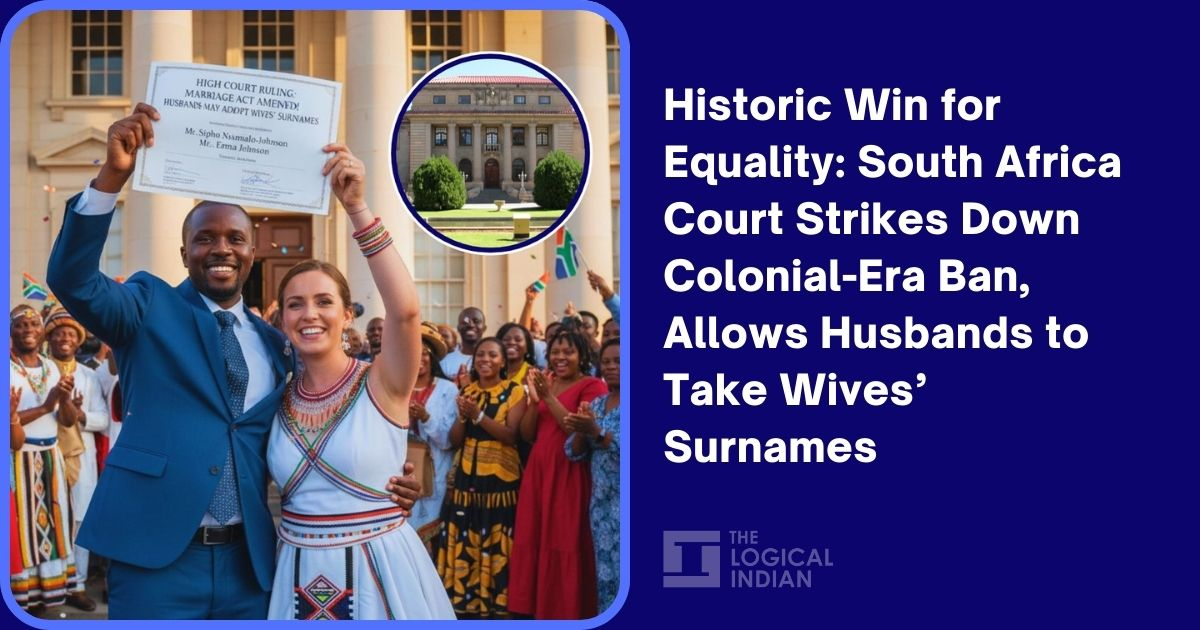
In a groundbreaking decision that underscores South Africa’s commitment to gender equality, the Constitutional Court has ruled that Husbands Can Take Wives’ Surnames upon marriage. Delivered on September 11, 2025, in Bloemfontein, this landmark judgment strikes down provisions in the Births and Deaths Registration Act of 1992 that previously barred men from making such changes. The ruling, which declares these sections unconstitutional, represents a significant step toward dismantling patriarchal norms embedded in the country’s legal framework.
It comes at a time when global conversations around gender roles in marriage are gaining momentum, and South Africa’s progressive constitution, adopted in 1994 at the end of apartheid, once again proves its transformative power. This decision was the culmination of a legal challenge brought by two couples who faced bureaucratic hurdles in their personal choices. For years, South African law allowed women to take their husbands’ surnames or hyphenate them, but the reverse was not permitted for men.
This asymmetry was rooted in colonial-era customs, a fact the court explicitly highlighted in its judgment. By invalidating the discriminatory clauses, the Constitutional Court not only affirms the right to equality under Section 9 of the Constitution but also challenges long-standing stereotypes about marital identity. The ruling suspends the declaration of invalidity for 24 months to allow Parliament to amend the legislation, ensuring a smooth transition. In the interim, a temporary provision has been read into the law, enabling both spouses to apply for surname changes on equal terms.
The implications of this ruling extend far beyond the immediate parties involved. It signals a broader societal shift toward recognizing individual autonomy in personal matters, particularly in a nation still grappling with the legacies of colonialism and apartheid. As South Africa continues to evolve as a beacon of constitutional democracy in Africa, this judgment reinforces the judiciary’s role in upholding human dignity and non-discrimination. In the following sections, we delve deeper into the origins of the case, the historical context that shaped the outdated law, and the potential ripple effects on South African society.
The Legal Battle: Two Couples Challenge Patriarchal Norms
The path to this historic ruling began with the personal stories of two couples whose desires to align their surnames after marriage clashed with rigid legal barriers. The first couple, Jana Jordaan and Henry van der Merwe, sought to honor Jordaan’s family legacy. As an only child whose parents had passed away when she was young, Jordaan wished to preserve her surname, and her husband wanted to adopt it as his own to strengthen their familial ties.
However, when they approached the Department of Home Affairs, they were informed that the system did not permit men to assume their wives’ surnames. Undeterred, van der Merwe applied under Section 26(1) of the Births and Deaths Registration Act, which governs surname amendments, but his request was denied due to the gender-specific wording of the law. The second couple, Jess Donnelly-Bornman and Andreas Nicolaas Bornman, faced a similar obstacle but with a twist: they wanted to hyphenate their surnames to create a combined identity—Donnelly-Bornman for both.
Bornman, like van der Merwe, was barred from making this change, as the regulations under the Act explicitly allowed only women to add or adopt their husband’s surname post-marriage. This couple argued that the law’s failure to provide reciprocal options for men perpetuated inequality and infringed on their rights to dignity and equality as enshrined in Sections 9 and 10 of the Constitution. These couples initially succeeded in the Free State Division of the High Court in September 2024, where the judge declared the relevant provisions—specifically sections 26(1)(a) to (c) of the Act and Regulation 18(2)(a) of the 2014 Regulations on the Registration of Births and Deaths—unconstitutional.
Read : Africa: Exploring the Continent of Contrasts
The High Court ordered the Department of Home Affairs to update its records accordingly. However, for such a declaration to have nationwide effect, it required confirmation from the Constitutional Court, South Africa’s apex judicial body. The case was heard on March 4, 2025, giving the justices ample time to deliberate on the broader constitutional implications. Notably, the government did not oppose the application. Minister of Home Affairs Leon Schreiber and Minister of Justice and Constitutional Development Mamoloko Kubayi both conceded that the law was outdated and inconsistent with modern values of equality.
Read : Ethno-shock! Missing Kaura Taylor Found Living Among Remote African-Origin Community in Scotland
They agreed to abide by whatever decision the court made, signaling a rare instance of executive alignment with progressive reform. Adding weight to the couples’ arguments was the intervention by the Free State Society of Advocates, a legal body that joined the case in support. The advocates contended that the law entrenched harmful gender stereotypes by denying men a choice readily available to women, thereby reinforcing patriarchal structures that the post-apartheid Constitution sought to eradicate.
In its unanimous judgment, penned by a panel of Constitutional Court justices, the court affirmed the High Court’s findings. It declared the impugned sections invalid, emphasizing that they discriminated on the basis of gender without any justifiable purpose. The court also issued interim relief by “reading in” provisions to Section 26(1), allowing married individuals of any gender to apply for surname changes. Furthermore, the couples’ specific requests were granted: van der Merwe’s surname was changed to Jordaan, and Bornman’s was updated to Donnelly-Bornman.
This not only resolved their individual grievances but set a precedent for future cases, ensuring that personal identity choices in marriage are no longer dictated by outdated gender roles. The legal battle highlights the accessibility of South Africa’s judicial system for ordinary citizens challenging systemic inequalities. By leveraging constitutional rights, these couples transformed a personal issue into a national conversation on equality. ‘
Their perseverance underscores the vitality of the Constitution as a living document, capable of addressing evolving societal needs. As the ruling takes effect pending legislative amendments, it serves as a reminder that justice in South Africa is not just about laws on paper but about their equitable application in everyday life. This case exemplifies how grassroots activism, supported by legal expertise, can drive meaningful change, inspiring other nations to examine their own marital naming conventions.
Historical Roots: From African Traditions to Colonial Imposition
To fully appreciate the significance of the Constitutional Court’s ruling, it is essential to trace the historical origins of the surname law it overturned. The practice of women adopting their husbands’ surnames upon marriage is not indigenous to South Africa but a “colonial import,” as the court aptly described it. Prior to European colonization, many African cultures in the region operated under matrilineal or clan-based naming systems.
Women typically retained their birth names after marriage, and children often inherited their mother’s clan name, reflecting the central role of maternal lineages in identity and inheritance. This system emphasized communal ties and gender parity in familial nomenclature, without the hierarchical imposition seen in Western traditions. The shift occurred with the arrival of European colonizers and Christian missionaries in the 17th and 18th centuries. Drawing from Roman-Dutch law, which itself was influenced by patriarchal European customs, the colonizers introduced the norm that a wife must take her husband’s surname.
This was not merely a naming convention but a symbol of male dominance, aligning with broader colonial efforts to impose Western values on indigenous societies. Under Dutch and later British rule, these practices were codified into South African common law, entrenching gender inequality. During the apartheid era (1948-1994), such laws were further solidified as part of the white-minority government’s strategy to maintain patriarchal control, often intersecting with racial segregation to subjugate both women and non-white populations.
The Births and Deaths Registration Act of 1992, enacted during the twilight of apartheid, inherited these discriminatory elements without reform. Section 26 allowed married women to assume or hyphenate their husband’s surname but provided no equivalent for men. This one-sided provision mirrored the societal expectation that marriage transferred a woman’s identity to her husband’s lineage, reinforcing notions of women as appendages rather than equals. The associated regulations compounded this by failing to recognize changes in a man’s marital status for surname purposes, effectively sidelining male agency in family naming.
The Constitutional Court’s judgment meticulously unpacked this history, noting how colonial imposition disrupted pre-existing African traditions. Justices highlighted that the law’s persistence post-1994 contradicted the Constitution’s founding principles of equality and dignity. By labeling it a “colonial import,” the court invoked the spirit of decolonization that has animated South African jurisprudence since the democratic transition. This ruling aligns with previous decisions, such as those challenging customary laws that disadvantaged women in inheritance or marriage, further eroding apartheid’s lingering shadows.
Understanding this historical context reveals why the ruling is more than a technical adjustment—it’s a reclamation of cultural sovereignty. In a country as diverse as South Africa, with 11 official languages and myriad ethnic groups, naming practices are deeply tied to identity. The judgment empowers individuals to choose names that resonate with their heritage, whether matrilineal or otherwise, free from imposed colonial legacies.
It also prompts reflection on other areas of law still tainted by historical biases, urging ongoing reform. As Parliament drafts amendments within the 24-month suspension period, lawmakers must ensure the new framework is inclusive, perhaps incorporating options for cultural or clan-based naming to honor indigenous practices. This historical lens not only validates the couples’ victory but positions the ruling as a pivotal moment in South Africa’s journey toward true equality.
Broader Implications: Advancing Gender Equality in Modern South Africa
The Constitutional Court’s decision to allow husbands to take their wives’ surnames carries profound implications for gender equality, family dynamics, and societal norms in South Africa. At its core, this ruling dismantles a key pillar of patriarchy by granting marital partners symmetrical rights over their identities. No longer will the law presume that a wife’s surname must yield to her husband’s; instead, couples can negotiate naming choices based on mutual respect and personal significance.
This shift challenges the traditional view of marriage as a transfer of identity from woman to man, promoting a more egalitarian model where both spouses’ heritages are valued equally. In practical terms, the judgment affects thousands of South Africans annually. With marriage rates remaining steady despite economic challenges, many couples will now have the freedom to hyphenate, adopt, or retain surnames without gender bias.
For instance, in cases like the Bornmans’, where dual surnames symbolize unity, the law now facilitates such expressions. This could lead to greater family cohesion, as children might inherit blended or maternal surnames, reflecting diverse parental influences. Moreover, it addresses dignity concerns for individuals like van der Merwe, who sought to honor his wife’s family, underscoring that personal autonomy in naming is a fundamental human right.

On a societal level, the ruling fosters cultural revival by acknowledging pre-colonial African naming traditions. In communities where matrilineal systems prevail, such as among the Xhosa or Zulu, this decision validates women’s central role in lineage. It could encourage broader discussions on gender roles, potentially influencing related areas like inheritance laws or parental rights. Critics might argue that surname changes are trivial compared to issues like gender-based violence, but the court recognized them as interconnected: entrenched stereotypes fuel broader inequalities. By striking down discriminatory laws, South Africa sends a message that equality starts with everyday choices.
Internationally, the ruling positions South Africa as a leader in progressive family law. While countries like the United States or United Kingdom allow flexible naming (though with varying bureaucratic hurdles), few have explicitly confronted colonial legacies in this way. This could inspire reforms elsewhere, particularly in former colonies grappling with similar patriarchal remnants. Domestically, it bolsters the Constitution’s reputation, reminding citizens of its role in transformative justice. As Parliament amends the Act, civil society groups may push for even more inclusive provisions, such as non-binary options or simplified processes for all citizens.
However, implementation challenges loom. The Department of Home Affairs must update its systems and train officials to handle new applications, avoiding the delays that plagued the original couples. Public education campaigns will be crucial to inform citizens of their rights, especially in rural areas where traditional norms persist. Reactions have been largely positive, with legal experts hailing it as a win for dignity, though some conservative voices decry it as eroding family structures. A South African lawyer, Juliet Hlatswayo, humorously noted that “men want us to marry them” now, reflecting lighthearted optimism.
Ultimately, this ruling is a testament to South Africa’s evolving democracy. It empowers individuals to define their identities free from historical constraints, paving the way for a more just society. As the nation marks this milestone, it reaffirms that true equality requires vigilance and reform, ensuring that the Constitution’s promise extends to every aspect of life.
References:
Holland casino vacatures
References:
https://raindrop.io/clauscanada9/frantzenwatts7697-68535576
References:
What steroids look like
References:
https://git.van-peeren.de/sabinaestep319/sabina2022/wiki/Why-Dianabol-may-cause-lower-back-pain-and-what-should-you-do%EF%BC%9F
References:
Choctaw casino pocola
References:
http://bioimagingcore.be/q2a/user/beechjason4
References:
Biggest steroid bodybuilder
References:
https://www.grenzlandgruen.de/Blog;focus=TKOMSI_com_cm4all_wdn_Flatpress_22892279&path=&frame=TKOMSI_com_cm4all_wdn_Flatpress_22892279?x=entry:entry230225-064340%3Bcomments:1
References:
How many people use steroids
References:
https://video.silverwolfstudios.com/@cathymckie717?page=about
References:
Benefits of steroids in sports
References:
http://121.41.2.71:3000/isispartlow661/howeasynetwork.com3815/wiki/Ventipulmin-0%2C025-mg-ml-Gel-zum-Eingeben-f%C3%BCr-Pferde%3A-Gebrauchsinformation%2C-Dosierung-%26-Effets