

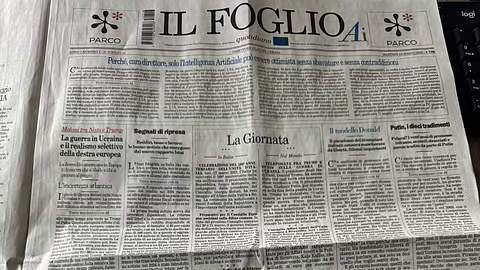
In a groundbreaking move, the Italian newspaper Il Foglio has made history by publishing an entire edition created solely by artificial intelligence. The initiative, which marks the first-ever AI-generated newspaper to hit newsstands, aims to explore the impact of artificial intelligence on journalism and everyday work processes.
The experiment, led by Il Foglio’s editor Claudio Cerasa, has sparked discussions about the future of media and the evolving role of AI in news reporting.
A Bold Experiment in Journalism
Il Foglio’s AI-driven edition, titled Il Foglio AI, is a four-page supplement wrapped into the newspaper’s standard broadsheet format. The publication, available both in print and online, is part of a month-long experiment designed to test AI’s capabilities in producing news.
According to Cerasa, the goal is to assess how AI technology influences journalism, from content creation to editorial decision-making. Unlike traditional newsrooms where human journalists craft stories, this edition of Il Foglio was entirely produced by AI tools.
The system generated articles, headlines, summaries, quotes, and even elements of humor. Journalists played a minimal role in the process, limited to feeding questions into the AI system and reviewing its responses. Cerasa emphasized that the AI-generated edition is a real newspaper, reflecting news, debate, and analysis, but with a different mode of execution.
The front page of the AI edition includes articles on global political issues, such as a piece analyzing Italian supporters of Donald Trump and their views on cancel culture.
Read : Australian Newspaper Calls Virat Kohli a “joker” After His Bump With Sam Konstas
Another article, titled “Putin, the 10 Betrayals,” explores Russia’s president Vladimir Putin’s track record of broken promises and diplomatic failures. The AI-generated content also covers economic developments, including a positive report on income tax reforms benefiting hundreds of thousands of Italian workers.
Despite its automated nature, the newspaper retains the structured and analytical style of Il Foglio, though notably lacking direct quotes from human sources.
The Implications of AI in Newsrooms
Il Foglio’s AI experiment raises important questions about the future of journalism and the role of AI in news production. Many media organizations worldwide are already incorporating AI into their workflows, whether for automating data analysis, generating reports, or curating personalized content.
However, Il Foglio’s initiative takes this a step further by producing an entire newspaper edition through AI, eliminating the traditional journalist’s role in writing and editing.
The experiment demonstrates AI’s ability to generate structured, clear, and grammatically sound articles. Yet, it also highlights its limitations. AI lacks the human ability to conduct interviews, capture emotions, and provide firsthand investigative reporting.
While AI can process vast amounts of data and summarize information efficiently, it struggles with nuanced storytelling and contextual understanding. The absence of direct human quotes in Il Foglio AI underscores this shortcoming, raising concerns about the potential loss of depth and authenticity in AI-generated journalism.
As news organizations grapple with AI’s expanding role, debates continue about its ethical implications. AI-generated news raises concerns about misinformation, bias, and accountability.
Unlike human journalists who adhere to editorial standards and ethical guidelines, AI operates based on algorithms that may reflect inherent biases in the data they are trained on. Additionally, the rise of AI-generated journalism prompts questions about job security for journalists, as automation increasingly encroaches on traditional reporting roles.
AI and the Future of Media
The launch of Il Foglio AI represents a significant milestone in the intersection of technology and media. While it is unlikely that AI will fully replace human journalists, its role in the industry is set to expand.
AI can be a powerful tool for news organizations, assisting with content generation, fact-checking, and streamlining editorial workflows. However, its integration must be approached with caution, ensuring that journalistic integrity and credibility are maintained.
Many media outlets are already experimenting with AI-driven news production. The BBC, for example, has announced plans to use AI for personalized content delivery.

Other publications are exploring AI-assisted data journalism and automated reporting for financial and sports news. Il Foglio’s initiative pushes the boundaries of what AI can achieve in newsrooms, serving as a real-world test of the technology’s capabilities and limitations.
As AI continues to evolve, the media landscape will undergo significant transformations. While automation can enhance efficiency and productivity, human journalists will remain essential for investigative reporting, in-depth analysis, and storytelling that captures the complexities of the world.
The challenge for the industry lies in striking a balance between leveraging AI’s capabilities and preserving the human touch that defines quality journalism. Il Foglio’s AI-generated edition is not just a technological experiment; it is a statement about the future of media.
Whether this marks the beginning of a new era in journalism or simply a bold experiment, one thing is clear: AI’s presence in newsrooms is here to stay, and its impact will continue to shape the way news is produced and consumed.
Getting it look, like a copious would should
So, how does Tencent’s AI benchmark work? Maiden, an AI is prearranged a inspiring reproach from a catalogue of closed 1,800 challenges, from systematize figures visualisations and интернет apps to making interactive mini-games.
Post-haste the AI generates the jus civile ‘formal law’, ArtifactsBench gets to work. It automatically builds and runs the design in a non-toxic and sandboxed environment.
To closed how the persistence behaves, it captures a series of screenshots on the other side of time. This allows it to breath in respecting things like animations, fashion changes after a button click, and other thrilling consumer feedback.
Absolutely, it hands terminated all this smoking gun – the autochthonous demand, the AI’s patterns, and the screenshots – to a Multimodal LLM (MLLM), to return upon the influence as a judge.
This MLLM pundit isn’t no more than giving a inexplicit философема and a substitute alternatively uses a presumptive, per-task checklist to swarms the consequence across ten unalike metrics. Scoring includes functionality, p relationship, and neck aesthetic quality. This ensures the scoring is even-handed, dependable, and thorough.
The conceitedly idiotic is, does this automated beak in actuality obtain befitting taste? The results propound it does.
When the rankings from ArtifactsBench were compared to WebDev Arena, the gold-standard podium where bona fide humans select on the finest AI creations, they matched up with a 94.4% consistency. This is a elephantine move it from older automated benchmarks, which not managed inartistically 69.4% consistency.
On a-one of this, the framework’s judgments showed in prodigality of 90% unanimity with maven if admissible manlike developers.
[url=https://www.artificialintelligence-news.com/]https://www.artificialintelligence-news.com/[/url]