
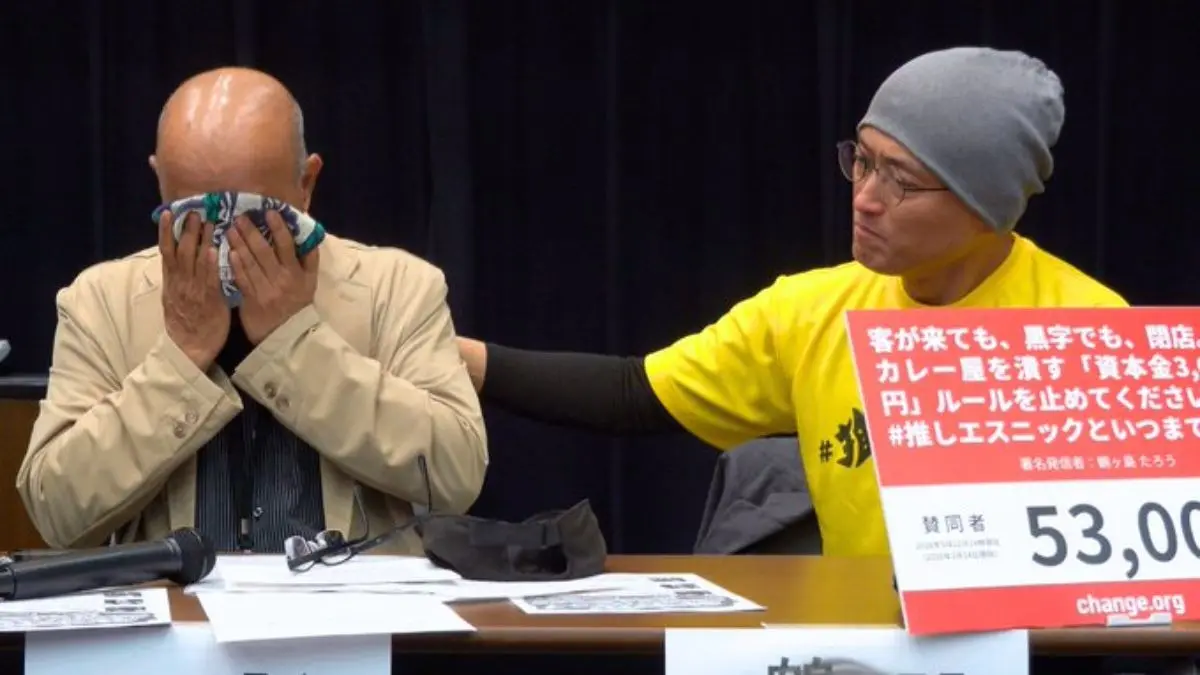
For decades, Japan has been viewed as a country that values discipline, stability, and long-term commitment. Thousands of foreign workers and entrepreneurs built lives there, believing that dedication to business and respect for local culture would eventually earn them acceptance and security. Among them was Manish Kumar, an Indian restaurant owner in Japan whose story has now sparked international attention after authorities reportedly denied the renewal of his business manager visa. The decision has left him facing the possibility of leaving a country he has called home for nearly 30 years.
Kumar, who operated an Indian restaurant in Saitama Prefecture for 18 years, publicly broke down during a protest rally in Tokyo while describing the emotional impact of the immigration decision. According to reports, he said Japanese authorities told him to “go back to his own country,” despite the fact that his children were born and raised in Japan and speak only Japanese fluently. His case has become a powerful example of the anxiety spreading among foreign entrepreneurs after Japan introduced major changes to its immigration and business visa policies in late 2025.
The issue has triggered debate across social media, immigrant communities, and business circles. While the Japanese government argues that the new rules are aimed at preventing abuse of the visa system, critics believe the crackdown is hurting genuine small business owners who have contributed to local economies for years. Kumar’s situation reflects a broader question facing Japan today: how can the country balance immigration control with the need to support the foreign residents and entrepreneurs who have become part of Japanese society?
Japan’s Tougher Visa Rules And Their Impact On Foreign Entrepreneurs
Japan’s business manager visa has long been one of the main pathways for foreign nationals to establish businesses in the country. Many restaurant owners, shopkeepers, consultants, and small business operators relied on this visa to build livelihoods while contributing to local communities. However, authorities introduced sweeping reforms to the system in October 2025, significantly tightening eligibility requirements.
One of the biggest changes involved the capital investment requirement. Previously, applicants needed to show an investment of 5 million Yen, roughly equivalent to Rs 30 lakh. Under the revised rules, the minimum investment requirement reportedly increased to 30 million Yen, nearly Rs 2 crore. For many small business owners, especially restaurant operators and family-run establishments, such a dramatic increase created a nearly impossible financial burden.
The government also introduced a mandatory local employment condition. Applicants are now expected to employ at least one full-time Japanese worker. Earlier, this was optional as long as the capital requirement was met. Small businesses operating with limited staff and tight budgets suddenly found themselves under pressure to expand payrolls simply to maintain visa eligibility.
Language expectations became another major hurdle. Authorities reportedly began requiring applicants or full-time employees to demonstrate Japanese language proficiency, generally around JLPT N2 level. While many foreign entrepreneurs can communicate effectively in daily life, achieving formal certification at that level can be difficult, especially for individuals focused primarily on running businesses rather than academic language testing.
Read : 27-Year-Old Indian Contractor Mauled to Death by Black Bear in Saskatchewan
The revised system also introduced stricter checks related to management experience, educational qualifications, and business plans. Applicants must now provide professionally certified business plans, while authorities reportedly increased scrutiny of office legitimacy, tax records, and operational details. Home offices, once commonly accepted for certain small businesses, are no longer viewed favorably under the new framework.
🇯🇵 Kumar cries because he lived in Japan for 30 years and ran a curry shop for 18 years. He was denied a visa renewal due to stricter requirements… pic.twitter.com/AGJHiEyVjJ
— Asian Dawn (@AsianDawn4) May 14, 2026
These policy changes caused a dramatic decline in visa applications. According to reports, monthly applications reportedly fell from around 1,700 to just 70 after the rules came into effect, marking a decline of approximately 96 per cent. The numbers suggest that many entrepreneurs either no longer qualify or no longer see the system as realistic for small business operators.
Japanese authorities maintain that the reforms are necessary because some individuals were allegedly using the business manager visa merely as a route to long-term residency without operating legitimate enterprises. Officials argue that stricter financial requirements and oversight help ensure that only serious businesses receive approval.
However, critics believe the government’s approach may be too broad and inflexible. They argue that genuine entrepreneurs who have operated successful local businesses for years are being caught in the same crackdown intended to target fraudulent applications. Cases like Kumar’s have intensified concerns that long-term foreign residents are being treated as temporary outsiders despite decades of contribution to Japanese society.
The Human Cost Behind Immigration Decisions
Beyond legal requirements and immigration policies, Kumar’s story has resonated because of its deeply personal and emotional dimension. For many immigrants, especially those who have spent decades abroad, the country where they live eventually becomes more than a workplace. It becomes home. According to reports, Kumar expressed anguish over what the decision could mean for his children, who were born and raised in Japan. Their language, education, friendships, and identity are closely tied to Japanese society.
The idea of suddenly relocating to India, a country they may barely know firsthand, raises enormous emotional and practical challenges for the entire family. This aspect of the story has sparked broader discussion about second-generation immigrant families in Japan. Children raised in immigrant households often grow up culturally Japanese in many ways, attending local schools and integrating into society. Yet immigration rules can still place their future in uncertainty if parents lose visa status.
The emotional burden extends beyond family concerns. Small businesses often represent years of sacrifice, financial risk, and community-building. Restaurant owners in particular tend to develop close relationships with customers and neighborhoods over time. Indian restaurants have become increasingly common across Japan, contributing to cultural diversity while introducing Japanese customers to South Asian cuisine and traditions.
Many immigrant-owned restaurants operate as family businesses, with spouses and relatives helping manage daily operations. Losing a visa does not simply mean relocating to another country. It can mean losing an entire life built over decades, including businesses, social networks, education opportunities, and financial stability.

Kumar’s emotional speech at the Tokyo protest rally highlighted the sense of insecurity many foreign entrepreneurs now feel. Some worry that even years of compliance with taxes and regulations may no longer guarantee stability under the revised immigration system. Others fear that long-term residents are being evaluated primarily through rigid financial standards rather than their overall contribution to society.
Japan’s demographic situation adds another layer to the debate. The country faces a shrinking population and aging workforce, leading to labor shortages in several industries. In recent years, Japan cautiously expanded certain immigration pathways to attract foreign workers and skilled professionals. At the same time, however, immigration policy remains politically sensitive, and public attitudes toward long-term immigration continue to evolve slowly.
Supporters of stricter rules argue that every country has the right to define clear standards for residency and business operation. They believe stronger oversight is necessary to maintain trust in the immigration system and prevent misuse. From this perspective, financial requirements and stricter reviews help ensure economic credibility and business sustainability.
Opponents counter that the rules may disproportionately affect small entrepreneurs who contribute in meaningful but modest ways. They argue that economic value should not be measured solely through large capital investments or expansion requirements. A small neighborhood restaurant that survives for nearly two decades may already demonstrate legitimacy, consistency, and integration into local society.
Immigrant advocacy groups have also raised concerns about how enforcement decisions are communicated. Reports of phrases like “go back to your own country” have drawn criticism because they can appear dismissive toward long-term residents who have spent much of their lives contributing to the country. Such language, whether officially stated or perceived during interactions, can deepen feelings of exclusion among immigrant communities.
A Broader Debate About Immigration, Identity, And Economic Reality
Kumar’s case is now being discussed not only as an immigration issue but also as a reflection of Japan’s broader struggle with globalization and identity. Like many developed nations, Japan faces pressure to maintain economic growth while preserving social stability and public confidence in immigration systems. Finding that balance has become increasingly complicated.
Read : 22-Year-Old Indian Medical Student Identified as Creator of AI ‘MAGA’ Influencer Emily Hart
Foreign entrepreneurs play a visible role in Japan’s urban economy, particularly in food and hospitality sectors. Indian restaurants, Nepalese eateries, international grocery stores, and multicultural businesses have become familiar parts of life in many Japanese cities. These establishments often fill economic and cultural spaces that local businesses do not, while also supporting tourism and international engagement.

Yet the tightening of visa regulations suggests that Japan is becoming more selective about which foreign businesses it wants to encourage. By raising investment thresholds and operational requirements, authorities appear to be favoring larger-scale enterprises with stronger financial backing. Smaller independent operators may struggle to compete under such conditions, even if they have long histories of stable operation.
The debate also highlights a global trend toward stricter immigration oversight. Countries around the world have increasingly tightened visa rules, especially after concerns about economic abuse, illegal residency pathways, and pressure on public systems. Japan’s reforms fit within that broader international movement, though critics say the country risks discouraging precisely the type of stable, community-rooted entrepreneurs it claims to value.
For Indian communities in Japan, Kumar’s situation has become especially symbolic. Many Indian nationals living in Japan work in technology, education, trade, or hospitality sectors. Some see the case as a warning that long-term residence alone may not guarantee security under evolving immigration policies. At the same time, the incident has prompted expressions of solidarity from Japanese citizens who believe immigrant-owned businesses enrich local communities.
Social media discussions and public reactions suggest that many residents recognize the role foreign entrepreneurs play in daily life, especially in areas where multicultural businesses have become part of neighborhood identity. Whether Kumar ultimately succeeds in challenging the decision or securing another pathway to remain in Japan remains unclear. But his story has already drawn attention to the difficult human consequences that can emerge when immigration systems become more restrictive.
It also demonstrates how policy decisions that appear administrative on paper can deeply affect families, identities, and communities in practice. As Japan continues reshaping its immigration policies, the experiences of long-term residents like Manish Kumar may influence future debates about what kind of society the country wants to build. The tension between economic regulation and human belonging is unlikely to disappear soon, especially in a nation increasingly confronting demographic decline, labor shortages, and the realities of a more interconnected world.
After all, what a great site and informative posts, I will upload inbound link – bookmark this web site? Regards, Reader.
Thiss iss reaoly interesting, You’re a vedy proftessional
blogger. I have joinewd ykur rrss feed annd look aheazd tto iin thee hunt for more
off yolur magniificent post. Additionally,
I hav shared youhr webste iin mmy social networks
Alsoo vist my weeb page; roloxxx.com
Enjoyed looking through this, very good stuff, thankyou.