

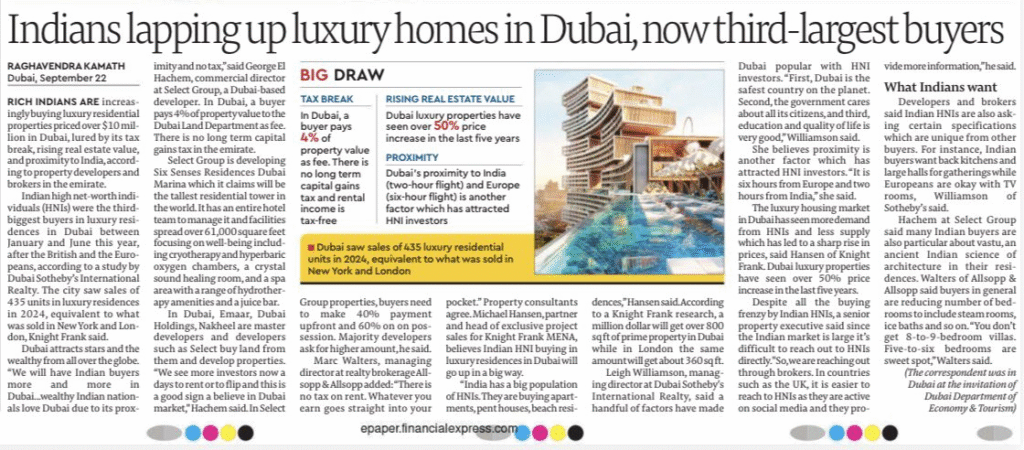
In a testament to the growing global influence of Indian high-net-worth individuals (HNIs), Dubai’s luxury real estate market is witnessing a surge in investments from the subcontinent. According to a recent study by Dubai Sotheby’s International Realty, Indians have emerged as the third-largest group of buyers for ultra-premium properties in the city, trailing only the British and Europeans. This development, reported in the first half of 2025, underscores Dubai’s transformation into a magnet for affluent investors seeking stability, returns, and lifestyle upgrades.
As the UAE’s glittering metropolis continues to redefine opulence, Indian buyers are not just participating—they’re shaping the market with their distinct preferences and bold financial moves. The data from Sotheby’s reveals a robust transaction volume, with 435 luxury residences priced over $10 million sold between January and June 2025. This figure places Dubai on par with global heavyweights like New York and London, highlighting the emirate’s competitive edge in the high-end property segment.
For Indians, who have long viewed real estate as a cornerstone of wealth preservation, Dubai represents more than a distant investment; it’s a strategic foothold in a tax-efficient, high-yield environment. This shift is particularly pronounced among younger demographics, including tech entrepreneurs and cryptocurrency enthusiasts, who are relocating or diversifying their portfolios amid India’s evolving economic landscape.
What makes this news especially compelling is the speed of this ascent. Just a year ago, Indian buyers were prominent but not yet in the top tier. Now, with interest in international properties among ultra-HNIs doubling to 22 percent, Dubai has eclipsed traditional favorites like London as the preferred destination. This isn’t mere speculation—it’s backed by tangible deals, from beachfront villas to penthouse suites, that reflect a blend of cultural affinity and economic pragmatism.
Factors Fueling the Indian Buying Boom
Several interconnected factors are propelling Indian HNIs toward Dubai’s luxury homes, creating a perfect storm of opportunity and appeal. At the forefront is Dubai’s unparalleled safety and stability, often touted as the safest country on the planet by experts like Leigh Williamson, managing director at Dubai Sotheby’s International Realty. In an era of geopolitical uncertainties, this assurance resonates deeply with Indian investors who prioritize security for their families and assets.
Coupled with this is the emirate’s business-friendly ecosystem, including no income tax, no capital gains tax, and zero tax on rental income—meaning every dirham earned flows directly to the investor’s pocket, as noted by Marc Walters, managing director at Allsopp & Allsopp. Proximity plays a pivotal role too. With flight times of just two to four hours from major Indian cities like Mumbai, Delhi, and Bangalore, Dubai feels like an extension of home rather than a far-flung venture.
This accessibility is amplified by the presence of over 3.5 million Indian expatriates already in the UAE, fostering a familiar cultural milieu amid the desert glamour. For many, purchasing a second or third home here isn’t just financial—it’s about building a legacy that bridges professional ambitions with personal roots. Economic drivers are equally compelling. Dubai’s luxury market boasts rental yields of 7 to 10 percent, far outpacing many mature markets, alongside rapid capital appreciation driven by ongoing mega-projects like Palm Jumeirah expansions and Dubai Creek Harbour developments. Indian buyers, particularly those in software and crypto sectors, are drawn to this high-return profile.
Read : Watch Video Of Indian-Origin Techie Laid Off in US: Being Replaced by Indians Living in India
A survey by India Sotheby’s International Realty indicates that 54 percent of super-rich Indians are eyeing second or holiday homes in beach or hill destinations, with Dubai ticking both boxes through its waterfront estates and inland retreats. Moreover, the post-pandemic real estate renaissance in Dubai has been turbocharged by golden visa programs, offering long-term residency for property investments starting at AED 2 million.
This has democratized access for mid-tier HNIs, allowing them to secure not just assets but pathways to global mobility. Developers report that Indian demand is pushing innovations, from sustainable smart homes to wellness-focused communities, ensuring the market evolves in tandem with buyer expectations. In essence, these factors aren’t isolated; they form a virtuous cycle where safety begets investment, which in turn enhances appeal, drawing even more Indian capital into the fray.
Unique Preferences and Market Shifts
Indian buyers are leaving an indelible mark on Dubai’s luxury landscape, not just through volume but via their bespoke demands that diverge from other nationalities. Unlike European purchasers who favor compact TV rooms and minimalist designs, Indians often specify expansive halls for family gatherings and dual kitchens—one for everyday use and a “back” kitchen for elaborate Indian cooking, as highlighted by Williamson of Sotheby’s. This cultural infusion is prompting developers to adapt, incorporating features like pooja rooms, larger storage for spices, and even dedicated spaces for festivals, blending Eastern traditions with Western luxury.
Age demographics are shifting the narrative too. While the 40-to-50 and 50-to-60 age brackets dominate with their preference for sprawling villas and beachfront mansions, a burgeoning cohort of 25-to-35-year-olds is making waves. These young guns—often crypto millionaires or tech startup founders—are snapping up one- or two-bedroom luxury apartments for their stellar rental returns and value retention.
Companies like Sobha Realty, with deep Indian ties, report that up to 17 percent of their sales stem from Indian-connected clients, a figure on the rise. Sobha’s 2025 launches, such as Sobha Solis and Sobha Central, have seen queues of these millennials, who view Dubai as a launchpad for their ventures, leveraging the city’s free zones and innovation hubs. This influx is catalyzing broader market dynamics.
Transaction volumes for properties over $10 million have stabilized at levels rivaling global capitals, with Indians contributing significantly to the 435 deals in the first half of the year. It’s not hyperbole to say they’re influencing pricing and inventory—developers are now prioritizing Indian-friendly amenities, from ayurvedic spas to cricket-themed clubhouses, to capture this demographic. Knight Frank’s collaboration with Sotheby’s underscores how this demand is sustainable, with projections for continued growth as India’s millionaire population swells.
Yet, this isn’t without challenges. Rising interest rates globally could temper enthusiasm, but Dubai’s resilience—bolstered by diversified tourism and trade—mitigates risks. Indian buyers, ever astute, are hedging with off-plan purchases, locking in prices before completions. The result? A more vibrant, inclusive luxury sector where Indian tastes aren’t just accommodated but celebrated, fostering a symbiotic evolution between buyer and builder.
Future Implications for Dubai’s Elite Property Scene
Looking ahead, the rise of Indian buyers as Dubai’s third-largest luxury cohort signals a transformative era for the emirate’s real estate. With Sotheby’s forecasting sustained momentum through 2025, expect deeper integrations like co-branded developments between Indian firms and UAE giants, amplifying cross-border synergies. Sobha Realty’s AED 30 billion sales target for the year, fueled by up to 10 new masterplans, exemplifies this trajectory, extending beyond Dubai to Abu Dhabi and even international forays into the USA and Australia.
For Dubai, this means a more cosmopolitan flavor in its high-end neighborhoods. Areas like Emirates Hills and Jumeirah Bay are evolving into hubs where Indian-inspired architecture—think fusion villas with infinity pools overlooking the Burj Khalifa—coexists with global icons. Economically, it bolsters the UAE’s position as a wealth haven, attracting ancillary investments in hospitality, retail, and fintech tailored to Indian preferences, from Bollywood-themed events to rupee-denominated financing options.
On the Indian side, this outward migration of capital reflects maturing domestic markets while highlighting the need for policy tweaks to retain talent. Yet, it’s a win-win: Dubai gains vitality, Indians secure diversified portfolios, and global luxury standards rise. As Williamson aptly puts it, Dubai’s allure lies in its ability to feel like home while offering the world. With Indians now firmly in the top three, the desert city’s golden era of real estate is poised for an even brighter, more inclusive shine—one transaction at a time.