
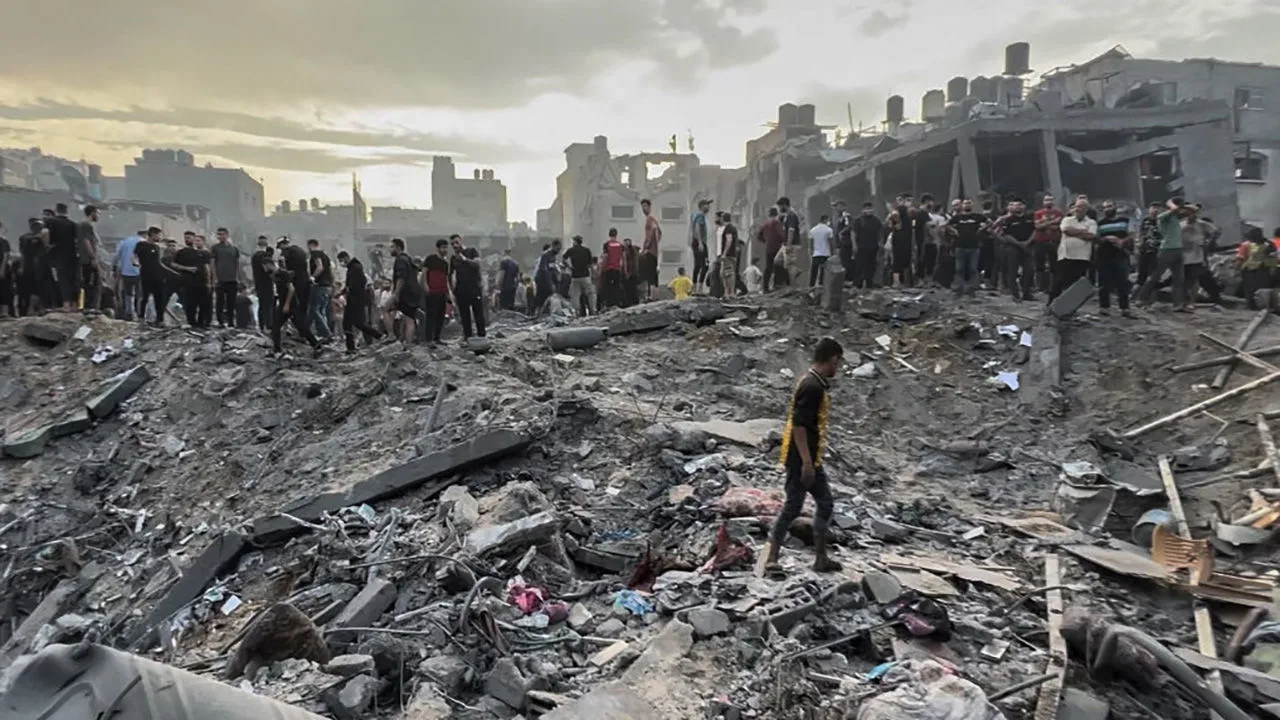
Israeli strikes on a humanitarian zone in Gaza have once again escalated the ongoing conflict, leaving 40 people dead and 60 others injured. The Israeli military stated that its aircraft had targeted significant Hamas terrorists operating within a command and control center embedded inside the humanitarian area in Khan Yunis, located in southern Gaza.
This tragic incident has further deepened the devastation in the region as innocent civilians, including women and children, continue to bear the brunt of the ongoing conflict.
The situation in Gaza has been deteriorating with each passing day, and the Israeli strikes have only added to the misery of displaced Palestinians seeking refuge in what was designated as a safe zone by the Israeli military.
Al-Mawasi, the area struck by Israeli forces, had been considered a shelter for tens of thousands of displaced individuals fleeing other parts of the Gaza Strip. The strike occurred without warning, causing widespread chaos and destruction.
In the aftermath of the Israeli strikes, Gaza’s civil defence agency reported that 40 martyrs were recovered from the debris, with 60 others injured. Many of the wounded were rushed to nearby hospitals, and civil defence officials expressed their concern about those still missing beneath the rubble.
Israeli Strikes Humanitarian Zone in Gaza:
According to civil defence spokesman Mahmoud Basal, at least 15 people remain unaccounted for, as rescuers continue their efforts to recover bodies from the sand and damaged tents.
The attack left deep craters in the ground and destroyed numerous tents in the humanitarian zone, which housed displaced families. Basal mentioned that entire families disappeared under the sand following the assault, making rescue operations even more challenging.
The lack of proper equipment and tools for digging has further hindered efforts to locate the missing individuals. The scale of destruction in the area is immense, with dozens of tents completely obliterated by the force of the Israeli strikes.
The Israeli military defended its actions by stating that the strike was necessary to eliminate Hamas terrorists embedded in the humanitarian area. According to the military, Hamas continues to use civilian and humanitarian infrastructure to conduct terrorist activities against Israel.
The command center, allegedly targeted by the Israeli strikes, was said to be a critical hub for Hamas operations. However, Hamas refuted these claims, stating that no fighters were present in the area and labeling the Israeli allegations as a blatant lie.
This latest episode in the ongoing Israeli strikes against Gaza underscores the complexity of the conflict, where civilians are often caught in the crossfire.
Over the course of the war, Israel has repeatedly accused Hamas of using civilians as human shields, a claim Hamas has consistently denied. Regardless of these allegations, the civilian death toll continues to rise, drawing widespread condemnation from international human rights organizations.
The situation in Gaza has reached a critical point, with humanitarian zones like Al-Mawasi shrinking in size and capacity due to repeated Israeli strikes.
According to the United Nations, the population density in the humanitarian area has skyrocketed, with up to 34,000 people per square kilometer seeking refuge in what was once a safe haven. This shrinking safe zone, coupled with the ongoing conflict, has placed immense pressure on the already overstretched resources and services in Gaza.
The Israeli strikes on Al-Mawasi follow a series of similar operations carried out by Israel in the area. In July, Israeli forces targeted Hamas military chief Mohammed Deif in the same region, leading to the deaths of over 90 people, according to Gaza health officials.
These strikes highlight Israel’s continued efforts to target Hamas leaders and infrastructure, even in areas designated as safe zones for civilians.
The humanitarian crisis in Gaza is exacerbated by the displacement of millions of Palestinians. According to the United Nations, the vast majority of Gaza’s 2.4 million residents have been forced to flee their homes at least once during the nearly year-long war.
The conflict, which began in October, has claimed the lives of over 40,000 people, with women and children constituting a significant portion of the casualties. The UN human rights office has repeatedly called for an end to the violence and for the protection of civilians in Gaza.
International mediation efforts led by the United States, Qatar, and Egypt have so far failed to secure a ceasefire or a hostage-prisoner exchange deal between Israel and Hamas. While Hamas demands a complete Israeli withdrawal from Gaza, Israel maintains that its troops must remain along the Gaza-Egypt border.
These deadlocked negotiations have left little hope for an immediate resolution to the conflict, with both sides entrenched in their positions.
The impact of the Israeli strikes on Gaza’s humanitarian zones has raised concerns among global observers about the potential for further escalation. As the safe zones shrink and the civilian death toll rises, the situation on the ground continues to worsen. The international community has urged both sides to exercise restraint and protect civilians, but the conflict shows no signs of abating.
In the broader context, Israel’s strikes on Gaza are part of its ongoing military offensive in response to the Hamas attack on October 7, which killed over 1,200 people in Israel.
The attack also resulted in the abduction of 251 hostages, 97 of whom remain in captivity. Israel’s retaliatory strikes have caused widespread devastation in Gaza, with homes, schools, and hospitals being destroyed in the process.
The long-standing conflict between Israel and Hamas shows no immediate resolution. As Israeli strikes continue to target areas across Gaza, civilians remain trapped in a cycle of violence, displacement, and fear. The need for a peaceful solution to the conflict is more urgent than ever, as the toll on human lives and infrastructure mounts with each passing day.