
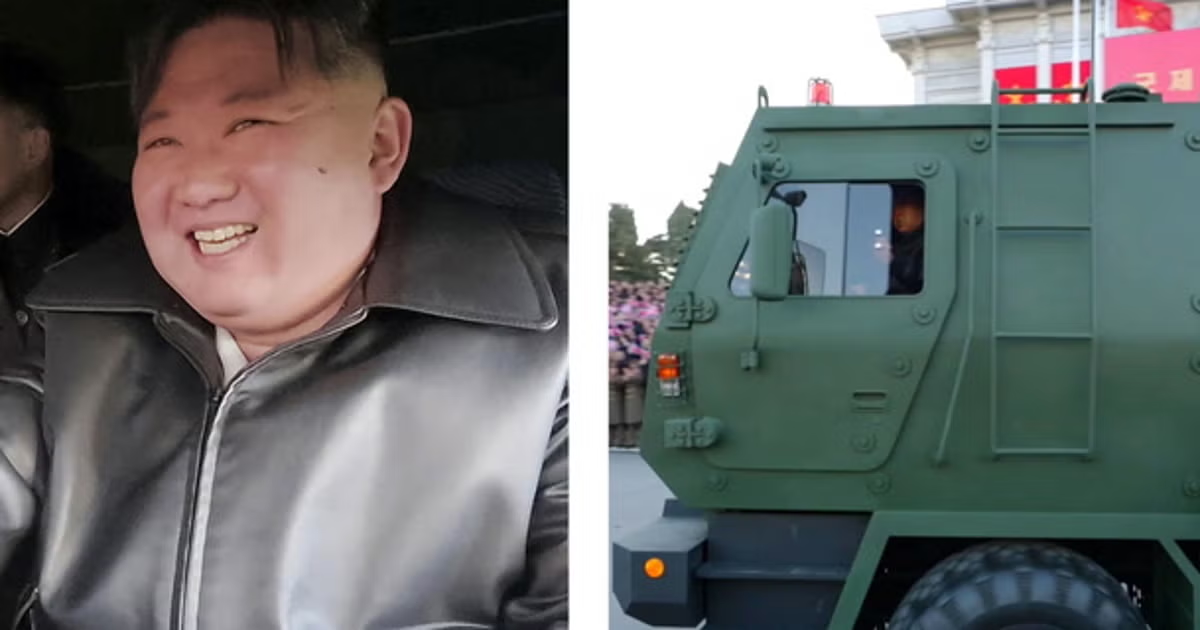
North Korea has once again placed military strength at the center of its national narrative, unveiling what it describes as a major advancement in artillery and strategic strike capability. In a highly choreographed ceremony held in Pyongyang, the country’s leadership presented a newly produced batch of 600mm super-large multiple rocket launchers, framing the event as both a technological milestone and a demonstration of military readiness.
The showcase featured rows of newly built launch vehicles, public celebration by defense industry workers, and a prominent display of political symbolism tied to the ruling party’s future strategic plans. At the center of the event was a carefully staged moment in which the national leader personally climbed into one of the vehicles and drove it across the ceremonial square, reinforcing the message of direct leadership involvement in military modernization.
State media coverage emphasized scale, precision, and deterrence, presenting the system not simply as another artillery platform but as a weapon designed to redefine battlefield dynamics. Official statements highlighted advanced guidance capabilities, artificial intelligence integration, and the potential for strategic mission deployment.
Observers noted that the event appeared intended to communicate both internal confidence and external warning, positioning the new rocket launcher as part of a broader effort to strengthen national defense capabilities while signaling readiness to confront regional adversaries. The presentation, therefore, functioned simultaneously as a military unveiling, a political message, and a symbolic display of technological ambition.
A Carefully Orchestrated Display of Military Power
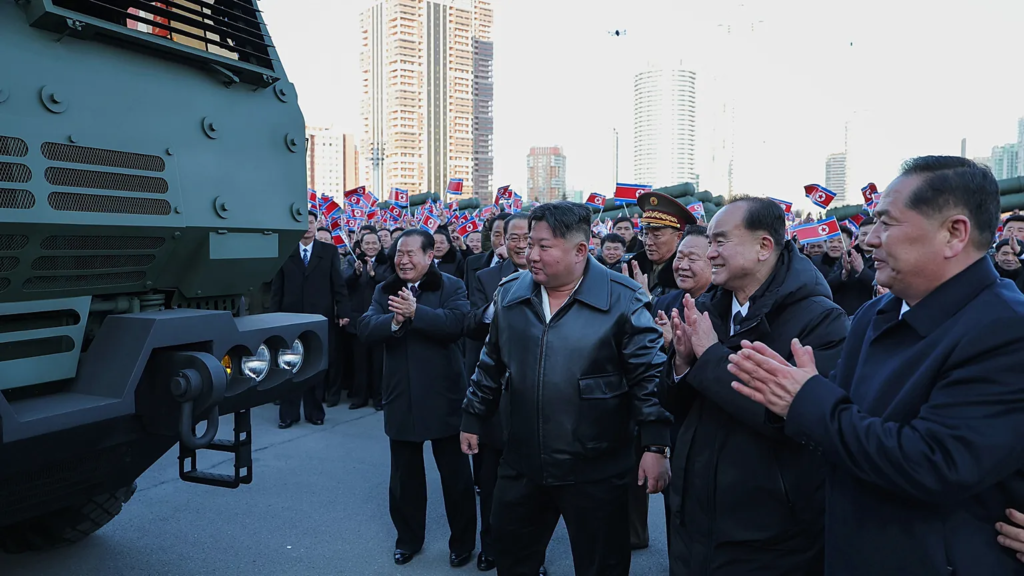
The presentation ceremony took place in a prominent public square associated with major political gatherings, reinforcing the connection between military advancement and national ideology. Fifty rocket launcher vehicles were arranged in formation, creating a visual spectacle intended to convey mass production capability and industrial efficiency. Defense industry workers gathered around the vehicles, waving flags and applauding, while official broadcasts documented every moment in detail.
The scene reflected a pattern long associated with North Korea’s military exhibitions, where visual scale and ceremonial precision serve to reinforce both domestic unity and international signaling. Particular emphasis was placed on the rapid production timeline. Officials reported that the defense sector manufactured the additional launchers within approximately two months, presenting the achievement as evidence of strong industrial mobilization and coordinated planning.
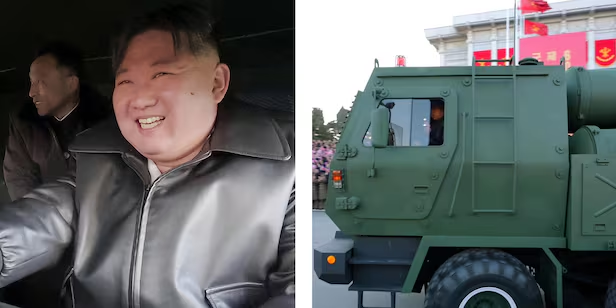
This narrative framed the weapons not as isolated prototypes but as deployable assets ready for operational integration. By highlighting the pace of production, authorities underscored their claim that the country’s defense manufacturing capacity remains capable of sustaining large-scale armament programs. One of the most widely circulated images from the ceremony showed the Kim Jong-un descending from a red-carpeted podium and entering the driver’s seat of one of the launcher vehicles.
The vehicle then circled the square before he exited, smiling and signaling approval. Such imagery is significant in the context of political messaging. Personal interaction with military hardware reinforces the portrayal of direct leadership oversight and personal commitment to national defense. Rather than presenting the weapons solely through technical briefings, the event placed them within a narrative of leadership authority, national pride, and collective achievement.
Speeches delivered during the ceremony reinforced these themes. Officials described the rocket launcher as among the most powerful concentrated attack systems developed by the country, combining the rapid-fire characteristics of multiple rocket artillery with precision guidance typically associated with tactical missile systems. The language used emphasized superiority, inevitability of deterrence, and transformative impact on modern warfare.
North Korean state media released footage showing Kim Jong Un personally driving what it described as a nuclear-capable missile launcher. The report claims the launcher is among the most powerful of its kind in the world.
— Media 🇺🇸 (@MediaWasHere) February 20, 2026
According to state media, 50 of these launchers have been… pic.twitter.com/sr9wJQP8iB
Statements suggested that the system could rapidly neutralize opposing military infrastructure and command networks, reflecting a doctrine centered on overwhelming initial strike capability. The ceremony also served a political function linked to broader strategic planning.
By presenting the launchers in connection with a major party congress, authorities indicated that the weapons form part of a larger roadmap for defense development. The display thus symbolized not only current capability but also future direction, signaling that further technological programs may follow. Military exhibitions in this context become milestones within an ongoing narrative of national self-reliance and technological progression.
Technical Capabilities and Strategic Significance
Beyond ceremonial presentation, the 600mm super-large rocket launcher represents a notable evolution in artillery technology. Classified by external intelligence assessments as comparable to short-range ballistic missile systems, the platform reportedly possesses a range approaching 400 kilometers. This range places much of the Korean Peninsula within potential reach, making the system strategically relevant to regional security dynamics.
The combination of long reach and improved accuracy positions the launcher between traditional artillery and missile forces, blurring conventional classification boundaries. The upgraded model unveiled at the ceremony features a four-axle launch vehicle carrying five launch tubes, an increase from earlier versions that carried fewer tubes on similar chassis platforms. The addition of extra launch capacity enhances salvo capability, allowing a single vehicle to deliver multiple guided projectiles in rapid succession.
This design supports saturation strike tactics while maintaining mobility, enabling deployment, firing, and repositioning within short operational windows. Another significant feature highlighted in official descriptions is the integration of artificial intelligence-assisted guidance and composite navigation systems. While specific technical details remain undisclosed, the emphasis on advanced targeting technology suggests efforts to improve accuracy and reduce circular error margins.
Read : Kim Jong Un Surprises Internet with Cheerful Tour of Newly Renovated Onpho Hot Spring Resort
Precision enhancement is particularly important for systems intended to strike hardened infrastructure, command centers, or strategic facilities. Improved guidance allows fewer projectiles to achieve desired effects, increasing operational efficiency and potentially reducing logistical demands. The weapon’s designation as suitable for “strategic missions” carries particular significance. In military terminology, this phrase often implies the capability to deliver high-impact payloads with strategic consequences.
Although official statements did not explicitly confirm nuclear compatibility, analysts interpret the terminology as a possible reference to dual-use capability. If the system is capable of delivering specialized warheads, its role would extend beyond conventional battlefield support to include strategic deterrence. Another technological aspect emphasized during the ceremony was the claim that the launcher redefines the concept of artillery warfare.
By merging rapid-fire capability with guided strike precision, the system seeks to combine volume and accuracy in a single platform. Traditional artillery typically relies on large numbers of unguided rounds to achieve area effects, while missile systems prioritize accuracy but at higher cost and lower firing rates. A hybrid system capable of delivering guided projectiles in rapid succession could provide flexible strike options across a range of operational scenarios.
Recent testing activities suggest that the launcher has already undergone developmental trials. Test launches conducted under leadership supervision earlier in the year demonstrated operational readiness and likely informed the decision to move toward broader deployment. The presentation of production-ready units indicates that the system may soon be integrated into active service formations, marking the transition from development phase to operational fielding.
Regional Implications and the Message of Deterrence
The unveiling of the 600mm super-large rocket launcher carries implications extending beyond technological advancement. In the strategic environment of Northeast Asia, military demonstrations often function as communication tools aimed at multiple audiences. Domestically, the presentation reinforces narratives of strength, technological competence, and national resilience. Internationally, it serves as a signal of capability and intent, particularly toward neighboring states and allied defense networks.
Read : Kim Jong Un Pays Tribute to North Korean Soldiers Killed Fighting for Russia in Ukraine
The reported operational range of the system means that key military installations across the Korean Peninsula could fall within reach. This geographic coverage enhances the credibility of deterrence messaging by demonstrating the ability to strike targets rapidly without relying solely on long-range missile forces. Mobile launcher platforms further complicate potential countermeasures, as they can disperse, relocate, and operate from multiple positions, reducing vulnerability to preemptive strikes.
Official statements emphasized the principle that overwhelming offensive capability forms the foundation of reliable deterrence. This doctrine reflects a strategic approach centered on demonstrating the ability to inflict immediate and severe damage in response to perceived threats. By presenting new weapons in highly visible ceremonies, authorities seek to reinforce the perception that military modernization continues despite external pressure.
The timing of the unveiling, in connection with a major political gathering, also suggests that military development remains a central component of long-term national planning. Announcements that future defense strategies will build upon current technological achievements indicate ongoing investment in weapons research and production. Such messaging signals continuity rather than isolated advancement, implying that additional systems may be introduced as part of a broader modernization trajectory.
Regional observers interpret these developments within the context of evolving security competition. Advanced artillery capable of high-precision strikes expands the range of tactical options available in potential conflict scenarios. It also contributes to an environment in which military capabilities are increasingly diversified, with multiple systems designed to perform overlapping strategic functions. This diversification complicates defense planning for neighboring states, which must account for both missile and artillery threats with similar reach and impact.
Ultimately, the presentation of the 600mm super-large rocket launcher illustrates the continued intersection of technology, politics, and strategic communication. The event combined ceremonial spectacle, technical announcement, and geopolitical signaling into a single carefully managed display. By personally operating one of the launch vehicles during the ceremony, national leadership reinforced the symbolic message that military strength remains closely tied to political authority and national identity.