

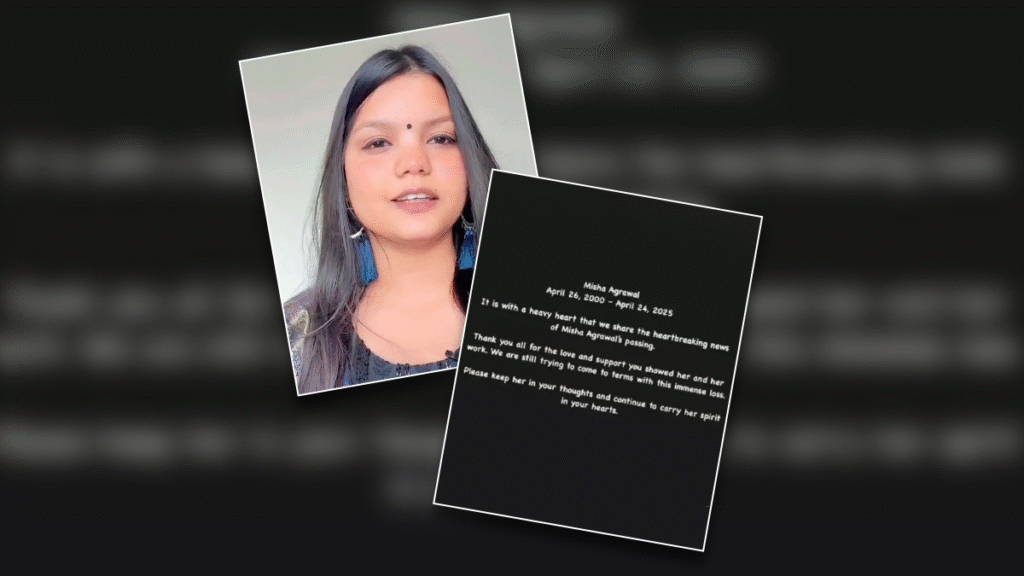
Misha Agarwal, a 24-year-old content creator from India, died by suicide on April 24, 2025, just days before her 25th birthday. The shocking and tragic news was confirmed by her family through a heartfelt message shared on her official Instagram account.
Known for her engaging presence on social media, Misha had spent years building a digital identity that revolved around her content and a growing follower base. But behind her bright smile and carefully crafted posts, she was fighting a silent and consuming battle with depression.
Her family, devastated by the loss, revealed the emotional and psychological struggles Misha had been facing for months. She had tied her self-worth and future to her online success.
When her Instagram followers began to decline, it severely impacted her mental health. What seemed like numbers on a screen to many was, for Misha, the foundation of her career and her dreams.
Misha had always dreamt of reaching one million followers on Instagram. She set that goal with passion and conviction, even going so far as to make it the lock screen on her phone. Her family shared that she would often talk about her vision, her aspirations, and how much it meant for her to succeed in the digital space.
But in the past few months, as her follower count began to drop, the pressure mounted. The joy she once found in creating content began to slip away, replaced by self-doubt and anxiety.
The Pressure of a Digital Identity
In an age where success is often measured by likes, shares, and followers, Misha Agarwal’s story brings into sharp focus the mental health crisis many content creators silently endure.
With the rise of social media platforms, influencers like Misha often find themselves under relentless pressure to maintain visibility, relevance, and engagement. These platforms reward visibility with validation—but also punish dips in performance with alarming emotional consequences.
For Misha Agarwal, her digital identity wasn’t just a part of her life—it was the center of it. Her family recalled how her mood would rise and fall based on her Instagram analytics. As her follower count dropped, so did her sense of purpose. She began doubting her value and the future she had once envisioned so clearly.
Read : People Rush to Sell Generational Jewellery After World’s First Gold ATM Installed in Shanghai
“She had built her whole life around Instagram,” her family said, remembering how she would hug them tightly and sob, saying, “Jijja, what will I do if my followers decrease? My career will be over.”
Despite their efforts to support her, comfort her, and remind her of her talents and other accomplishments, Misha could not escape the downward spiral. Her family shared that she was not only an online personality but also a bright student who had earned a law degree and was diligently preparing for the judicial service exams.
They tried to steer her attention toward that path, reminding her that life was bigger than any social media platform. But the emotional damage caused by her perceived failure on Instagram was already too deep.
A Family’s Unbearable Grief
In their public statement, Misha Agarwal’s family conveyed their heartbreak and their attempts to help her through the storm. “My little baby sister had built her world around Instagram and her followers, with a single goal of reaching 1 million followers and gaining loving fans. When her followers started decreasing, she became distraught and felt worthless,” they wrote.
They described how she became deeply depressed in April, often expressing her fear that her declining followers would ruin her entire career. Her despair ran so deep that it overshadowed everything else in her life, including her impressive academic achievements and her future potential outside the realm of social media.
Her family’s words painted a painful picture of Misha Agarwal’s internal struggle. They recalled comforting her, urging her to remember her law degree and the goal of becoming a judge—reminders of her intelligence, discipline, and strength. But for Misha, none of it seemed to matter anymore. She could not look past the disappointment she felt from her online performance.
“Unfortunately, my little sister didn’t listen and became so consumed by Instagram and followers that she left our world forever. Tragically, she became so overwhelmed that she took her own life, leaving our family devastated,” her loved ones said.
The emotional statement ended with a plea for understanding and remembrance. On April 25, a post on her Instagram page broke the news publicly, reading: “It is with a heavy heart that we share the heartbreaking news of Misha Agrawal’s passing. Thank you all for the love and support you showed her and her work.
We are still trying to come to terms with this immense loss. Please keep her in your thoughts and continue to carry her spirit in your hearts.” The caption added, “Our loss is unimaginable. We have no words. Take care.”
Mental Health and the Toll of Online Expectations
Misha Agarwal’s passing is a tragic reminder of the mental health challenges faced by young creators in the digital age. While platforms like Instagram provide incredible opportunities for visibility, creativity, and connection, they can also foster anxiety, self-doubt, and a dangerous dependency on external validation. The curated lives we see online are often built on pressure and performance, with creators constantly fearing irrelevance.
Content creators, especially those who tie their careers to social media platforms, often face an unpredictable environment. Algorithm changes, audience shifts, and fluctuating engagement can create significant emotional stress.
For many, the pressure to maintain success becomes an all-consuming force. Misha Agarwal’s case is not isolated—there have been several instances globally of influencers grappling with similar issues, some of which have ended in tragedy.

Mental health conversations must now include the specific struggles of those in the digital space. As more young people aspire to become influencers, driven by dreams of fame and financial independence, there needs to be greater awareness about the psychological toll this path can take. Support systems—both personal and institutional—are crucial in helping creators separate their identity from their online persona.
Misha’s story also underscores the importance of open, honest conversations about mental health within families and communities. Her family tried desperately to guide her back to a more grounded view of life, encouraging her to see the bigger picture. But the psychological grip of social media had already clouded her perspective.
Let this heartbreaking event not just be a moment of mourning but a call to action—to ensure that young creators know they are more than their follower count, and that real worth comes from within, not from metrics on a screen.
It’s time for society, tech companies, and mental health professionals to work together to build environments that value mental well-being as much as creativity and success.
Rest in peace, Misha. You were loved, and you will be missed beyond words.