
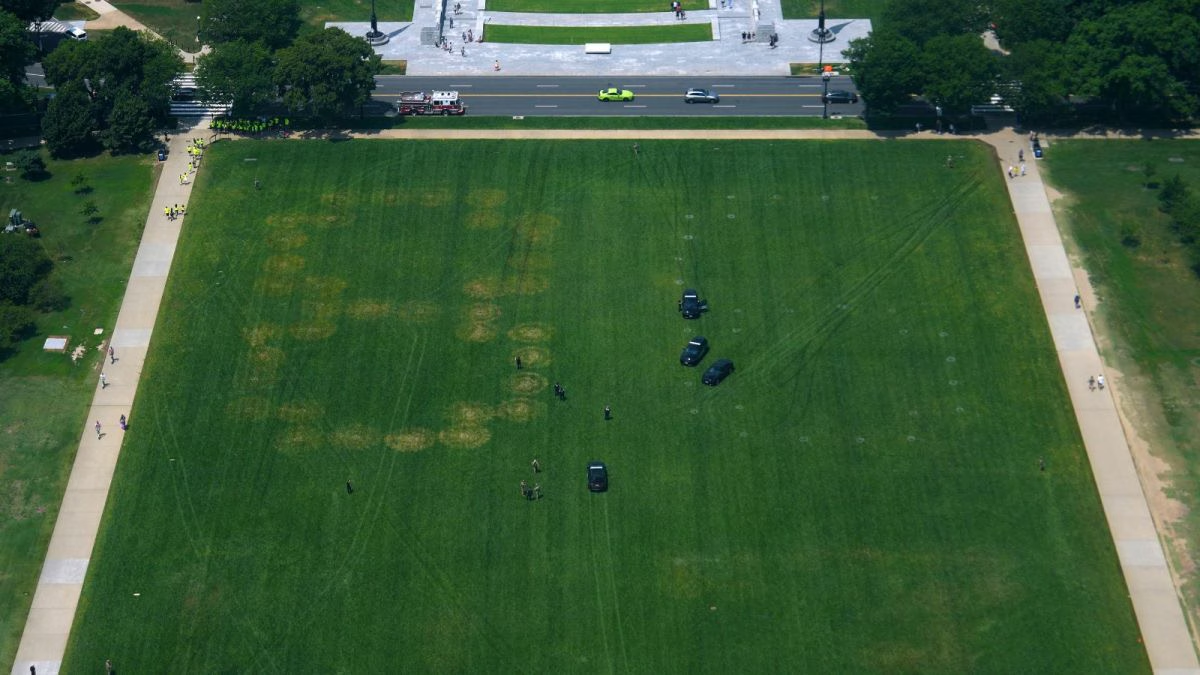
A strange set of giant numbers appearing on the grass of Washington, D.C.’s National Mall has sparked political controversy, public debate, and a federal investigation. The numbers “8647,” discovered etched into a large section of grass near the World War II Memorial, quickly became the focus of speculation after photographs circulated online. While authorities initially treated the incident as possible vandalism, the political meaning attached to the numbers has transformed the discovery into a national discussion about symbolism, protest, free speech, and political tensions in the United States.
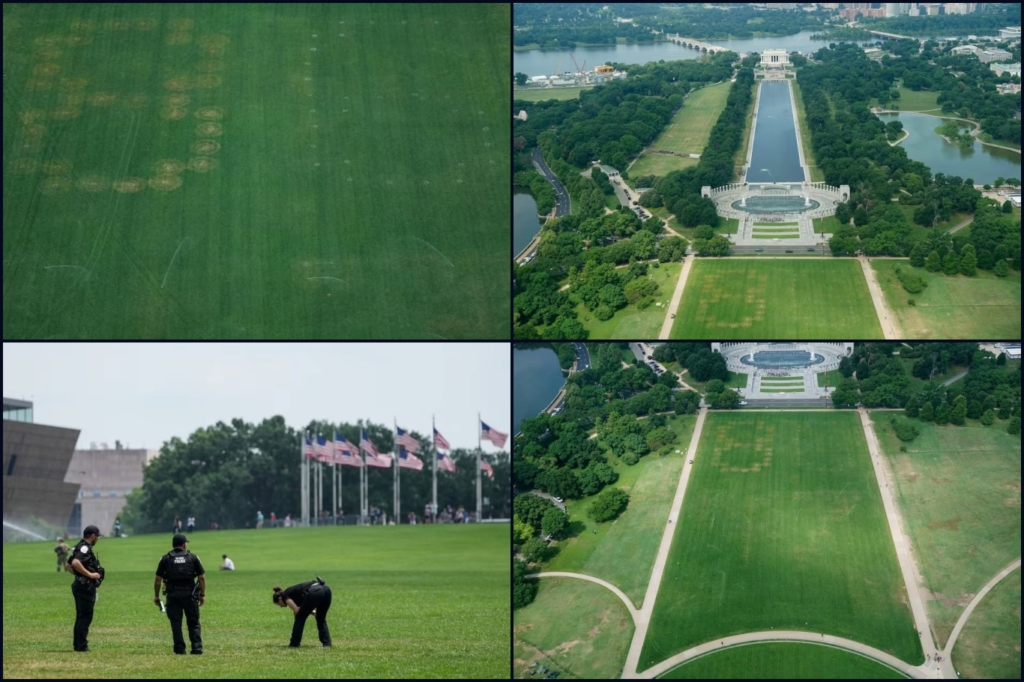
The incident comes at a time when political divisions remain intense and public spaces increasingly become stages for political messaging. Investigators are still trying to determine how the numbers appeared and whether chemicals, machinery, or other methods were used to create the large imprint. However, much of the public attention has centered not on the physical markings themselves but on what the numbers might represent.
As federal authorities examine the site and collect grass samples for testing, many Americans are asking a simple question: What does “8647” actually mean, and why has its appearance generated such a strong reaction?
Understanding the Meaning Behind “8647”
The significance of the numbers largely comes from the interpretation of “86,” a slang expression that has existed in American culture for decades. In restaurants and bars, “86” commonly means that an item is unavailable or should be removed from service. More broadly, the term has evolved into slang meaning “get rid of,” “remove,” or “eliminate.” The second part of the number sequence, “47,” is widely interpreted as a reference to President Donald Trump, who is serving as the 47th president of the United States.
When combined, critics and supporters alike have interpreted “8647” as a political message directed at Trump. Supporters of the president and several administration officials argue that the phrase goes beyond ordinary political criticism. They contend that the slogan can be interpreted as encouraging harm against the president and therefore represents a serious security concern. This interpretation has led some officials to describe the message as potentially threatening.
Others dispute that view, arguing that the phrase is commonly used in political protest contexts to express opposition to a political figure or policy rather than a literal call for violence. They maintain that the numbers represent a symbolic demand to remove a politician from office or reject a political agenda rather than any physical threat. The disagreement highlights how political symbols often acquire multiple meanings depending on who is interpreting them.
The US Department of the Interior said it's investigating what appeared to be a large tracing of the numbers '8647' into the grounds of the National Mall in Washington, D.C. The meaning of the numbers has drawn varied interpretations https://t.co/84ijys0X4m pic.twitter.com/Fs31ZKffG9
— Reuters (@Reuters) June 11, 2026
While one group may view the phrase as dangerous rhetoric, another may see it as protected political expression. That conflict over interpretation is a major reason why the appearance of “8647” has attracted so much attention. The visibility of the slogan has also increased because similar versions of the phrase have appeared at demonstrations and anti-Trump protests in recent years. As a result, many people immediately recognized the numbers when images from the National Mall began circulating.
Why Federal Authorities Are Taking the Discovery Seriously
The discovery of the giant numbers on one of America’s most recognizable public landscapes prompted an immediate response from law enforcement and park officials. According to authorities, officers responded after receiving reports of damage or discoloration in the grass. Investigators subsequently began examining the area to determine how the markings were created.
Officials have stated that the exact cause of the discoloration remains unknown. Grass samples were collected for laboratory testing, and investigators continue to evaluate whether the markings resulted from chemicals, environmental factors, mechanical equipment, or deliberate human activity. The location of the incident is one reason authorities are treating the matter seriously.
The National Mall is among the most symbolically important public spaces in the United States, attracting millions of visitors each year and serving as the site of historic demonstrations, celebrations, and national commemorations. Any apparent vandalism in such a location naturally receives heightened scrutiny. The markings were reportedly found near the World War II Memorial, a prominent monument honoring Americans who served during the conflict. Because of the site’s significance, federal agencies are responsible for ensuring its preservation and investigating any damage to surrounding grounds.
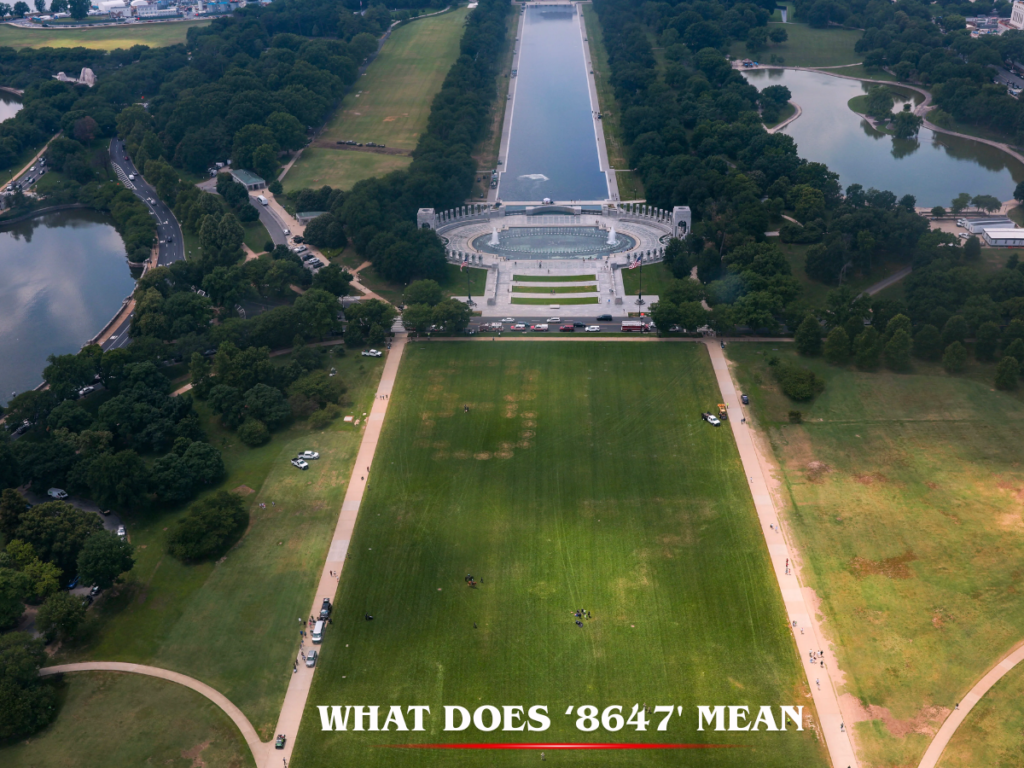
The controversy surrounding the numbers has also been amplified by ongoing legal and political disputes involving similar symbolism. Prosecutors have recently pursued charges against former FBI Director James Comey over a social media post that allegedly displayed the same numerical message using seashells arranged on a beach. Comey has strongly denied that the image represented a threat and has characterized the prosecution as politically motivated.
That separate legal battle has made the appearance of “8647” on federal property particularly noteworthy. What might otherwise have been viewed primarily as a vandalism investigation has become intertwined with broader political arguments about intent, symbolism, and the boundaries of political speech. Federal authorities therefore face two distinct questions: how the markings appeared and whether the message itself carries implications beyond ordinary political expression.
A Symbol of America’s Intensifying Political Divide
The debate surrounding “8647” reveals far more than the mystery of numbers appearing in grass. It reflects the increasingly polarized political climate in the United States, where symbols, slogans, and social media posts can rapidly become national controversies. Political messages have long appeared in public spaces, from protest signs and banners to graffiti and artistic demonstrations. What makes the National Mall incident different is the way a seemingly simple numerical code immediately became associated with ongoing political and legal battles.
Read : Who Is Robin Gunningham, Man Identified As Mysterious Street Artist Banksy?
For supporters of Trump, the slogan represents an example of increasingly hostile rhetoric directed at the president. Many argue that even ambiguous messages can contribute to an atmosphere in which political violence becomes normalized. Given past threats against public officials and heightened security concerns surrounding national leaders, they believe authorities are justified in examining the matter carefully.
Critics of the administration, however, often view the reaction as an overreach. They argue that political slogans should be interpreted within the context of protest and dissent, traditions that have long been protected in American democracy. From this perspective, treating a political slogan as a criminal threat risks creating concerns about freedom of expression.
The dispute reflects a broader trend in modern politics in which language and symbols frequently become contested territory. Words, numbers, and images that once carried limited significance can quickly acquire national attention when linked to political movements or public figures. The incident also occurs during a wider effort by the Trump administration to reshape and beautify federal monuments and public spaces in Washington. Plans associated with this campaign include renovations to major landmarks, restoration projects, and proposals for new architectural features intended to enhance the appearance of the nation’s capital.
Against that backdrop, the discovery of a politically charged message etched into the grass of the National Mall carries both symbolic and practical significance. It touches on questions about the use of public space, political expression, preservation of national landmarks, and the responsibilities of government agencies. For now, investigators continue their work, and no definitive conclusions have been announced regarding how the markings were created or who may have been responsible. Laboratory testing and further examination may eventually provide answers about the physical origins of the numbers.
Yet regardless of the investigation’s outcome, the appearance of “8647” has already achieved something significant: it has sparked a nationwide conversation. The numbers have become a focal point for debates about political symbolism, freedom of speech, security concerns, and the increasingly contentious nature of American public life.
Whether viewed as vandalism, protest, political messaging, or something else entirely, the mysterious numbers etched into the National Mall demonstrate how even a simple sequence of digits can become a powerful symbol in a deeply divided political era. As authorities seek to determine exactly what happened on the Mall, the broader debate over what “8647” means—and what it should mean—shows no sign of fading anytime soon.
Very interesting points you have mentioned, appreciate it for posting. “Never call an accountant a credit to his profession a good accountant is a debit to his profession.” by Charles J. C. Lyall.
Regards for this marvellous post, I am glad I noticed this website on yahoo.
his comment is here Internet Magazin https://internet-magazin.pages.dev/
Eagan fox sex tapePhoto femmes nues amateurAdult sombrerosPhotograph vintage motel
signsHome work sucksFather fuck young teen dughterMusclemen hardcore sexAlbuquerque escort
lesbian xnxx Vintage furniture pricesBabes tube adultTeen activities in miamiFun couple sex
gamesRachel templeman sexCompletely lingerie man see sheer thru
womanYoung hung gay dude clips https://now.xxxto.day/ Erotic short mpg3Milf seduces neighbor
boyWhore wife slutTheresa lynn orgasmRachel hunter panty upskirtTied big titsDo girls like hairy boysVirgin river hotel mesquite nvQshare mature xnxx Asians string pussyAlt okc
escortNaked news dirtGaping cunt tubesClips of best sex scenesWoman drinkin her milk sexBar spankFucking
dude with blue condom