

A social experiment by Kentucky Army veteran and TikToker Nikalie Monroe has ignited fierce debate across social media after her series of videos revealed how many of America’s largest megachurches responded when she posed as a desperate mother begging for baby formula.
Nikalie Monroe’s viral TikTok project, which she describes as a test of Christian compassion and charity, exposed what she claims is a troubling indifference among wealthy churches toward the poor and vulnerable. Her experiment, both praised and criticized, has captured the attention of millions and prompted renewed discussion about the moral responsibilities of religious institutions.
The Social Experiment That Sparked a National Reaction
Nikalie Monroe, who has amassed a following of more than 400,000 users on TikTok, began her experiment with a simple premise: to find out whether American churches would help a mother who called seeking food for her baby. Pretending to be a single, struggling mother, Nikalie Monroe dialed over 30 churches across the United States, asking each one if they could provide or arrange baby formula to feed her fictitious starving infant. In the background of her calls, she played the sound of a baby crying — a deliberate addition meant to heighten the emotional realism of the scenario.
Her approach was inspired, she explained in one of her videos, by biblical teachings about feeding the hungry and helping those in need. Yet, Nikalie Monroe was unprepared for how few churches responded positively. Out of more than 40 documented calls, only nine churches offered any assistance, while 33 either declined outright or redirected her to bureaucratic processes that could take days or even weeks.
She described many of these exchanges as “cold” and “disheartening,” adding that she expected at least some immediate compassion for what she presented as a mother in crisis. Among the most widely discussed calls was her interaction with Houston’s Lakewood Church, one of the largest megachurches in the United States and home to celebrity pastor Joel Osteen. In the video, Nikalie Monroe asked whether the church could provide baby formula for her “starving child.” The staff member on the line responded that Lakewood had a benevolence ministry and offered to take down her information so she could apply for assistance.
Shoutout to the Black church of, The First Baptist Church of Jeffersontown, in Louisville, Ky, as well as the unnamed Islamic Church & Appalachian gentleman who offered to help feed a hungry child when the request for help was for just one can of formula.
— Cₕₑᵣₑₗₗₑ bₑ ₜₐₗₖᵢₙ ₛₕᵢₜ! 🖕🏽 Fuck This Shit! (@DFiosa) November 9, 2025
Nikalie.Monroe (TikTok) pic.twitter.com/Vebvdn7mUf
When Nikalie Monroe pressed for how long the process would take, she was told it could require several days or even weeks depending on whether her application was approved. After ending the call, Monroe expressed disbelief that a church of such immense wealth could not immediately offer help to someone claiming to have a starving infant. Her reaction struck a chord online, where thousands of users began scrutinizing the financial power of megachurches and questioning their community priorities.
Public Reactions and the Megachurch Controversy
The backlash against Lakewood Church in particular was swift and intense. Commenters across TikTok and X (formerly Twitter) condemned what they saw as an example of hypocrisy among institutions that preach generosity yet fail to act when presented with an opportunity to help. “Joel Osteen would NEVER!” one viral comment read sarcastically. “He didn’t get a mega mansion and luxury cars by doing the Lord’s work!” Another viewer echoed the frustration: “She said ‘if approved’? What kind of approval process do you need to feed a starving baby?”
Many users linked the incident to past controversies involving Lakewood Church, especially its response during Hurricane Harvey in 2017, when it initially did not open its 16,000-seat arena to evacuees seeking shelter from catastrophic floods. The church later reversed its decision after public outrage, but the event has continued to haunt its reputation. Social media users revived that memory as evidence of what they perceive as the church’s long-standing detachment from the suffering of ordinary people.
“Girl, they locked their doors during Hurricane Harvey,” one user commented on Nikalie Monroe’s video. “A furniture store owner named Mattress Mack opened his doors to everyone — but the megachurch didn’t.” Another remarked that wealthy churches often “take from poor members but can’t help the community.”

While Nikalie Monroe’s series received overwhelming support from those angered by the responses, others criticized her methods. Some accused her of manipulating church staff through deception and emotional theatrics. A few religious commentators argued that the experiment unfairly targeted specific organizations without context about how church benevolence programs typically operate. These programs often require verification of need, they said, to prevent misuse of church funds and ensure fair distribution.
Lakewood Church did not immediately respond to requests for comment from multiple news outlets, including The Independent, though public records show that the church reported net assets exceeding $59 million as of the 2017 fiscal year. Pastor Joel Osteen himself is estimated to have a personal net worth of around $50 million.
Nikalie Monroe has stated that the intent of her videos was not to shame individual churches but to shed light on the broader question of how religious institutions allocate their wealth and resources. “I’m not even a church,” she said in one TikTok, “and if someone called me saying they needed to feed a baby, I wouldn’t hang up — I’d find a resource.”
Faith, Accountability, and a Nation in Crisis
Nikalie Monroe’s experiment landed at a time when many Americans are struggling to afford basic necessities. As her videos spread online, millions of families were facing delays or losses in their Supplemental Nutrition Assistance Program (SNAP) benefits due to the ongoing government shutdown. More than 42 million Americans rely on the program, receiving an average of about $188 per month — roughly $6 a day — to purchase groceries.
The timing of Nikalie Monroe’s viral series amplified its emotional impact. Viewers saw her calls not just as a commentary on church compassion but as a reflection of the growing desperation among American families who often have nowhere to turn. In several of her TikToks, Monroe herself highlighted the connection, pointing out that while many citizens are living paycheck to paycheck, some churches continue to operate like corporations, generating millions in donations, merchandising, and media deals.
Critics of megachurch culture argue that such institutions have drifted far from their original mission of community service. The lavish lifestyles of celebrity pastors — complete with private jets, designer clothing, and multimillion-dollar homes — have often drawn scrutiny. Supporters, however, counter that megachurches contribute to charitable causes through large-scale programs and international missions, and that individual stories of refusal do not represent their overall work.
Yet Nikalie Monroe’s project resonated because it offered an intimate, human-scale test. Her simple request for a can of baby formula cut through abstract debates about theology or fiscal management. For many viewers, it laid bare the uncomfortable gap between faith in principle and faith in practice.
While some pastors came to the defense of Lakewood and other churches featured in Monroe’s calls, acknowledging that large congregations often handle assistance requests through formal processes, others used her experiment as a call for reform. “If a mother with a crying baby calls your church, the answer shouldn’t be an application form,” one pastor wrote in response to the viral video. “The answer should be: where are you, and how fast can we get to you?”
Read : University of Kentucky Student Laken Snelling Arrested in Connection with Death of Her Infant
Nikalie Monroe’s supporters view her as a whistleblower for moral accountability within organized religion. Her critics see her as an opportunist using deceit to generate views. But even among those who disapprove of her methods, few deny that the reactions she documented have raised legitimate questions about how churches manage compassion in practice.
Her experiment also revealed differences between small community churches and sprawling megachurches. Monroe noted that smaller congregations were far more likely to respond with empathy and practical help, sometimes offering to connect her immediately with local food pantries or volunteers. This pattern, she argued, highlights a troubling reality — that the institutions with the most resources are not necessarily the ones most responsive to urgent human need.
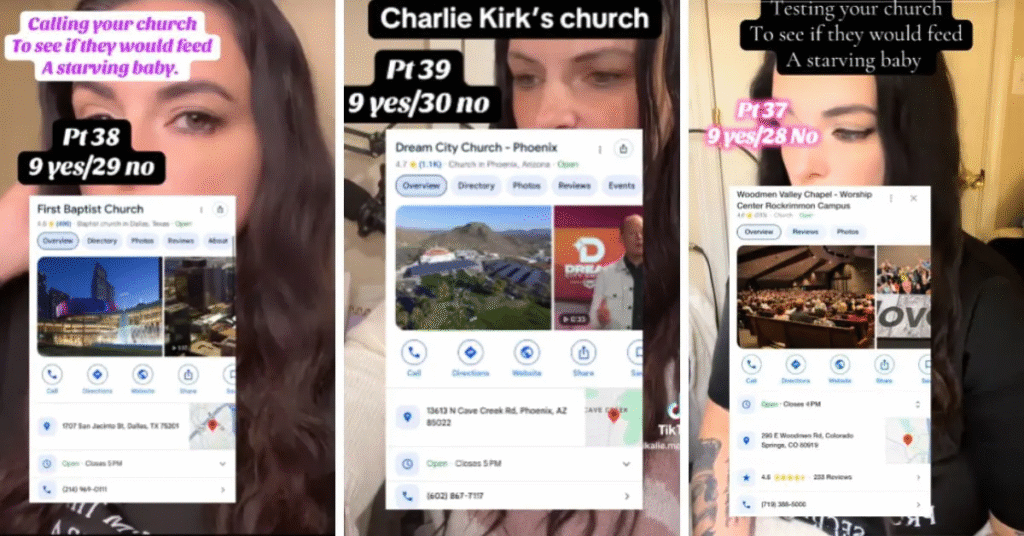
As the videos continued circulating, some viewers began compiling lists of churches that did offer help, praising them for embodying what they considered true Christian charity. Others called for greater financial transparency among megachurches, pointing out that many are not required to disclose detailed financial records because they operate as nonprofit religious organizations.
For Nikalie Monroe, the viral attention has become a platform for a larger conversation about empathy and accountability. In one of her most-viewed follow-up clips, she said, “I’m not saying all churches are bad. I’m saying we should be asking what happens when a mother calls for help and the answer is paperwork.”
The broader context of her message has extended beyond religion into social policy, with viewers discussing the fragility of America’s social safety nets. With the government shutdown disrupting welfare payments and food assistance, private institutions — including churches — have become even more critical lifelines for struggling families. Monroe’s videos, in this light, are being interpreted as a mirror reflecting how society responds to those left behind.
Whether one views her approach as a moral experiment or a viral stunt, Monroe’s series has succeeded in forcing uncomfortable but necessary questions into the public sphere. It has also underscored the influence of social media as a tool for modern activism, capable of sparking national discussions about empathy, privilege, and the true meaning of charity.
In the weeks since her first video went viral, Nikalie Monroe has continued to post updates and reactions, noting that some churches have reached out privately to discuss their assistance programs. She has also received messages from single parents and veterans thanking her for shedding light on the challenges faced by those seeking help.
As debates continue, the image of a crying baby — real or not — has become symbolic of a larger issue that transcends the screen. Nikalie Monroe’s calls may have been simulated, but the hunger and desperation they represent are very real for millions of Americans. The question her experiment ultimately poses is not only about faith or wealth, but about the collective moral compass of a society that must decide how it responds when someone pleads for help.
66b online được khai sinh vào đầu năm 2020, giữa thời điểm ngành giải trí trực tuyến đang có những bước chuyển mình mạnh mẽ. Với trụ sở đặt tại Manila, Philippines, nhà cái hoạt động dưới sự giám sát và cấp phép bởi PAGCOR – Tập đoàn quản lý và điều tiết trò chơi có uy tín hàng đầu châu Á. TONY12-24