
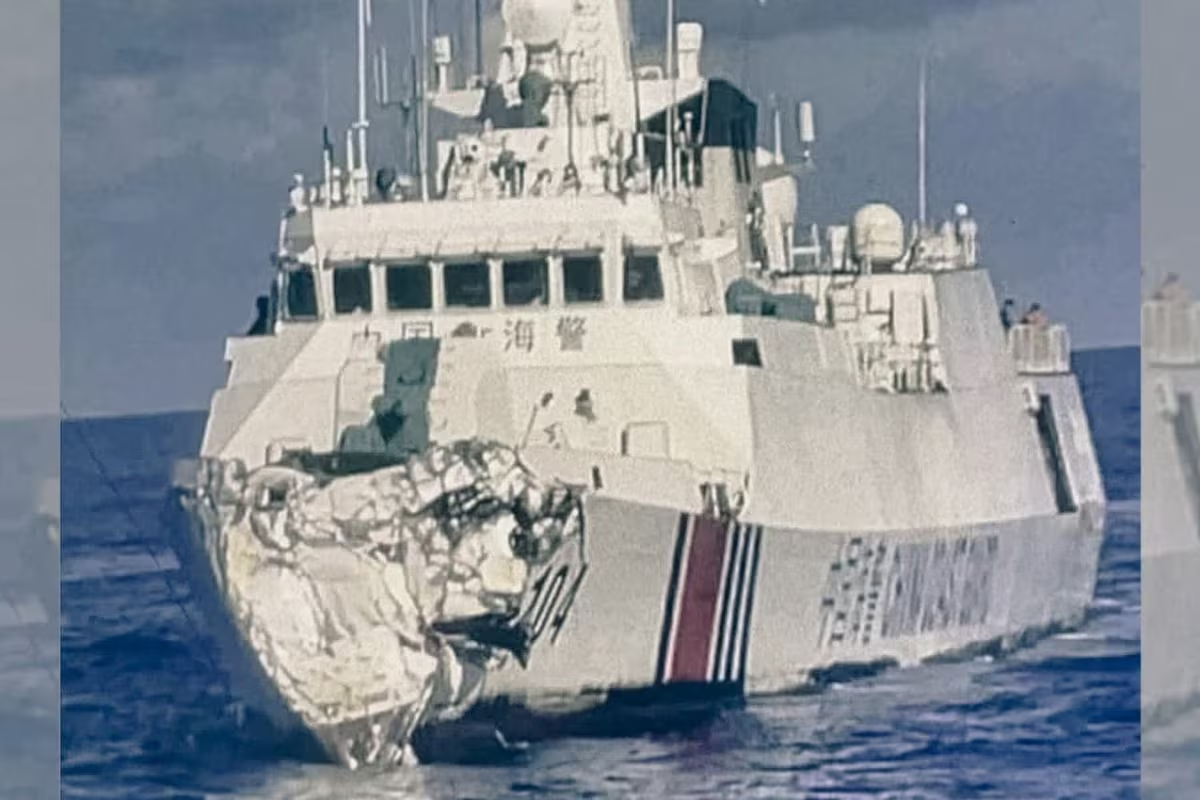
Tensions in the South China Sea have once again escalated after a dramatic incident involving Chinese maritime forces near the disputed Scarborough Shoal. Video footage released by the Philippines shows a Chinese warship crashing into its own coastguard vessel while aggressively pursuing a Philippine patrol boat. This unprecedented collision has drawn sharp reactions from both Manila and Beijing, highlighting the growing volatility in this contested region.
The Incident: Collision in the South China Sea
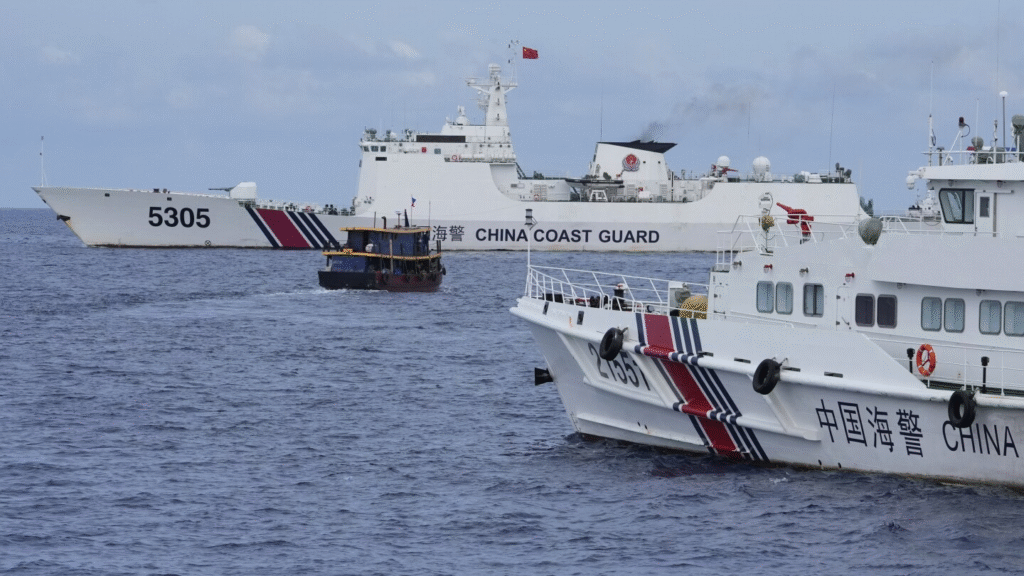
On a tense Monday near the Scarborough Shoal, a Philippine Coast Guard (PCG) vessel was escorting aid boats distributing supplies to local fishermen in the area. This mission triggered a high-stakes maritime confrontation when Chinese coastguard ships moved in to block the Philippine vessels. During the pursuit, a large Chinese navy warship bearing hull number 164 collided with a smaller Chinese coastguard ship, CCG 3104.
The Philippine government quickly released footage capturing the collision. The video shows the larger warship crashing into the bow of the coastguard vessel with a loud, unmistakable impact. Subsequent images revealed the coastguard ship with its entire forecastle — the front part of the ship — crumpled inward, rendering it unseaworthy.
Philippine authorities accuse the Chinese vessels of dangerous maneuvers and unlawful interference during the resupply mission. Commodore Jay Tarriela, spokesperson for the Philippine Coast Guard, detailed the sequence of events. The smaller Chinese vessel, CCG 3104, was reportedly chasing the Philippine patrol boat BRP Suluan at high speed. It suddenly performed a risky maneuver from the starboard quarter of the BRP Suluan, causing it to collide with the larger PLA (People’s Liberation Army) navy warship.
Before the collision, the BRP Suluan had successfully evaded water cannon fire aimed at it by the Chinese ships, underscoring the aggressive tactics employed. The Philippine Coast Guard also noted uncertainty regarding the well-being of crew members who were visible on the damaged Chinese vessel’s bow just before the crash. The Philippine side reportedly offered assistance, but the Chinese crew did not respond.
China has acknowledged the confrontation but has neither confirmed nor denied the collision itself. Chinese coastguard spokesperson Gan Yu claimed the coastguard was enforcing “rights-protection law enforcement activities” and took “necessary measures” against Philippine vessels which they accused of forcibly intruding into Chinese waters. China refers to the Scarborough Shoal as Huangyan Dao, asserting territorial sovereignty and maritime rights in the region.
Scarborough Shoal and the South China Sea Dispute
The Scarborough Shoal, a triangular chain of reefs and rocks, has long been a flashpoint between China and the Philippines. It lies in the resource-rich South China Sea, an area claimed in its entirety or in large parts by China, Taiwan, Vietnam, Malaysia, Brunei, and the Philippines. This region is one of the busiest maritime corridors in the world, with over 60% of global maritime trade passing through it annually. Control over these waters is strategically crucial for economic and military reasons.
The Philippines claims sovereignty over the Scarborough Shoal, citing historical usage and a 2016 ruling by the Permanent Court of Arbitration which invalidated China’s expansive claims based on the so-called “nine-dash line.” Despite this international ruling, China has continued to assert control, effectively blocking Philippine access since seizing the shoal in 2012.
Read : Russian YouTuber Vitaly Zdorovetskiy Jailed in the Philippines for Harassing Security Guard
The repeated confrontations between Chinese and Philippine vessels, including harassment of Filipino fishermen and interference in supply missions, highlight the persistent and unresolved tensions in this contested space. The recent collision between Chinese vessels adds a new dimension to these encounters, signaling heightened risk and potential for miscalculation.
Read : Only Two Countries in the World Where Divorce is Illegal: The Philippines and Vatican City
Philippine President Ferdinand Marcos Jr. has been clear about Manila’s intention to continue asserting its sovereign rights in the area. At a news conference following the incident, he vowed that Philippine patrol vessels would remain present to defend their territory. Marcos also highlighted the broader implications of regional tensions, particularly regarding Taiwan. He warned that any conflict over Taiwan could drag the Philippines into the fray, given its proximity and the large Filipino population in Taiwan.
Geopolitical Implications and Future Outlook
The collision incident underscores the fragile and increasingly militarized environment of the South China Sea. It exposes not only the intense rivalry between China and the Philippines but also the risks posed by aggressive maneuvers in crowded maritime spaces. The fact that two Chinese vessels collided in the midst of a chase suggests operational pressure and complexity, raising questions about the command and control during such confrontations.
This event could further strain Beijing-Manila relations at a time when the geopolitical stakes in the Indo-Pacific region are growing. The South China Sea is a critical theater in the broader strategic competition between the United States and China, with Washington supporting the Philippines and other Southeast Asian nations in upholding freedom of navigation and international law.
China’s persistent claims and military presence in the area have sparked concerns among regional actors and global powers about the risk of escalation. The Philippines, which relies heavily on U.S. military support, finds itself navigating a delicate balance between asserting its territorial rights and avoiding a direct confrontation with the powerful Chinese navy.
Moreover, the growing tensions over Taiwan add another layer of complexity. Marcos’s warning about the Philippines being inevitably drawn into any conflict over Taiwan highlights the interconnected nature of regional security challenges. The Bashi Channel, a vital sea passage near Taiwan, lies close to Philippine territory, making the archipelago a strategic player in any potential Taiwan Strait conflict.
In response to the collision and ongoing maritime confrontations, regional diplomacy faces significant challenges. Efforts to establish a binding Code of Conduct in the South China Sea between China and ASEAN countries have made limited progress, and incidents like this demonstrate the urgency for clear rules to prevent accidents and misunderstandings.
The collision between a Chinese warship and its own coastguard vessel while chasing a Philippine patrol boat near Scarborough Shoal is a stark reminder of the volatility in the South China Sea. It reflects the high tensions over territorial claims, the aggressive tactics employed by China, and the determination of the Philippines to uphold its sovereignty.
As regional and global powers watch closely, the incident raises serious concerns about maritime safety, the potential for unintended escalation, and the future stability of one of the world’s most strategic waterways. Moving forward, the Philippines is likely to continue its naval presence in the disputed waters, while China maintains its assertive posture.
The international community must remain engaged to support peaceful resolutions, respect for international law, and the avoidance of conflicts that could disrupt global trade and regional security. The South China Sea remains a litmus test for diplomacy, power projection, and the future of Indo-Pacific stability.