

The historic Gaîté Lyrique theatre in central Paris became the epicenter of a months-long standoff between young migrants seeking shelter and the French authorities. On March 19, police forcibly removed hundreds of migrants who had occupied the venue since December.
The operation, which began in the early hours of the morning, was marked by clashes between police and protesters, with allegations of excessive force being used against those inside the building.
The eviction has reignited debates on France’s immigration policies, the treatment of unaccompanied minors, and the government’s handling of the ongoing humanitarian crisis.
The Occupation of the Gaîté Lyrique Theatre
The occupation of the Gaîté Lyrique theatre began on December 10, 2024, when around 200 young migrants, most of them unaccompanied minors from sub-Saharan Africa, took over the building.
Their demands were simple: food, shelter, and recognition of their legal status as minors. Many of them were living on the streets, facing the harsh winter conditions with little to no support from the authorities. Over time, their numbers grew, and the theatre became a symbol of their struggle.
A week after the occupation began, the theatre’s management canceled all scheduled performances, citing both the occupation itself and the inaction of the authorities.
While they condemned the takeover, they also criticized the French government’s failure to address the issue of homeless migrant children. The occupation quickly drew support from left-wing activists, human rights organizations, and politicians who called for urgent action to provide the migrants with proper housing and legal recognition.
Read : Paul Tazewell Becomes First Black Man to Win Best Costume Oscar 2025
Despite repeated pleas, the French government did little to resolve the crisis. The standoff between activists and authorities intensified, with the far right demanding the migrants’ immediate expulsion and the left advocating for their protection.
#French #Police evicted over 400 migrants from a #Paris theater after a three-month illegal occupation that began after a lecture on benefits of migration.
— Michael Ashura (@MichaelAshura) March 18, 2025
Clashes with protesters led to tear gas use, 46 arrests, and nine injuries. Mayor Anne Hidalgo has already assured that… pic.twitter.com/FEvZ5aOR74
The Gaîté Lyrique became a battleground not just for the migrants, but for broader political tensions surrounding immigration in France.
A Controversial and Forceful Eviction
On the morning of March 19, the French anti-riot police (CRS) arrived at the Gaîté Lyrique under orders from Paris police prefect Laurent Nunez.
Around 450 migrants were inside the building when officers forced their way in, breaking through human chains formed by activists who tried to block their entry. Reports from the scene described chaotic and distressing scenes as police used tear gas and batons to remove the migrants.
Human rights organizations such as Utopia 56 and the Collectif Accès au Droit condemned the operation, calling it “extremely violent.” Danielle Simonnet, a leftist lawmaker present at the scene, accused the police of “hitting and beating” the migrants despite their peaceful behavior.
Witnesses reported seeing young migrants carrying their personal belongings out of the theatre, many leaving suitcases and bags abandoned on the pavement.
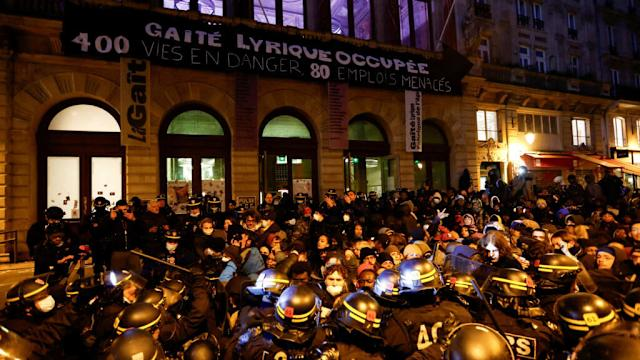
Throughout the day, demonstrators gathered outside the theatre, chanting slogans such as “we are all the children of migrants” as they faced lines of riot police. The eviction order had come just a day earlier when Nunez declared that the occupation posed a “threat to public order.”
He assured the public that the young migrants would be offered alternative housing and that their legal cases would be reviewed. However, many migrants rejected the proposed accommodations outside Paris, particularly in Rouen, fearing they would be further isolated from education and community support.
A Humanitarian Crisis and Political Fallout
The eviction of the Gaîté Lyrique migrants has once again exposed the dire situation faced by thousands of homeless children in France. According to UNICEF, more than 2,000 children are still sleeping rough in the country, with little hope of securing stable housing.
Many of the young migrants at the theatre had been trying for months to prove their underage status in hopes of receiving government protection, but bureaucratic delays and skepticism from authorities have left them in limbo.
The French government’s handling of the situation has drawn widespread criticism. Advocates argue that forcibly removing vulnerable young people without ensuring their safety contradicts France’s commitments to human rights and child welfare.
Others see the eviction as a politically motivated move ahead of upcoming elections, designed to appeal to right-wing voters who demand stricter immigration controls.

At the end of February, more than 300 cultural figures, politicians, and civil society members signed a petition urging authorities to find a housing solution for the migrants. Their call for compassion and action went unanswered, and the eviction has left many wondering what will happen next for those removed from the theatre.
For migrants like Adama, a 15-year-old from Côte d’Ivoire, the situation remains uncertain. “I need to go to class at 10:00 am today,” he told reporters after the eviction. “I don’t know what to tell my teacher. I need to leave a message saying that I won’t make it.”
His words reflect the harsh reality faced by many young migrants who have come to France in search of a better future but have found themselves trapped in a cycle of displacement and uncertainty.
As the dust settles on the Gaîté Lyrique eviction, questions remain about the future of France’s migrant policies. Will the government take meaningful steps to provide support and protection for homeless minors, or will events like this continue to unfold? For the hundreds of young people who once found shelter within the theatre’s walls, the struggle is far from over.