

A shocking incident occurred aboard a Hong Kong Airlines flight when a power bank catches fire mid-air, forcing an emergency diversion to Fuzhou. The flight, which was en route from Hangzhou to Hong Kong, had to make an unscheduled landing after a blaze erupted in an overhead compartment.
The dramatic event left passengers and crew scrambling to contain the fire, which was eventually extinguished, ensuring the safety of everyone on board.
The Mid-Air Fire and Emergency Landing
On Thursday, Hong Kong Airlines flight HX115 took off from Hangzhou, carrying 168 people, including crew members. Approximately an hour into the flight, panic spread through the cabin when a fire broke out in an overhead bin.
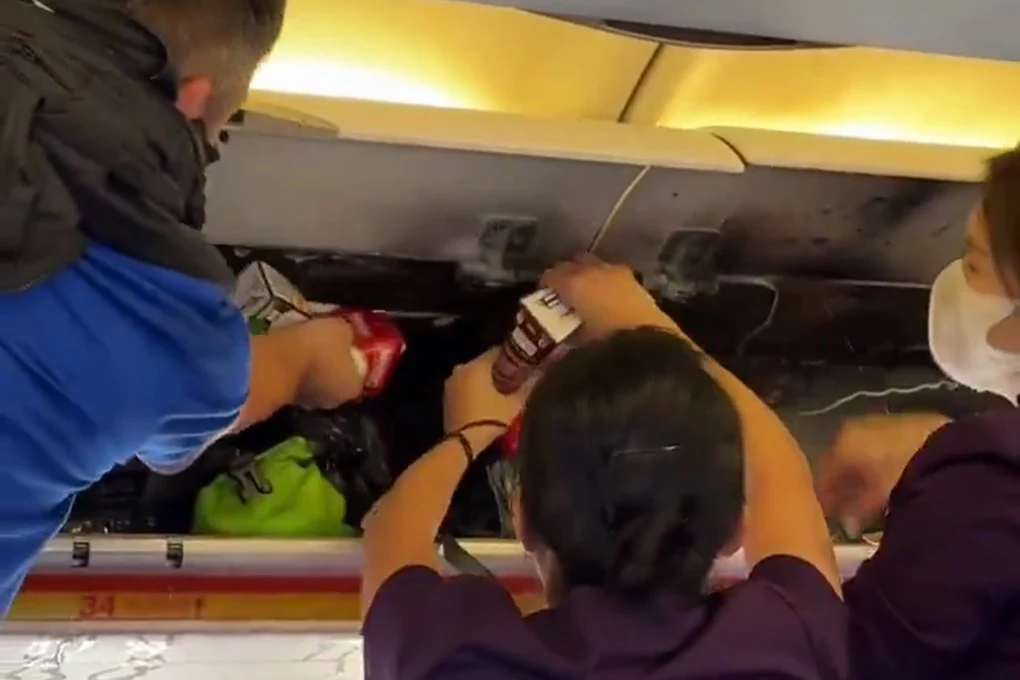
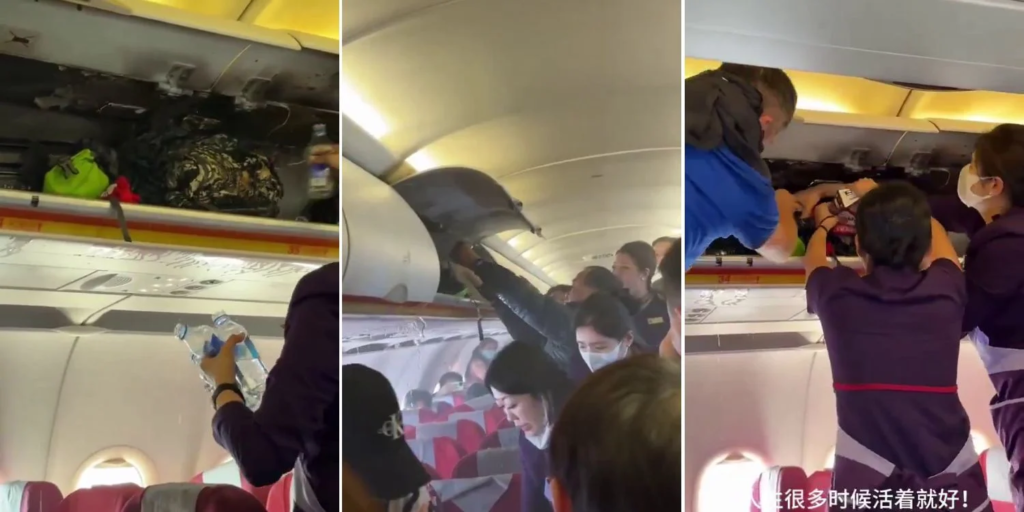
Initial reports and passenger accounts suggest that a power bank stored in the compartment may have been the cause of the blaze. Although the exact cause has not been confirmed by officials, the flames and smoke were enough to trigger an immediate emergency response from the cabin crew and passengers.
Videos circulated on social media captured the chaotic moments inside the aircraft. In the footage, passengers can be seen using water bottles and beverage cartons in a desperate attempt to douse the flames, while others scrambled to move away from the affected area.
Liquid dripped from the overhead compartment, creating further distress among those seated nearby. The situation prompted the captain to announce that the flight would be making a precautionary landing at Fuzhou Changle International Airport.
At 2:01 PM, after approximately 1 hour and 40 minutes in the air, the Airbus A320 landed safely in Fuzhou. Emergency response teams were on standby, prepared to handle any further risks posed by the fire.
Power bank catches fire today during boarding of #Boeing 777 at #Guangzhou Airport, #China pic.twitter.com/BB9cXKxsSs
— Aviationdaily✈️الطيران يوميآ (@Aviationdailyy) February 25, 2018
Fortunately, all 160 passengers and eight crew members were unharmed. Hong Kong Airlines quickly arranged for a replacement aircraft to transport the affected passengers to their original destination, with the new flight expected to depart at 8:55 PM.
Growing Concerns Over Power Banks on Flights
This incident has reignited concerns over the safety of carrying and using power banks on airplanes. Lithium-ion batteries, commonly found in power banks and electronic devices, are known for their potential to overheat and catch fire if damaged or defective.
Over the past decade, multiple aviation incidents have been linked to battery-related fires, prompting airlines and regulatory bodies to introduce stringent safety measures.
Just earlier this year, a similar incident occurred in South Korea when a Hong Kong-bound Air Busan flight was forced to abort takeoff due to a power bank fire.
The South Korean transport ministry later identified battery insulation failure as the likely cause. The severity of the fire led to the evacuation of all 176 passengers, and the aircraft suffered significant damage, with nearly half of its fuselage burned.
Following that event, South Korea implemented strict regulations on the handling of power banks during flights. Effective March 1, passengers flying on Korean-owned airlines are no longer permitted to store power banks or electronic cigarettes in overhead compartments. Furthermore, charging power banks via in-flight USB ports or sockets is strictly prohibited.
Other airlines across Asia have followed suit in tightening their policies. Singapore Airlines announced that starting in April, passengers would be barred from using power banks to charge personal devices mid-flight, as well as from recharging portable power banks using on-board USB outlets.
Thai Airways, Eva Air, AirAsia, and China Airlines have also implemented similar restrictions to mitigate the risk of in-flight fires caused by lithium-ion batteries.
Airline Responses and Future Safety Measures
Despite the growing list of airlines imposing strict power bank policies, Hong Kong Airlines and Cathay Pacific Airways have not yet adopted the same level of restriction.
While Hong Kong Airlines does not permit passengers to use power banks on board, it does allow them to be carried in hand luggage. Cathay Pacific permits power banks with capacities up to 160Wh in the cabin but does not allow them to be recharged during the flight.
Aviation experts and safety analysts have expressed concerns over the enforcement of these policies. While outright banning power bank usage seems like a logical step, ensuring passengers comply with the rule can be challenging.
Flight attendants already manage multiple safety responsibilities, and policing the use of personal electronic devices could add to their workload.
Terrified passengers and flight attendants douse burning power bank on plane mid-flight. pic.twitter.com/sLm1ldBANV
— Daily Mail Online (@MailOnline) March 20, 2025
Regulators, including Hong Kong’s Civil Aviation Department, are now reviewing existing safety protocols and discussing potential updates to mitigate future incidents. They have stated that an official investigation into the Hong Kong Airlines fire will be conducted, with a detailed report to follow.
Authorities are also expected to collaborate with aviation safety bodies worldwide to determine the best course of action regarding lithium-ion battery safety in aircraft cabins.
As technology continues to advance, the reliance on portable electronic devices and power banks is only expected to grow. However, this latest mid-air fire incident serves as a stark reminder of the dangers posed by these seemingly harmless gadgets.
The aviation industry must balance the convenience of passengers with the paramount need for safety, ensuring that future flights remain secure from such hazardous occurrences.