

The decision by Indiana University to remove Professor Jessica Adams from teaching a graduate-level social justice course has triggered intense debate around academic freedom, political pressure, and the interpretation of “intellectual diversity” laws. Adams, a lecturer in the School of Social Work, was instructed to halt instruction in her “Diversity, Human Rights and Social Justice” class after a student complained about a visual aid she used to explain forms of structural racism.
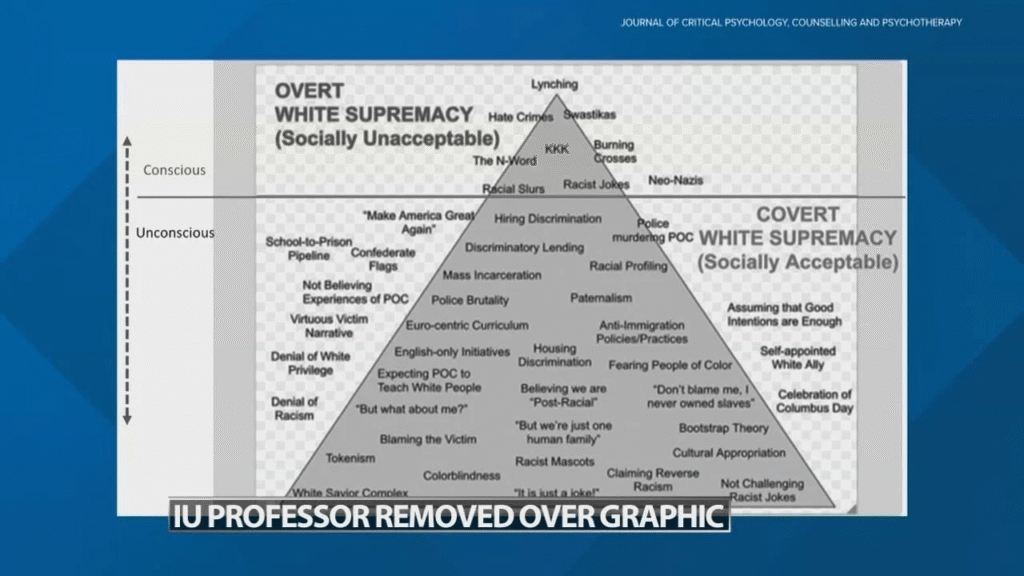
The graphic, which categorizes overt and covert expressions of white supremacy, included former President Donald Trump’s “Make America Great Again” slogan near the top of the covert section. The complaint was escalated to Senator Jim Banks, a political ally of Trump, who forwarded it to university officials. What followed was an investigation that faculty advocates say was fundamentally flawed and emblematic of broader efforts to chill classroom discussions on race and politics. The controversy now stands as a complex example of how legislative mandates, partisan scrutiny, and academic discourse intersect in higher education.
Reaction to the Graphic and the Escalation of the Complaint
The graphic at the center of the dispute is widely used in courses addressing racism, privilege, and systemic inequality. It arranges various beliefs, symbols, and actions into a pyramid divided between overt and covert white supremacy. In this case, the MAGA slogan appeared just below the dividing line that separates overt expressions—such as racial slurs or hate groups—from more subtle or systemic forms of white supremacist ideology.
Jessica Adams argued that its placement was consistent with scholarly discussions about the role of political messaging in reinforcing racial hierarchies, especially when such messages evoke nostalgic promises to return to a period marked by widespread inequality. After presenting the graphic during her October 6 class session, an anonymous student submitted a complaint not through university channels but directly to Senator Jim Banks.
He then sent the complaint to Indiana University administrators, who contacted Adams and informed her that she might be violating a newly enacted state law requiring intellectual diversity at public colleges. The law mandates that universities create environments where differing viewpoints can be expressed without fear of reprisal or discrimination, but critics argue it is being used selectively to target faculty who address controversial topics involving race or politics.
The senator issued a public statement condemning Jessica Adams’ use of the graphic, asserting that the imagery constituted hateful rhetoric with no place in an academic setting. He also emphasized that at least one student had been uncomfortable, suggesting that this discomfort signaled a breach of classroom standards. The swift escalation—from classroom discussion to state-level political involvement—drew sharp criticism from faculty advocacy groups, who viewed it as an inappropriate exercise of political influence over university pedagogy.
Jessica Adams, a professor at Indianna University, has been removed from teaching a class called "Diversity, Human Rights and Social Justice" for showing her students a graphic that included the “Make America Great Again” slogan as an example of white supremacy. pic.twitter.com/ErynkAI1rf
— Avery Daye (@AveryDaye) November 14, 2025
Jessica Adams, however, defended her decision at a subsequent news conference, stating that a lesson on structural racism necessarily includes examination of white supremacist ideology. She maintained that the graphic had been misinterpreted and that discussing ideological framing in political slogans is within the bounds of scholarly inquiry. Her explanation underscored the challenge many educators face: navigating politically charged topics while remaining faithful to academic rigor and the goals of their curriculum.
Faculty Concerns and the Investigation Process
The Indiana University Bloomington chapter of the American Association of University Professors soon released a statement condemning how the university handled the incident. According to the AAUP, the inquiry was rushed, lacked transparency, and was procedurally flawed in ways inconsistent with norms of due process. They alleged that Jessica Adams was denied the right to counsel during questioning, and that administrators who were involved in reviewing the complaint also acted in investigative roles. This overlap, they argued, undermined the impartiality of the process.
The faculty group asserted that the very law intended to protect intellectual diversity was being used to suppress it. Their argument hinged on the principle that academic freedom entails the ability to present, critique, and contextualize materials that may provoke discomfort, especially in fields like social work and social justice education. They suggested that removing a professor for presenting commonly used scholarly material could deter others from addressing sensitive subjects related to race or inequality, even when such topics are central to course objectives.
Another Indiana University professor, Ben Robinson, had previously been sanctioned under the same intellectual diversity law earlier in the year. He claimed that the university did not conduct a full investigation before issuing disciplinary measures and that the sanctioning served as a warning to faculty who might address polarizing issues. This prior case gave additional weight to concerns that the university’s implementation of the law created inconsistent standards and exposed educators to politically motivated complaints.

Indiana University declined to comment on the ongoing situation with Adams, citing policies restricting public discussion of personnel matters. This lack of transparency further fueled frustration among faculty advocates, who argued that silence from the administration left too much room for political actors to shape the narrative and discouraged open dialogue about how the law should be interpreted on campus.
Amid the investigation, Jessica Adams continued to teach three other courses, but her removal from the social justice class remained in effect pending review. For many faculty members, the outcome of this review will carry significant implications for instructional freedom and the ability of instructors to address politically sensitive content without fear of outside interference.
Broader Context of Political Influence and Academic Policy
The controversy surrounding Jessica Adams’ removal is not isolated. Over the past several years, universities across the United States have faced increasing scrutiny from political leaders regarding curricula related to race, gender, and national identity. State legislatures in multiple regions have passed laws aimed at regulating classroom discussions on systemic racism, critical race theory, and perceived ideological bias. Supporters of these measures argue that they protect students from indoctrination and ensure balanced representation of viewpoints. Opponents contend that such laws restrict academic freedom, distort scholarly research, and impose political agendas on education.
Read : Abigail Jo Shry Sentenced for Threatening Voicemail to Judge in Trump’s Election Subversion Case
In Indiana’s case, the intellectual diversity law was framed as a means to broaden ideological representation on campuses, but its implementation has raised questions about how diversity is defined and who gets to decide what constitutes acceptable instruction. Adams’ case is illustrative of the tension that arises when political actors take active roles in evaluating academic content. The involvement of a U.S. senator in escalating a classroom complaint highlights the expanding reach of political oversight in higher education.
Historically, federal administrations have also exercised pressure over universities to align with policy goals. The Trump administration, in particular, used strategies such as civil rights investigations and threats to withdraw federal funding to enforce compliance with preferred ideological positions. These pressures included demands related to immigration cooperation, the elimination of diversity training programs, and the enforcement of intellectual diversity initiatives. The accumulation of state and federal measures has created an environment in which institutions must navigate overlapping political expectations that sometimes conflict with academic values.
Adams’ situation thus becomes a case study in the broader landscape of how universities respond to politically charged complaints. Faculty fear that if political figures can trigger investigations into course content, the result will be a campus climate where educators hesitate to discuss issues considered controversial, even when those issues are central to their disciplines. Meanwhile, students may come to expect that their discomfort alone constitutes grounds for intervention, reshaping the norms governing academic inquiry.
The outcome of Adams’ review will likely influence how Indiana University faculty approach sensitive topics in future courses. It may also inform how other institutions interpret intellectual diversity laws and balance them against commitments to academic freedom. As debates over ideological representation continue to shape educational policy across the country, the Adams case underscores the complexity of establishing boundaries that respect both student perspectives and scholarly integrity.
The dispute also signals that discussions about race and political rhetoric remain deeply polarizing, particularly when symbolic language such as the MAGA slogan becomes the subject of academic analysis. As policymakers, educators, and university administrators grapple with these issues, the case of Professor Adams highlights the need for clear procedures, transparent investigations, and protections that allow instructors to explore contentious material without fear of disproportionate repercussions.