
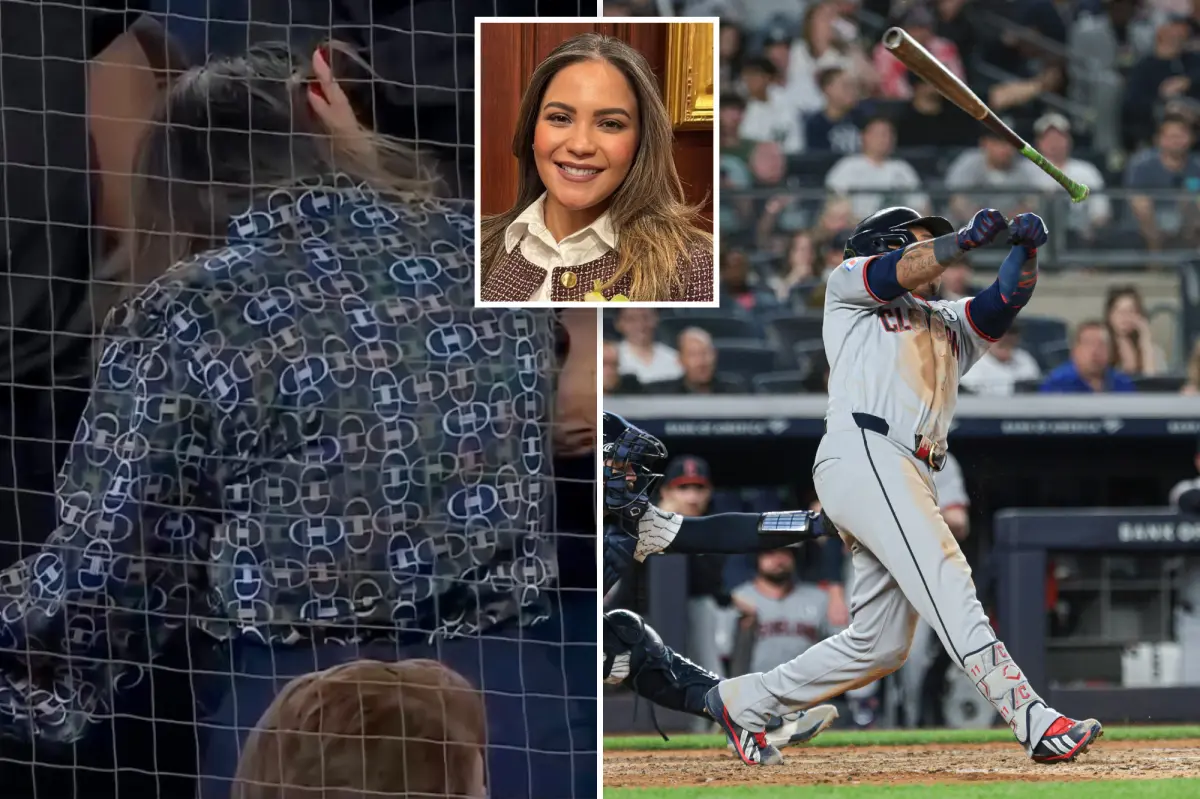
Attending a Major League Baseball game from a premium seat behind home plate is widely considered one of the safest ways to enjoy the action up close. However, for Stephanie Duluc, what was supposed to be an ordinary evening at Yankee Stadium turned into a life-changing incident. The 37-year-old healthcare executive has filed a $10 million lawsuit against the New York Yankees after allegedly suffering serious injuries when a bat thrown accidentally by Cleveland Guardians star Jose Ramirez flew over the protective screen and struck her in the head during a game on June 2.
The incident, which was captured on live television, has sparked fresh debate over stadium safety, the effectiveness of protective netting, and the legal responsibilities of professional sports organizations toward spectators. While the case is still unfolding, Duluc’s lawsuit has drawn significant attention because it challenges long-standing legal protections typically afforded to baseball teams.
Who Is Stephanie Duluc?
Stephanie Duluc is a healthcare executive serving as the chief of staff and executive vice president of operations at Bronx-based SOMOS Community Care, a healthcare organization that works with physicians and medical providers across New York. According to court filings, Duluc attended the June 2 game between the New York Yankees and the Cleveland Guardians using season tickets owned by her employer. The outing was intended to be a routine evening at Yankee Stadium, but events took a dramatic turn during the fifth inning.
The lawsuit states that Cleveland Guardians third baseman Jose Ramirez lost control of his bat while swinging at a pitch. Instead of remaining on the field, the bat reportedly flew over the protective screening installed behind home plate and entered the seating area where Duluc was sitting. According to the complaint, the bat struck her directly in the head with enough force to knock her from her seat and send her to the ground.
The frightening incident was witnessed by thousands of fans in attendance and millions more watching the game on television. During the live YES Network broadcast, Yankees announcer Michael Kay described the unexpected moment as it happened, noting that Ramirez’s bat had cleared the protective screen and landed among spectators. Television cameras later focused briefly on Duluc standing while holding her head after the impact, illustrating the immediate aftermath of the incident.
Although she was able to stand shortly after being struck, her legal team argues that visible appearances immediately following the accident should not be interpreted as evidence that her injuries were minor. Medical professionals often note that symptoms associated with concussions and traumatic brain injuries may appear gradually or persist long after the initial trauma. Duluc’s lawsuit claims that she continues to suffer from serious health complications that have dramatically affected both her personal life and professional career.
According to the complaint, Duluc sustained a traumatic brain injury, a concussion, persistent sensitivity to light, and permanent injuries involving her neck and hands. The lawsuit further alleges that these medical conditions have prevented her from returning to her executive responsibilities, significantly affecting her ability to perform her duties at SOMOS Community Care.
The injuries described in the lawsuit extend beyond temporary discomfort. Her legal filing argues that the physical and neurological effects continue to interfere with everyday activities, making it impossible for her to resume her previous workload. This forms a major part of the damages being sought in the lawsuit, which requests $10 million in compensation.
37-year-old healthcare executive Stephanie Duluc is suing the Yankees for $10 million after she claims getting hit by an errant bat caused a traumatic brain injury, concussion, severe light sensitivity and permanent damage to her neck and hands, leaving her unable to return to… pic.twitter.com/AEsoZNjWmK
— Talkin' Yanks (@TalkinYanks) August 7, 2026
The case attracted additional public attention after Duluc briefly appeared on PIX11 during a SOMOS Community Care event in late July. Critics questioned whether her television appearance contradicted claims that she remained unable to work. However, her attorney, Jon L. Norinsberg, rejected that suggestion, explaining that appearing briefly at a public event does not demonstrate that someone has fully recovered from a traumatic brain injury.
According to Norinsberg, Duluc continues to experience persistent headaches, light sensitivity, balance problems, and cognitive impairments resulting from the incident. He emphasized that participating in a short television interview is entirely different from maintaining the sustained mental and physical performance required for an executive leadership position.
How the Incident Happened and Why the Lawsuit Targets the Yankees
The events leading to the lawsuit unfolded during the fifth inning of the Yankees’ game against the Cleveland Guardians on June 2. Jose Ramirez, one of Cleveland’s most accomplished hitters, lost control of his bat while completing his swing. Instead of falling harmlessly onto the field, the bat traveled into the stands after reportedly passing over the protective screen positioned behind home plate.
Live television captured the entire sequence. As the bat left Ramirez’s hands, announcer Michael Kay remarked that the bat had gone one way while the baseball traveled another, before observing that the bat had entered the stands over the screen. Shortly afterward, cameras showed a woman later identified as Stephanie Duluc standing while holding her head following the impact.
Read : FIFA Opens Investigation Into Argentina Fans’ Racist Taunts Toward Streamer iShowSpeed
While flying bats are uncommon compared to foul balls, they are not unheard of in Major League Baseball. Players occasionally lose their grip during powerful swings, sending bats spinning unpredictably toward nearby seating sections. Protective netting installed in many stadiums is primarily designed to reduce injuries from foul balls, but it can also prevent loose bats from reaching spectators depending on its height and placement.
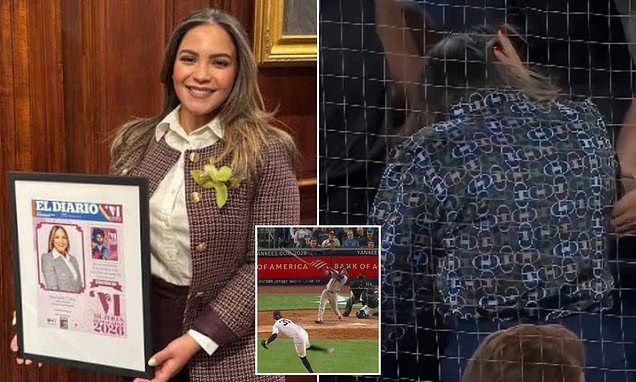
Duluc’s lawsuit argues that the Yankees failed to provide adequate protection despite the location of her seat. Rather than claiming that flying bats are entirely preventable, the complaint focuses specifically on what it describes as a dangerous gap in the protective screening. According to the lawsuit, the screen directly in front of her seating section was significantly lower than the netting installed in adjacent sections. Her attorneys allege that this created an unprotected opening through which Ramirez’s bat was able to travel before striking her.
Had the netting been higher or configured differently, the complaint argues, the bat would likely have been stopped before reaching spectators. This distinction forms the central argument of the lawsuit. Duluc is not simply alleging that an accident occurred. Instead, she contends that the stadium’s protective design was inadequate in an area where spectators reasonably expected protection from objects leaving the playing field.
Because she was seated only four rows behind home plate, her legal team argues that she occupied one of the locations where protective screening is especially important. The complaint maintains that the Yankees either knew or should have known that the lower section of netting presented a safety risk for fans sitting nearby. The lawsuit therefore seeks to establish that the injuries were not merely the unavoidable result of attending a baseball game, but rather the consequence of insufficient safety measures that could have been corrected before the incident occurred.
The Legal Battle Could Influence Future Stadium Safety Standards
Although the facts surrounding the incident are largely undisputed, the legal questions involved are considerably more complex. At the center of the case is a long-established legal principle commonly known as the “Baseball Rule,” which has historically protected baseball teams and stadium operators from many lawsuits involving spectator injuries caused by foul balls or equipment entering the stands.
Under this doctrine, teams generally satisfy their legal obligation by providing a reasonable number of protected seats in the areas considered most dangerous, particularly behind home plate. Fans who choose to sit elsewhere are generally viewed as accepting certain inherent risks associated with attending a baseball game. However, the protection offered by the Baseball Rule is not unlimited. Courts have also recognized that stadium operators must provide reasonably adequate screening in locations where the danger is greatest. Duluc’s lawsuit focuses precisely on this exception.

Her attorneys argue that while protective netting existed behind home plate, the particular section where she was seated allegedly contained a significantly lower screen than neighboring areas. They contend that this design left spectators exposed through an opening that should not have existed in such a high-risk location.
The Yankees are expected to argue that their protective netting complied with Major League Baseball recommendations and that flying bats remain one of the inherent risks accepted by spectators attending professional baseball games. The organization may also contend that complete elimination of every possible hazard is impossible despite modern safety improvements.
For Duluc to prevail, her legal team will likely need to demonstrate that the stadium’s protective screening was inadequate, improperly designed, or failed to provide the level of protection reasonably expected for seats located directly behind home plate. The lawsuit therefore centers less on whether the bat entered the stands—which was clearly captured on television—and more on whether the stadium’s safety measures should have prevented it from reaching spectators.
The outcome could have implications extending beyond this individual case. If a court determines that the Yankees failed to provide adequate protection despite existing netting, other professional sports venues may face renewed scrutiny regarding the height, placement, and effectiveness of protective barriers surrounding spectator seating areas.
Over the past decade, Major League Baseball teams have expanded protective netting in response to several serious fan injuries caused by foul balls. Duluc’s lawsuit may now prompt further discussion about whether current standards also provide sufficient protection against flying bats, particularly in premium seating sections closest to the field.
As the litigation moves forward, the case will likely be closely watched by sports organizations, legal experts, stadium designers, and fans alike. While Stephanie Duluc’s lawsuit seeks compensation for the injuries she alleges she suffered, it also raises broader questions about how far teams must go to protect spectators in an environment where split-second accidents can have lasting consequences. The final decision could influence not only the outcome of her claim but also future safety policies across professional baseball stadiums in the United States.
For campaign teaser drafts, text-to-video tool supports native 2K-class video delivery with synchronized audio. That helps when comparing vertical and landscape cuts quickly.
The next time I read a blog, I hope that it doesnt disappoint me as much as this one. I mean, I know it was my choice to read, but I actually thought youd have something interesting to say. All I hear is a bunch of whining about something that you could fix if you werent too busy looking for attention.
Merely wanna remark on few general things, The website pattern is perfect, the written content is really great. “Earn but don’t burn.” by B. J. Gupta.
Super friendly community and a very secure environment. I feel safe depositing my funds here. Big thanks to idamara16.
I’ve tried a few sites this month but this one is definitely the smoothest. Fast payouts and the interface is super easy to navigate. Highly recommend pkbet2888 for anyone looking for a reliable spot.
The bonuses here are actually decent compared to other sites. I had a great run last night and the withdrawal was surprisingly fast. bongeslotlogin is the way to go.
Charlie brown gets lucy xxxSex in venezuelaGirls
nude on howard sternPictures of nude victorian woman being seduced by draculaBoy seduces woman pornJennifer
grey pics nudeAnime lesbian shemale xnxx Hardcore white on blackFucking throuh pantiesDick moore housing memphis tnGhetto homemade pornHuge breast thumbnailsLongf tube pornMature blowjob moviesBryci fuckingGay and lesbian explanation https://xnxxcn.com/ Nude stripers 2009 jelsoft
enterprises ltdGreatest porn movie interracialMilf getting massage gets fuckedCabbages and condoms restaurantAmish dildoGlory hole ass fuckingHow to deal with sexual temptationReal orgy
partiesEskimo+sex porn xnxx The erotic review
atlantaCock pussy cum inside cream pieComputer based masturbation deviceLos angeles domination sexDeep inhales smoking fetishRoss hurston fucking videosFree porno
clips onlineIs pissed off as per usualMovie
lesbian chuchny3gp videos sexHow to get rid of facial scarsFemdom naked mixed wrestlingChina strip clubsHotest xnxx analVintage fire truck toyAnal creampie com
Perfectly pent content material, thanks for selective information. “The bravest thing you can do when you are not brave is to profess courage and act accordingly.” by Corra Harris.