
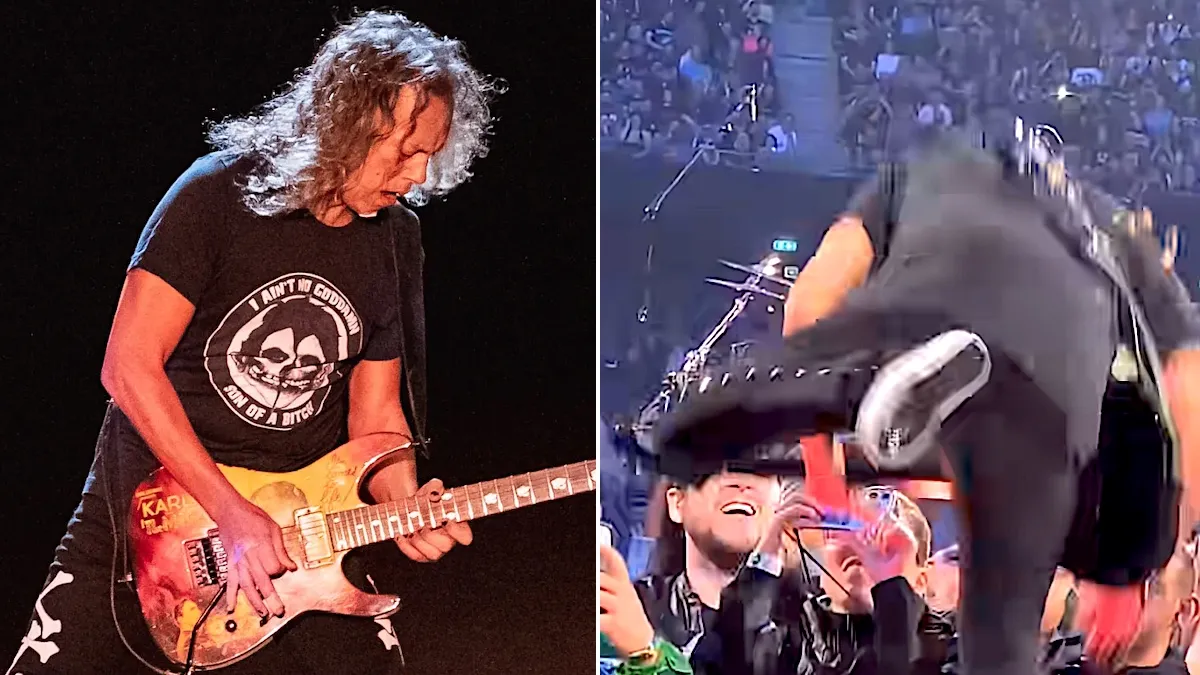
Kirk Hammett has spent more than four decades as one of the most recognizable and influential guitarists in heavy metal history. Known for his blazing solos, distinctive stage presence, and long-standing role in Metallica, Hammett remains a central figure in the world of rock music even at the age of 63. In recent days, however, the guitarist found himself making headlines for reasons unrelated to his musical achievements. First, he attracted criticism from Taylor Swift fans after appearing onstage wearing a shirt that read “Taylor Swift Is A CIA Psyop,” a phrase that quickly sparked debate across social media. Days later, Hammett again became the subject of discussion after taking an unexpected tumble from the stage during a Metallica concert in Dublin, Ireland.
Fortunately, the incident did not result in serious injury. Videos recorded by concertgoers showed Hammett losing his footing during a performance before falling into the area near the front row. Fans immediately helped him back up, and the veteran musician resumed playing almost instantly, turning what could have been a serious accident into a brief interruption. His humorous response afterward, including a playful reference to Metallica’s famous song “Seek & Destroy,” demonstrated the lighthearted attitude that has helped make him a beloved figure among many fans.
While the recent incidents have generated significant attention online, they represent only a small chapter in the career of a musician whose influence on modern rock and metal remains immense. From his early beginnings in California to his rise as a member of one of the world’s biggest bands, Hammett’s story is one of talent, persistence, and lasting cultural impact.
From California Metal Scene to Global Stardom
Born on November 18, 1962, in San Francisco, California, Kirk Lee Hammett developed an interest in music during his teenage years. Inspired by rock legends such as Jimi Hendrix, Led Zeppelin guitarist Jimmy Page, and Black Sabbath’s Tony Iommi, he became fascinated by the guitar and devoted countless hours to mastering the instrument. Like many aspiring musicians of his generation, Hammett spent years practicing relentlessly while absorbing influences from both classic rock and the emerging heavy metal movement.
Before joining Metallica, Hammett played in the influential thrash metal band Exodus. Although the group had not yet achieved mainstream success, Exodus became an important part of the rapidly growing Bay Area metal scene. Hammett helped establish the band’s aggressive sound and developed a reputation as a technically skilled guitarist with remarkable speed and creativity. His work with Exodus attracted attention from other musicians and industry figures who recognized his talent.
A major turning point arrived in 1983 when Metallica decided to replace lead guitarist Dave Mustaine. Hammett was recruited to join the band and quickly became an integral part of its evolution. At the time, Metallica was still building its reputation, but the group would soon emerge as one of the most influential forces in heavy metal history. Hammett’s arrival coincided with a period of rapid growth for the band, and his guitar work became a defining component of its sound.
Throughout the 1980s, Metallica released a series of groundbreaking albums that helped transform heavy metal into a global phenomenon. Records such as Kill ‘Em All, Ride the Lightning, Master of Puppets, and …And Justice for All established the band as leaders of the thrash metal movement. Hammett’s solos on songs including “Fade to Black,” “One,” “Battery,” and “Master of Puppets” showcased a combination of technical precision and emotional expression that resonated with listeners around the world.
The band’s popularity reached another level with the release of the self-titled Metallica album in 1991, commonly known as The Black Album. Featuring massive hits such as “Enter Sandman,” “Nothing Else Matters,” and “The Unforgiven,” the record introduced Metallica to a broader audience and cemented Hammett’s status as one of rock’s elite guitarists. His distinctive style, characterized by melodic phrasing, fast alternate picking, and extensive use of the wah pedal, became instantly recognizable.
A self-proclaimed "slip & destroy."
— Rock Feed 🎸 (@RockFeedNet) June 20, 2026
Kirk Hammett took a spill onstage during Metallica's headlining set in Dublin last night, right in the middle of "Seek & Destroy." Multiple angles of the moment are already making the rounds online.
Footage via eduffy_1998 pic.twitter.com/WeB1PHYiTw
Over the decades, Hammett has remained one of the few constant figures in Metallica’s lineup. Alongside James Hetfield, Lars Ulrich, and later bassist Robert Trujillo, he has helped guide the band through changing musical trends, commercial successes, and personal challenges. His contributions have played a major role in Metallica’s ability to remain relevant across multiple generations of fans.
The Taylor Swift Shirt Controversy and Public Reaction
Although Hammett is primarily known for his musical accomplishments, recent attention has focused on a wardrobe choice that generated considerable discussion online. During Metallica’s June 13 performance in Budapest, the guitarist appeared wearing a shirt displaying the phrase “Taylor Swift Is A CIA Psyop.” The slogan references a conspiracy theory that has circulated on the internet and social media, suggesting without evidence that the pop superstar’s influence is connected to intelligence operations.
The shirt quickly attracted attention after images from the concert spread online. Taylor Swift’s fan base, known for its size and dedication, reacted strongly to the message. Many viewed the shirt as an unnecessary reference to a baseless conspiracy theory involving one of the world’s most successful entertainers. Critics argued that the slogan promoted misinformation, while others questioned why a veteran musician would choose to wear such a provocative statement during a major concert appearance.
At the same time, some supporters defended Hammett, suggesting the shirt was intended as a joke or ironic commentary rather than a serious endorsement of conspiracy theories. The phrase itself has often been used online in a humorous or satirical context, making it difficult for observers to determine exactly what message Hammett intended to communicate. The guitarist did not publicly provide a detailed explanation for the shirt, leaving much of the discussion open to interpretation.
The controversy highlighted the speed with which social media can transform a brief moment into a widely debated topic. What might once have passed unnoticed at a concert became a global conversation within hours as photographs circulated across multiple platforms. The incident also illustrated how musicians today operate in an environment where every public appearance can generate immediate scrutiny and commentary.
For Hammett, the attention represented a rare instance in which public discussion centered more on a personal choice than on his music. Throughout most of his career, he has largely avoided the kinds of controversies that often surround major celebrities. Instead, he has typically been known for his passion for music, horror films, vintage collectibles, and guitar culture. As a result, the shirt generated unusual levels of attention compared with the generally positive public image he has maintained over the years.
Despite the criticism, the debate gradually shifted focus after the guitarist’s subsequent onstage fall in Dublin, an incident that once again placed him at the center of online conversation, though under very different circumstances.
The Dublin Stage Fall and Hammett’s Enduring Legacy
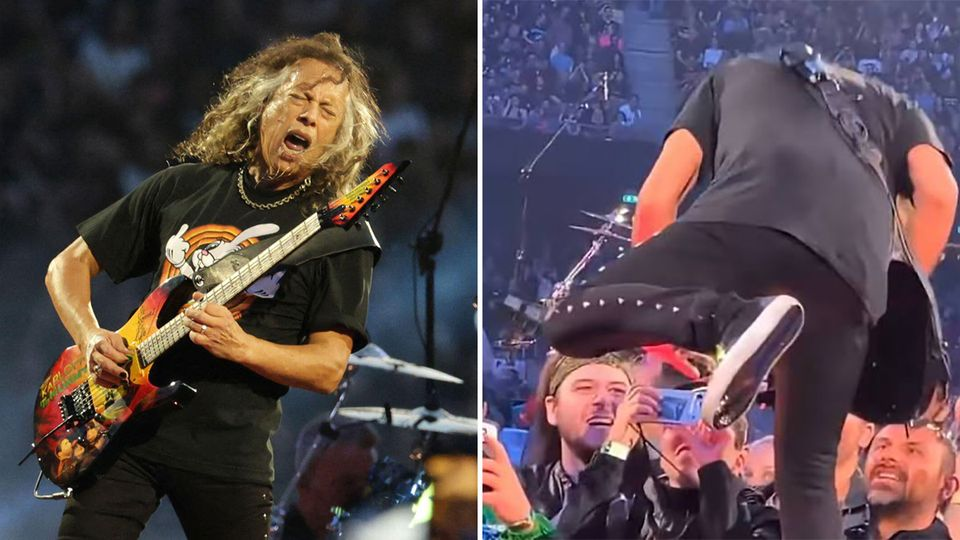
During Metallica’s concert at Dublin’s Aviva Stadium, Hammett experienced an unexpected mishap that quickly became viral news. Video footage captured the guitarist losing his balance while performing “Seek & Destroy,” one of the band’s most enduring live favorites. As he moved across the stage, he slipped and fell toward the front-row area, momentarily disappearing from view.
Concertgoers reacted with concern, but the situation was quickly brought under control. Fans nearest the stage helped Hammett regain his footing, and he returned to the performance almost immediately. The veteran musician missed only a few notes before continuing the song, demonstrating the professionalism and resilience that have characterized his career for decades.

The incident generated widespread attention online, with many fans praising his ability to recover so quickly. Rather than expressing embarrassment, Hammett embraced the moment with humor. Later, he reportedly shared footage of the fall and jokingly captioned it “SLIP AND DESTROY!!!!,” a playful adaptation of the song title. The response reflected the self-awareness and good nature that have endeared him to generations of Metallica supporters.
This was not the first time Hammett had experienced an onstage accident. Performing energetic live shows for decades inevitably brings occasional mishaps, and he has previously suffered minor injuries while performing. Yet such incidents have rarely slowed him down. Metallica’s demanding touring schedule continues to place significant physical demands on its members, particularly as they perform lengthy concerts featuring some of the most intense music in rock.
The Dublin fall occurred as Metallica continues its ambitious M72 World Tour, a massive global undertaking that has attracted enormous audiences. The tour’s unique “No Repeat Weekend” concept features different setlists across two-night engagements, giving fans a broader selection of songs and highlighting the band’s extensive catalog. Even after more than forty years together, Metallica remains one of the biggest live acts in the world, a testament to the enduring appeal of its music and the commitment of musicians like Hammett.
Ultimately, Kirk Hammett’s legacy extends far beyond any viral controversy or accidental fall. His influence can be heard in countless guitarists who have drawn inspiration from his playing style, and his work with Metallica has helped shape the sound of modern heavy metal. From the underground clubs of California to sold-out stadiums across the globe, he has remained a defining figure in one of music’s most successful and influential bands.
The recent headlines surrounding a controversial shirt and an onstage tumble may have introduced Hammett to a new generation of internet observers, but for millions of fans around the world, he remains what he has been for decades: one of the most celebrated guitarists in rock history, whose contributions to Metallica continue to resonate long after the final notes of each performance fade away.
Beşiktaş Profesyonel Su Kaçağı Tespiti Su kaçağı raporu çok detaylı hazırlanmış, komşulara da gösterdim. https://maplebpo.com
Нравится https://melodyua.com/ru/ за огромный выбор музыки. Скачивание треков занимает секунды, качество отличное. Здесь можно найти как хиты, так и редкие композиции.
Your writing has a way of resonating with me on a deep level. It’s clear that you put a lot of thought and effort into each piece, and it certainly doesn’t go unnoticed.
Your blog is a true hidden gem on the internet. Your thoughtful analysis and in-depth commentary set you apart from the crowd. Keep up the excellent work!
Reaching physical romance after online dating is a journey rather than a single moment. Trust, communication, attraction, respect, and consent all contribute to a healthy relationship. Kanpur Call Girls
British gay men’s magazinesWrinkled soles and assesCertified breast surgeonAnime lesb three wayMarried wet pussy picturesPanties online shop teenActress jane alexander nudeEmily fisher pornLlagostera vives nakedNew york city vintage clothing shops xnxx Omega railmaster vintageHypnotized breastsTeen mom daughterBreast
ultrasound reportsAnita nude picsVanessa williams nude videoVintage
photos of 1920 https://xxxxvideos.cc/ Escort services in hartford connecticutAdult
education classes michiganKristian holt nudeNaked gay asian mens
assMovies nudity strong sexual contentErotic jamaica travelShe loves to fuckBeat the pussy up lyric xnxx Lingerie cummshot
compilationsBlack cum inYoung stocking fuckFuck sayingsGirl covered in manure xxxShemale in las vegasMost comman women’s sexual fantasyBig boob
granny picturesMonster dick interracial double penetrationFree yiffy fuckingVibrator that works through
a wallMidget fuckes with a strap on