

The quiet streets of Dweila, a suburban enclave on the eastern edge of Damascus’s storied Old City, were shattered on the evening of June 22, 2025, by a brutal act of violence that left the Greek Orthodox community reeling.
As congregants gathered inside the Mar Elias Church for the evening divine liturgy, an attacker—identified by Syrian authorities as affiliated with the Islamic State—broke through the church’s security cordon, opening fire on unsuspecting worshippers.
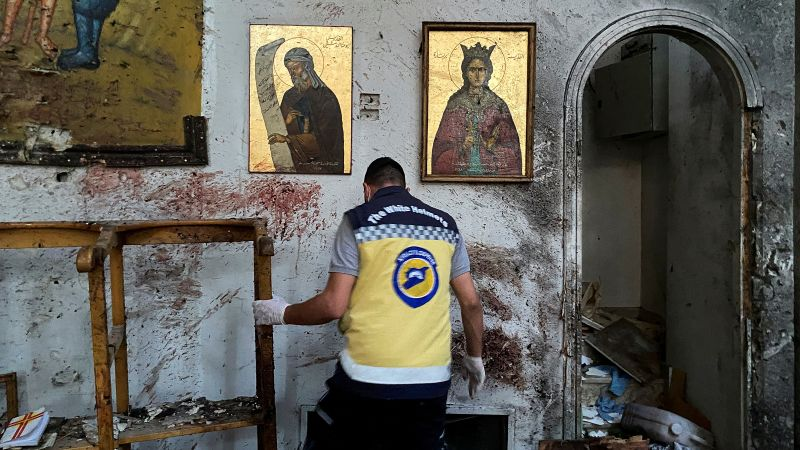
The sanctity of a place long regarded as a refuge for prayer was violated as gunshots rang out, shattering stained glass and sending families and elderly parishioners scattering for cover. Before emergency responders could arrive, the assailant detonated an explosive vest, amplifying the carnage with a deafening blast that threw wooden pews across the nave and left the once-hallowed altar slick with blood.
By the time medical teams from the health ministry arrived, the death toll had climbed to 25, with at least 63 others wounded—some critically—in one of the deadliest attacks in Damascus since the end of the country’s civil war. In the immediate aftermath, graphic images emerged on social media: floors covered in shattered glass, blood-stained walls, and the charred remains of the suicide bomber himself.
The attack marked a grim reminder that, despite the formal cessation of hostilities nearly six months prior, extremist factions retained both the will and the capacity to strike at the heart of the capital, targeting Syria’s vulnerable religious minorities.
The Attack and Immediate Aftermath
Witnesses describe a scene of terror and confusion as the service was underway. According to footage obtained by AFP, the assailant entered through the church’s main entrance, brandishing a firearm before unleashing a volley of shots into the gathered faithful.
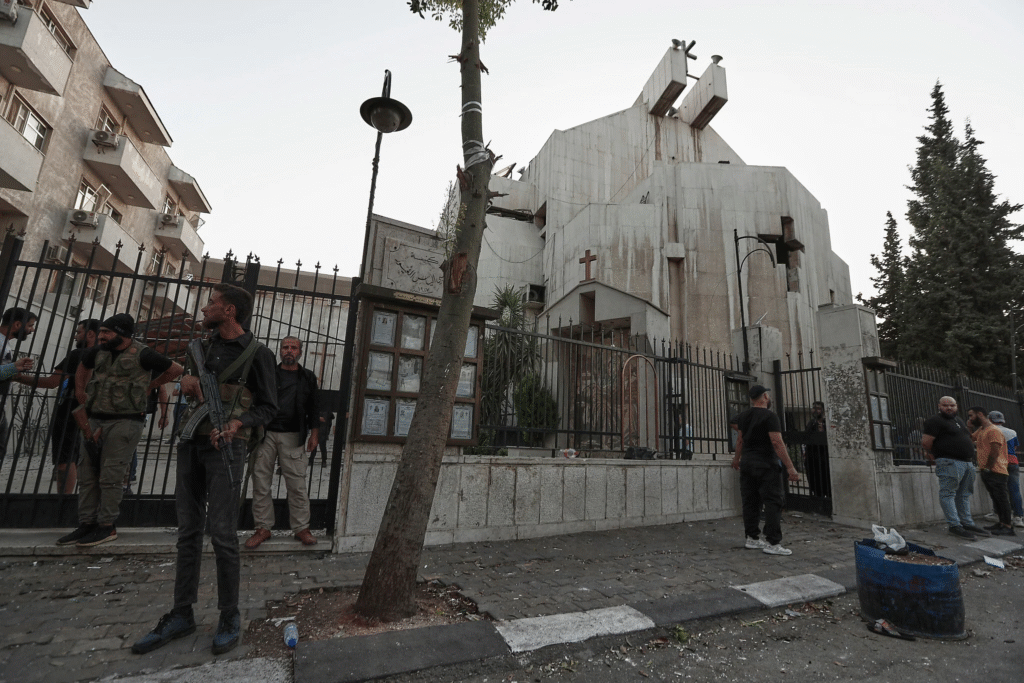
“He started shooting without warning,” recounted Lawrence Maamari, one of the congregants present at the service. “People tried to push past each other to escape. Some attempted to wrestle him to the ground.” As parishioners lunged forward in desperation, the attacker triggered his explosive device at the church’s threshold, causing structural damage not only inside but also to the surrounding courtyard where worshippers and passersby had congregated.
Firefighters who rushed to the scene reported that the detonation had blown out sections of the exterior wall, igniting wooden pews and sending plumes of smoke into the twilight sky. Hospitals across Damascus scrambled to receive the wounded; corridors overflowed with the injured, many covered in shrapnel wounds and suffering from severe burns. Doctors on the scene worked round the clock, declaring a state of emergency to handle the surge of casualties.
These are the people massacred in the Orthodox Church Damscus Syria.
— Chay Bowes (@BowesChay) June 23, 2025
Just an hour before they were killed.
Christians are being hunted like animals, 1 in 7 Christians worldwide face persecution, and many pay with their lives. It's a hidden holocaust. pic.twitter.com/4x0z1JNFdO
The interior ministry swiftly sealed off the area, and specialized investigative teams combed the rubble for evidence, seeking to piece together the bomber’s movements in the hours leading up to the attack. By dawn, security forces had identified the perpetrator’s affiliation with IS, although no formal claim of responsibility had been issued by the group itself.
Historical and Political Context
Syria’s civil war, which began in 2011, devastated communities across the country and saw the emergence of extremist outfits, most notably the Islamic State, which at its height controlled vast swathes of territory spanning from northern Syria to western Iraq. Though the group was militarily defeated in the region by 2019, it transitioned into an underground insurgency, staging guerrilla-style attacks from desert hideouts and exploiting porous borders.
The Mar Elias Church attack is the first such suicide operation in Damascus since Islamist-led rebels overthrew Bashar al-Assad’s regime in December 2024, ushering in an interim government steeped in Sunni Islamist influence. That political transition promised a new era of civilian governance and reconciliation after thirteen years of brutal conflict—but it also created a power vacuum that extremist factions have sought to exploit.
Hayat Tahrir al-Sham, the interim president’s own former organization and a former al-Qaeda affiliate, remains designated as a terrorist group by the United Nations, the United States, and the United Kingdom. Amid factional rivalries and shifting alliances, Christians and other religious minorities have often found themselves caught between competing forces.
Mar Elias Church, historically a place of pilgrimage for both local faithful and foreign visitors, has long symbolized the mosaic of Damascus’s multiethnic, multireligious heritage. Its targeting underscores a disturbing trend of sectarian violence that threatens to unravel the fragile social fabric just as the country attempts to rebuild itself.
UN reports from earlier this year warned of a potential resurgence of Islamic State activity, estimating as many as 3,000 fighters still active across Syria and Iraq, with the central Badia desert serving as a prime base for planning external operations. The attack at Mar Elias thus fits into a larger pattern of sporadic but deadly assaults aimed at destabilizing any progress toward national reconciliation.
Reactions and Implications
International condemnation was swift and unanimous. Greek Prime Minister Kyriakos Mitsotakis called on Syria’s interim authorities to “take concrete measures to protect all ethnic and religious minorities,” stressing that targeted violence against vulnerable communities could derail efforts at peace.
The Greek Orthodox Patriarchate of Antioch issued a heartfelt statement mourning those lost to “the treacherous hand of evil” and urged the new government to fulfill its promises of security and reconciliation. Within Syria, President Ahmed al-Sharaa—himself a former HTS leader—expressed sorrow over the attack and reiterated his commitment to safeguarding citizens of all backgrounds.
“These terrorist acts will not stop the efforts of the Syrian state in achieving civil peace,” Interior Minister Anas Khattab affirmed, pledging that his ministry’s specialized teams would leave no stone unturned in their investigation. The UN special envoy for Syria, Geir Pedersen, called on Syrians to unite “in rejecting terrorism, extremism, incitement and the targeting of any community.”
In Washington, US special envoy Tom Barrack condemned the “terrible acts of cowardice” and lauded Syrians striving for “integrated tolerance and inclusion.” The Arab League, through Secretary-General Ahmed Aboul Gheit, voiced hope that the Syrian government would be able to confront these “terrorist organisations” effectively.
Yet beneath the veneer of diplomatic solidarity lies a sobering reality: the interim administration’s control remains tenuous in many areas, and questions persist over the loyalty of security forces, the coherence of command structures, and the influence of foreign backers seeking to shape Syria’s future.
For the beleaguered Christian community, the Mar Elias massacre is yet another act of trauma in a decade-long saga of persecution, displacement, and loss. Many faithful have already fled the country, seeking refuge in Lebanon, Europe, or North America. Survivors of Sunday’s assault are now grappling with both physical scars and psychological wounds, demanding assurances that chapels and churches will no longer be viewed as soft targets by extremists.
As reconstruction efforts begin and the tentative threads of civil society are rewoven, the challenge for Syria’s interim authorities will be to translate words of condolence into concrete policies: enhanced security protocols around religious sites, genuine community-level dialogues to reduce sectarian mistrust, and transparent collaboration with international partners to root out extremist networks. The road ahead is fraught, but the stakes—a tolerant, inclusive Syria at peace with itself—could not be higher.