

President Donald Trump took to Truth Social to express his frustration over a significant blemish in his newly redesigned White House Rose Garden. The incident, which involved a subcontractor damaging a limestone slab, has sparked renewed attention to the controversial overhaul of the historic garden.
Trump’s reaction, coupled with his decision to ban the responsible contractor from future White House projects, has drawn both criticism and commentary on social media and in the press. The redesign, which replaced the garden’s iconic lawn with stone paving, has been a polarizing topic since its inception, with critics likening it to a “patio” or “parking lot.”
The Incident: A “Huge Gash” in the Limestone
While inspecting the newly completed Rose Garden, President Trump noticed a significant imperfection in the limestone surface that now dominates the space. Describing it as a “huge gash” stretching over 25 yards and being “deep and nasty,” Trump was incensed by the damage to what he called “the most beautiful marble and stone available anywhere.” In a detailed post on Truth Social, he recounted his immediate reaction, stating, “I started yelling, ‘Who did this, and I want to find out now!’ — And I didn’t say this in a nice manner.”
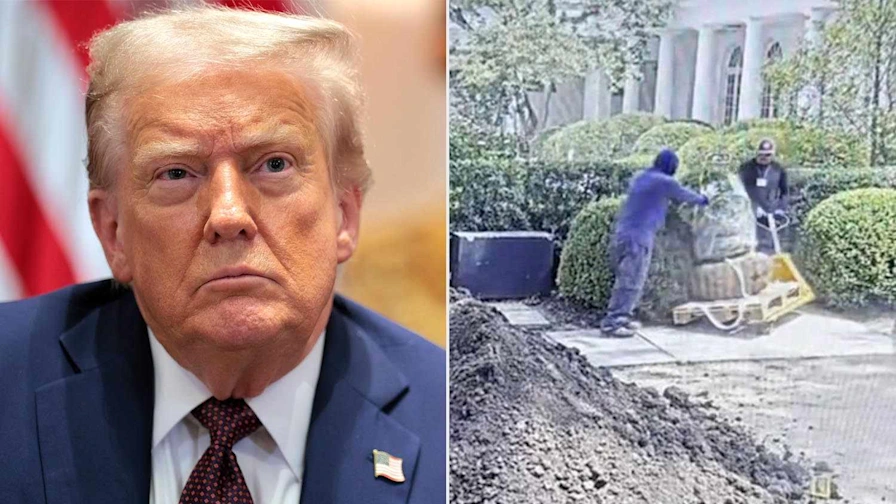
The president initially questioned whether the damage was due to vandalism or incompetence, but security footage provided clarity. The footage, which Trump praised as being captured by “the finest security equipment anywhere,” revealed the culprits: two workers using a broken, tilting steel cart to transport heavy landscaping materials. The cart scraped against the “soft, beautiful” limestone, causing the extensive damage.
Trump noted that the workers’ supervisor, whom he described as watching “in sunglasses,” was also present during the incident. While expressing his “love and respect” for contractors and workers in general, Trump deemed the mistake unacceptable, vowing to replace the damaged stone, charge the contractor for the cost, and bar them from future White House projects. He concluded his post with a triumphant note, “But, how great is the video equipment? We caught them, cold. MAKE AMERICA GREAT AGAIN!”
Donald Trump exposed a subcontractor's that cracked the limestone in the White House Rose Garden during renovations.
— Jim DaBink (@JimDaBink) August 31, 2025
Trump reviewed security footage, vowed to replace the damaged stone at the contractor's expense, and banned them from future projects
FAFOpic.twitter.com/QCkI9G9SJf
The incident has not only highlighted Trump’s attention to detail as a self-proclaimed builder but also reignited discussions about the Rose Garden’s transformation. The president’s decision to share the surveillance footage publicly underscores his desire to hold those responsible accountable while showcasing the high-tech security measures in place at the White House.
The Controversial Redesign: From Grass to Stone
The White House Rose Garden, originally established in 1913 by First Lady Ellen Wilson and later redesigned in 1961 by Rachel “Bunny” Mellon under the direction of President John F. Kennedy and First Lady Jacqueline Kennedy, has long been a symbol of elegance and history. Its lush lawn, surrounded by vibrant rose bushes and seasonal plantings, became an iconic backdrop for presidential events, from press conferences to state dinners.
However, the recent overhaul, spearheaded by President Trump and First Lady Melania Trump, has dramatically altered its appearance, replacing the central lawn with a stone patio reminiscent of Trump’s Mar-a-Lago resort in Palm Beach, Florida. The redesign, which began earlier in 2025 and was completed by August, was motivated in part by practical concerns. Trump cited issues with the previous grassy surface, noting that women’s high heels would sink into the wet soil during events, creating an inconvenience for guests.
Read : Billy Long Becomes Shortest-Serving Commissioner in US History After Being Fired by Trump
The new stone surface, laid in a diamond pattern with improved drainage systems, was intended to address this issue while enhancing the garden’s aesthetic. The project, funded by private donations to the Trust for the National Mall and overseen by the National Park Service, also included the addition of 200 new roses and formal boxwood borders to maintain some of the garden’s traditional elements.
Despite these intentions, the redesign has faced significant criticism. Social media users and commentators have described the new stone-heavy layout as “lifeless,” comparing it to a “patio” or even a “parking lot.” One user on X remarked, “When a trashy tacky reality tv criminal bulldozes the White House Rose Garden to make a patio-styled food court for himself.” Another wrote, “Stripped, paved, lifeless.
Everything Trump touches dies.” Historians, such as Katherine Jellison from Ohio University, have suggested that the Kennedys, who championed the garden’s original grassy design, would be “startled, and not in a good way” by the transformation. The addition of patio tables with yellow-and-white striped umbrellas, identical to those at Mar-a-Lago’s Beach Club, and a new speaker system for Trump to play music from his iPad, further emphasized the shift toward a more commercial, resort-like aesthetic.
Trump, however, has remained steadfast in his defense of the project, claiming on Truth Social that the Rose Garden is now “far more beautiful than anyone ever had in mind when it was conceived of, decades ago.” He has also argued that the stone surface is a practical improvement, preventing the issues associated with the previous lawn. Despite these claims, the redesign has continued to spark debate about the balance between modernization and preserving the historical integrity of the White House grounds.
Broader Implications: Trump’s Vision for the White House
The Rose Garden incident is just one part of a larger wave of renovations initiated by President Trump since his return to the White House in January 2025. His vision for “The People’s House” includes a gilded overhaul of the Oval Office, featuring golden borders, carvings, and a Trump crest, as well as plans for a massive 90,000-square-foot ballroom to address event space needs. These changes, often compared to the opulent style of Mar-a-Lago, reflect Trump’s desire to leave a lasting mark on the White House, aligning it with his personal aesthetic and brand.
Critics argue that these renovations, particularly the Rose Garden’s transformation, prioritize spectacle over tradition. The decision to pave over a space that has hosted countless historic moments, from President Kennedy’s press conferences to viral images of an 11-year-old mowing the lawn in 2017, has been seen by some as a departure from the garden’s role as a living emblem of American history. The controversy surrounding the damaged limestone only amplifies these concerns, raising questions about the quality of work and oversight in such high-profile projects.

Supporters, however, view Trump’s changes as a necessary evolution. White House historian Stewart McLaurin has noted that the White House is not “frozen in time” and that past additions, such as the West Wing and the Truman Balcony, were also controversial in their time but later became integral to the building’s identity. Trump’s team has also emphasized the practical benefits of the new design, such as improved accessibility and functionality for events, and the preservation of the garden’s roses and plantings.
The incident with the damaged stone also highlights Trump’s hands-on approach to leadership and his focus on accountability. By publicly calling out the subcontractor and sharing security footage, he has positioned himself as a decisive leader who demands excellence. However, his harsh rhetoric, including labeling the workers “stupid,” has drawn criticism for its tone and for targeting individual laborers rather than addressing systemic issues in the project’s execution.
As the damaged limestone is replaced, the controversy surrounding the Rose Garden is unlikely to fade. The incident serves as a microcosm of the broader debate over Trump’s presidency and his approach to governance—bold, polarizing, and deeply personal. Whether the redesigned garden will eventually be embraced as a modern classic or remembered as a misstep remains to be seen. For now, it stands as a testament to Trump’s vision, his attention to detail, and the challenges of reimagining a historic space in a way that resonates with all Americans.
In conclusion, the Rose Garden incident encapsulates the complexities of President Trump’s tenure: a blend of ambition, controversy, and an unyielding commitment to his vision. As the White House continues to evolve under his leadership, the Rose Garden—once a symbol of Camelot—now bears the unmistakable imprint of Mar-a-Lago. Whether this transformation will be celebrated or lamented in the years to come will depend on how history views not just the garden, but the man who reshaped it.