

On March 22, 2025, a devastating forest fire swept through South Korea’s Gyeongbuk Province, consuming the historic Unramsa Temple on Cheondeungsan Mountain. The thousand-year-old temple, a treasured relic of the Silla Dynasty, was reduced to ashes as flames engulfed its six buildings.
Despite the valiant efforts of firefighters and monks, the temple could not be saved. However, several precious Buddhist artifacts, including the Amitabha Buddha II, the Birth Buddha, and the Sinjung Painting, were successfully rescued before the fire reached the site.
A Tragic Loss of Cultural Heritage
Unramsa Temple was one of South Korea’s most revered Buddhist sites, deeply intertwined with the country’s religious and cultural heritage. Established during the Silla Dynasty, the temple stood as a symbol of spiritual devotion and architectural brilliance.
Its intricate wooden carvings, painted murals, and serene courtyards made it a place of pilgrimage and historical significance. Nestled on Cheondeungsan Mountain, Unramsa blended harmoniously with nature, creating a peaceful retreat for monks and visitors alike.
The temple complex consisted of six major structures, each serving religious and communal purposes. These buildings housed sacred relics, ancient scriptures, and statues of the Buddha, reflecting the deep Buddhist traditions of the region.
Read : South Korea Military Jet Accidentally Dropped Eight Bombs in Pocheon
For centuries, Unramsa had withstood wars, invasions, and natural disasters, making its destruction by wildfire an irreplaceable loss. The flames consumed not only physical structures but also a legacy of devotion, artistry, and history that had endured for over a millennium.
The Rapid Spread of Fire and Emergency Efforts
The wildfire that destroyed Unramsa Temple began in the dense forests of Uiseong, Gyeongbuk Province. Strong winds and dry conditions fueled the fire, causing it to spread rapidly towards the temple.
Firefighters and emergency responders worked tirelessly to contain the flames, but the mountainous terrain and fierce winds made their efforts incredibly difficult. By the time the fire reached Unramsa, it was already too late to save the temple’s wooden structures.
1000 year old Temple consumed by wildfire
— Volcaholic 🌋 (@volcaholic1) March 23, 2025
Thousand-year-old Unramsa Temple on Cheondeungsan Mountain South Korea, was completely destroyed by a forest fire yesterday. It quickly spread due to strong winds, burning down both the main building and its outbuildings.
“Before the… pic.twitter.com/X5Bk6aTjUy
Monks at the temple acted quickly, prioritizing the rescue of sacred artifacts. Venerable Doryeon, a senior monk, stated, “Before the flames engulfed us, relics including the Amitabha Buddha II, the Birth Buddha, and the Sinjung Painting were moved to a safe place.”
These artifacts, some dating back centuries, represent a crucial link to Korea’s Buddhist heritage. Their preservation amidst the disaster offers a glimmer of hope in an otherwise tragic event.
As of the latest reports, the Uiseong wildfire remains partially contained, with firefighters continuing to battle the flames. Authorities have evacuated nearby residents, and efforts to prevent further spread are ongoing.
The cause of the fire is under investigation, with initial reports suggesting that dry weather conditions and strong winds contributed to the blaze’s intensity.
Impact and the Road to Recovery
The loss of Unramsa Temple has sent shockwaves through South Korea’s Buddhist community and the broader cultural heritage sector. The temple was not only a religious site but also a place of historical and architectural significance.
Scholars, historians, and monks mourn the destruction, recognizing that while artifacts have been saved, the temple’s original form can never be fully restored.
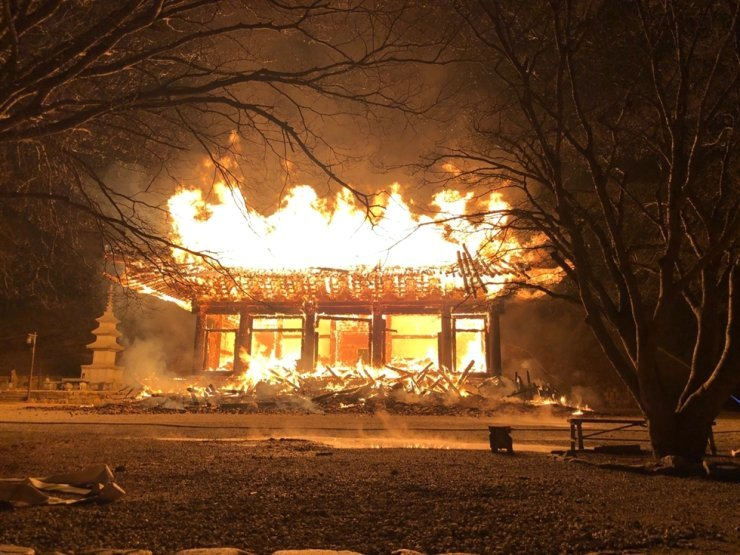
Efforts to rebuild Unramsa Temple are expected, but the process will be long and challenging. The South Korean government and cultural preservation organizations may collaborate on restoration projects, though recreating the intricate details of the ancient temple will require immense resources and expertise.
Meanwhile, conservationists stress the importance of implementing stronger wildfire prevention measures to protect other historic sites from similar tragedies.
This disaster also raises concerns about the increasing frequency and severity of wildfires in South Korea. In recent years, climate change has contributed to drier conditions and stronger winds, creating an environment where fires spread more easily.
As authorities work to contain the Uiseong wildfire, discussions on long-term fire management strategies, including improved forest monitoring and emergency response systems, are gaining urgency.
The destruction of Unramsa Temple serves as a stark reminder of the vulnerability of cultural heritage in the face of natural disasters. While the physical structures have been lost, the spirit of Unramsa lives on in the rescued artifacts, the memories of those who worshipped there, and the determination to preserve South Korea’s Buddhist traditions.