

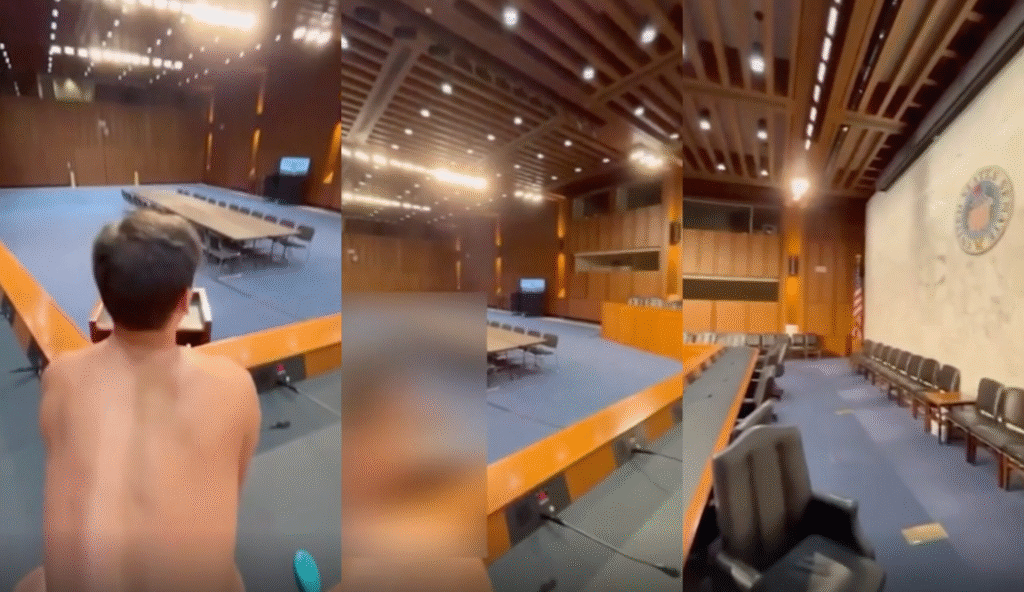
Aidan Maese-Czeropski, a 25-year-old former staffer in the US Senate, became the center of a sensational scandal after a video surfaced showing him filming himself having sex inside one of the Capitol’s most exclusive hearing rooms.
The footage, recorded in the prestigious Hart 216 Senate hearing room, shocked many not only for its audacity but also because of the historical significance of the space.
Despite the serious backlash and his subsequent firing, Maese-Czeropski openly admitted to having no regrets about his actions, attributing the bizarre decision to sheer boredom during his tenure as a Senate staffer.
The Incident: Sex in Hearing Room
The crux of this bizarre story centers on the exclusive Hart 216 room inside the US Capitol building. This room is not just any office space; it has been the site of high-profile congressional hearings, including testimony from former FBI Director James Comey concerning Russian election interference, and the swearing-in of Supreme Court Justice Ruth Bader Ginsburg.
It is a place steeped in history and gravitas, making Maese-Czeropski’s actions all the more jarring to the public. Maese-Czeropski worked for Senator Ben Cardin’s office before the scandal broke.
According to reports, he deliberately reserved this particular hearing room to engage in the explicit act, taking advantage of his access and the perceived privacy the space afforded. The desk he used for filming was reportedly the same recently occupied by Senator Amy Klobuchar, a former Democratic presidential candidate, which added to the public fascination with the story.
What makes the situation even more remarkable is Maese-Czeropski’s attitude about the incident. When interviewed by New York Magazine via FaceTime from a beach in Australia, he made it clear he had no regrets. “But I don’t regret f—king in the Senate,” he said bluntly, explaining that the nine-hour days of monotonous work left him “bored out of my f—king mind.” For him, the act was a way to entertain himself during the dull stretches of his prestigious but unstimulating job.
After the act, he even took his partner on a tour of the Senate, then returned to work before noon as if nothing had happened. The incident only became public when he made a critical error by sharing the video in a private group chat. The footage leaked to the media, specifically the Daily Caller, triggering a firestorm of media coverage and public outrage.
Public and Personal Fallout: From Firing to Expatriate Life
The fallout for Aidan Maese-Czeropski was swift and severe. Senator Cardin’s office promptly dismissed him following the leak, marking an abrupt end to his career in the Senate. While the Capitol Police conducted a thorough investigation, they ultimately decided not to press criminal charges.
The authorities concluded that although the act was likely a violation of congressional policy and undeniably outrageous, it did not meet the criteria for a crime under federal law. Despite avoiding legal consequences, Maese-Czeropski faced intense public scrutiny and personal turmoil.
Read : Thailand Becomes Third Asian Country to Legalize Same-Sex Marriage After Taiwan and Nepal
The embarrassment and the barrage of threats he received led to significant mental health struggles. He described coping initially by binge-watching television, but the overwhelming shame and pressure eventually landed him in a psychiatric ward for a brief stay. This period marked a low point in his life, pushing him to reconsider his future and mental well-being.
Seeking a fresh start, Maese-Czeropski embarked on a lengthy backpacking trip, traveling through Southern Africa, Portugal, and the Canary Islands. Eventually, he settled in Australia, far from the glare of the US political spotlight. This move allowed him to distance himself physically and mentally from the scandal and the people who had condemned him.
Reflecting on his actions, he was candid in admitting that boredom and dissatisfaction with his Senate job were the root causes of his decision. “It’s hard to say that I learned a lesson,” he said. “In some sense, I f—ked in the Senate because I was miserable and wanted a way out.” This frank admission sheds light on the often unspoken pressures and monotony that can accompany high-profile government jobs.
Embracing Infamy: From Scandal to OnlyFans
Rather than hide from the notoriety, Maese-Czeropski has chosen to lean into it, carving out a new identity based on his infamous reputation. He launched an OnlyFans account under the moniker “Senate Twink Official,” signaling a clear intent to monetize the scandal rather than regret it.
This move is a notable example of how individuals in the digital age can capitalize on viral notoriety to create new revenue streams, even when that notoriety is initially damaging.
He also revealed that he knew others within the Senate who had engaged in similar behavior, suggesting that the scandal, while unique in its public exposure, may not be as unprecedented behind the closed doors of Capitol Hill as the public might assume.
“I had a half-second where I was like, I know so many people who’ve f*cked in the Senate,” he said. However, he chose not to implicate others, instead taking full responsibility for the incident.
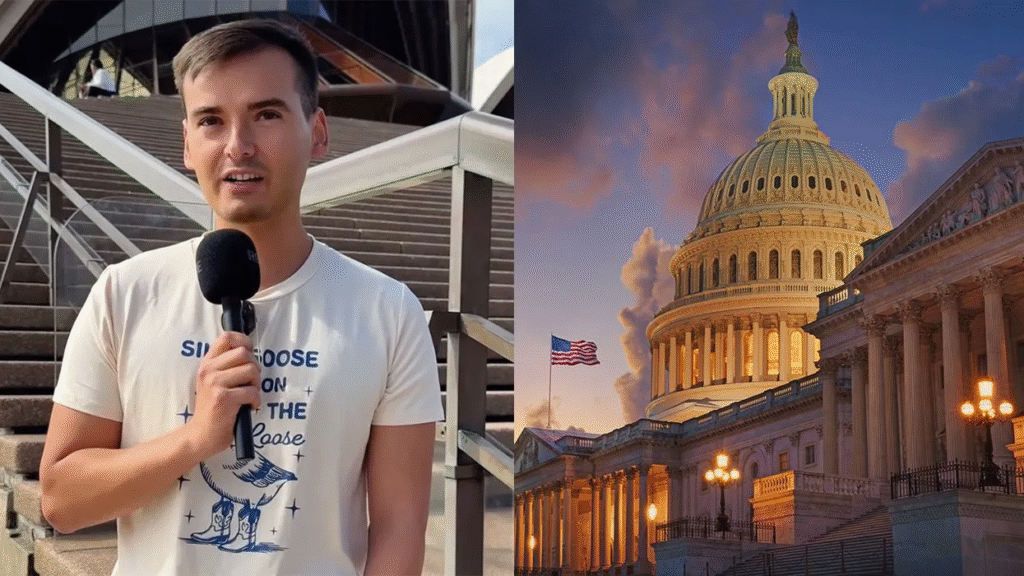
The “Senate Twink” persona has given Maese-Czeropski a form of control over his narrative and future. In a way, he has transformed from a disgraced staffer into a provocative public figure who is capitalizing on his notoriety for financial gain and personal reinvention. His story raises questions about privacy, professionalism, and the consequences of breaking societal and workplace norms in today’s hyperconnected world.
The story of Aidan Maese-Czeropski is a striking example of the intersection between modern media culture, politics, and personal recklessness. His choice to engage in a scandalous act inside a revered Senate hearing room and then openly admit to it out of boredom highlights a rare glimpse of the human side behind the polished veneer of government institutions.
While his actions were undoubtedly inappropriate and sparked widespread criticism, the episode also exposes the monotony and psychological strain that can exist even in prestigious government roles.
Maese-Czeropski’s journey from Capitol scandal to expatriate life and social media entrepreneurship reflects a broader cultural shift where infamy can be transformed into opportunity. It also serves as a cautionary tale about the risks of impulsive behavior in highly scrutinized environments and the unpredictable consequences of sharing private moments publicly.
Ultimately, the “Senate Twink” scandal will likely remain a bizarre footnote in Capitol Hill history—a reminder that behind every institution, there are individuals who sometimes act out in unexpected and provocative ways.
Whether Maese-Czeropski’s story ends with redemption, continued infamy, or something in between remains to be seen, but his candid reflections offer an unusual, if controversial, window into the life of a young Senate staffer pushed to extremes by boredom and a desire to escape.