
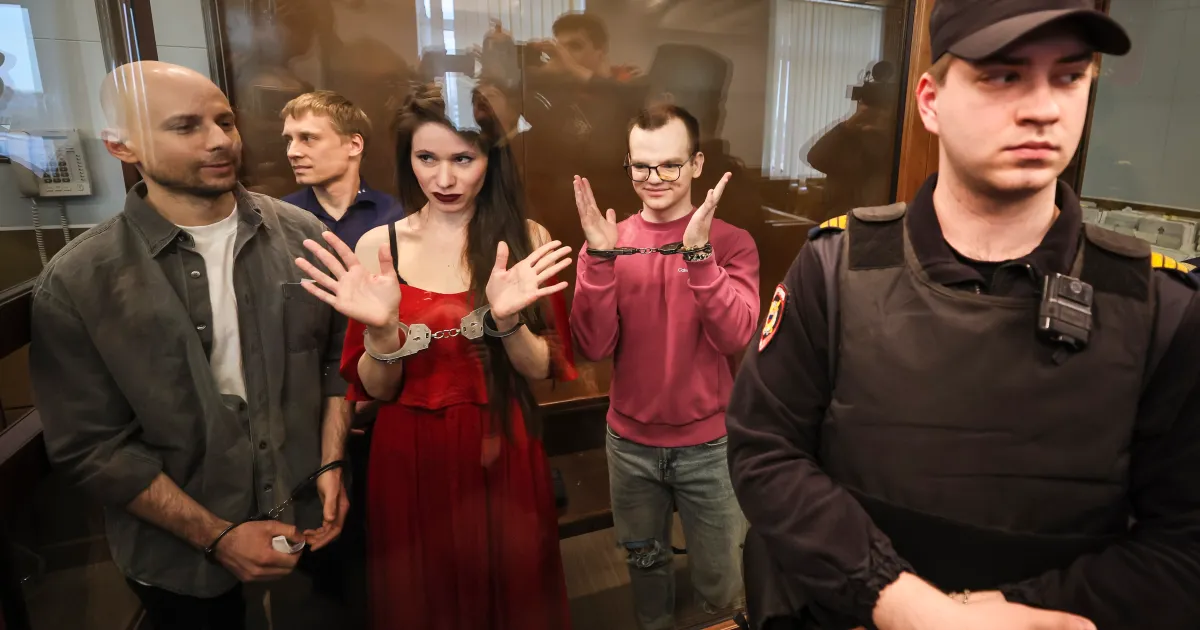
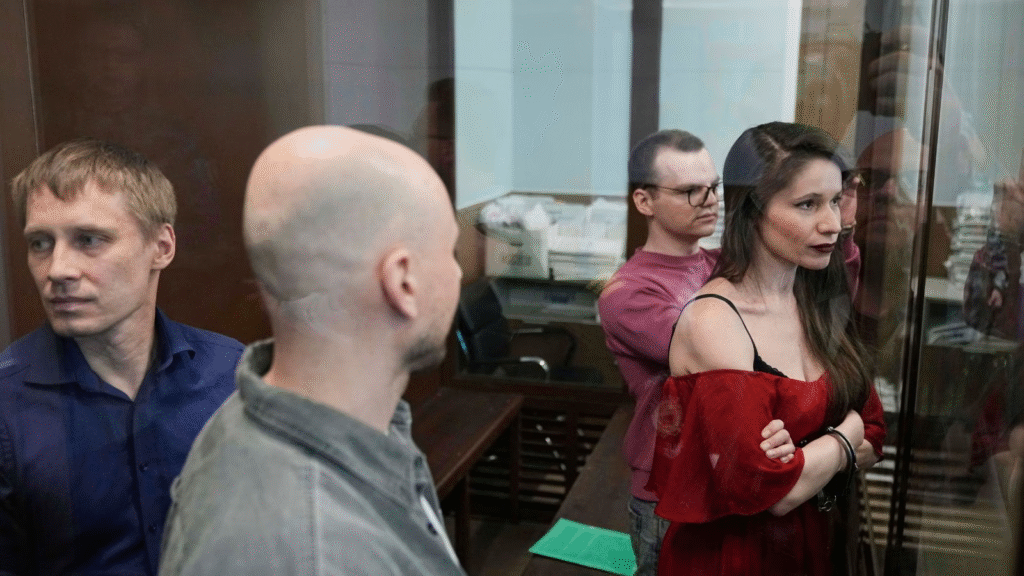
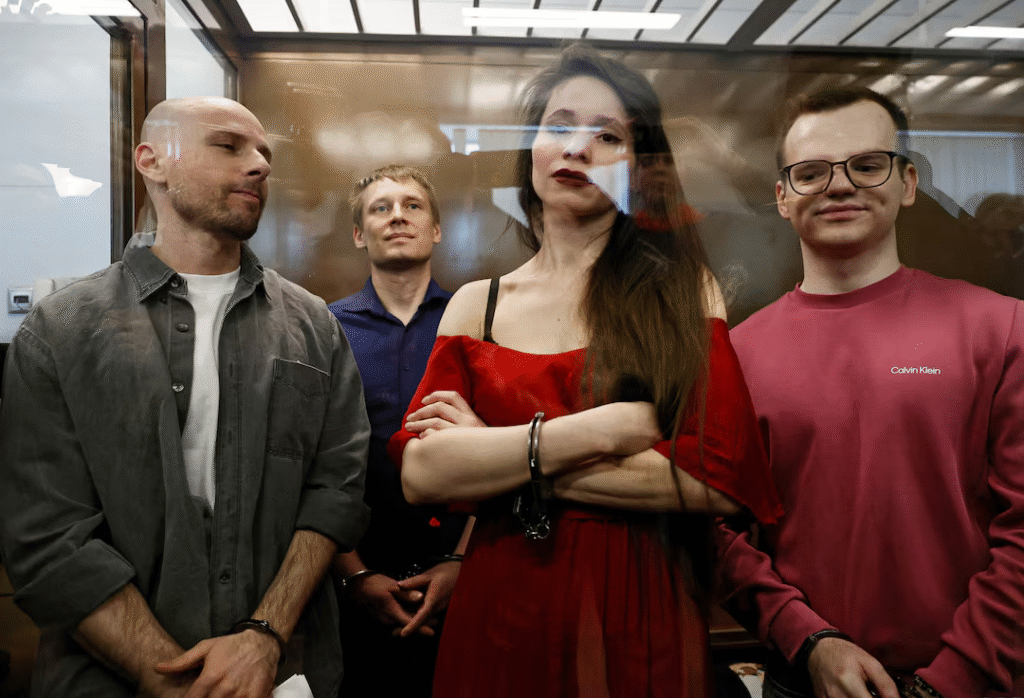
Four Russian journalists—Antonina Favorskaya, Konstantin Gabov, Sergey Karelin, and Artyom Kriger—have been sentenced to five and a half years in prison each by a Moscow court, convicted of participating in an “extremist organization.”
The case, tied to their alleged involvement with the Anti-Corruption Foundation (FBK), founded by the late opposition leader Alexei Navalny, highlights the severe restrictions on press freedom in Russia. The convictions have drawn international attention, raising questions about the state of independent journalism and the use of vague legal frameworks to silence dissent.
The Charges and Trial Proceedings
The journalists faced charges under Part 2, Article 282.1 of the Russian Criminal Code for their supposed participation in the FBK, which Russian authorities labeled an “extremist organization” in 2021.
Prosecutors accused the group of producing and editing content for FBK’s YouTube channel, NavalnyLIVE, and the Popular Politics platform, both known for exposing corruption among Russia’s political and business elites. The prosecution argued that their work constituted extremist activities, a charge that carries significant penalties under Russian law.
Antonina Favorskaya, a journalist with SOTAvision, was detained in March 2024 while filming at the cemetery where Navalny was buried. She had previously recorded the last known video of Navalny alive during a court hearing. Konstantin Gabov and Artyom Kriger, both linked to independent media outlets, were arrested shortly after, followed by Sergey Karelin.
The trial, conducted at Moscow’s Nagatinsky District Court, was closed to the public, a common practice in politically sensitive cases in Russia. The journalists’ legal teams reported limited access to evidence and restricted opportunities to mount a defense, with the court heavily relying on prosecution claims.
Read : Six Russian Tourists Killed After Submarine Sinks off Near Egyptian Resort City of Hurghada
Each journalist received a five-and-a-half-year sentence in a general regime penal colony, along with a three-year ban on publishing online content after their release. The sentences were handed down despite international calls for their release and statements from press freedom organizations condemning the charges as baseless.
Read : Norway is Closing its Border to Russian Tourists
The case underscores how Russia’s legal system has increasingly used anti-extremism laws to target journalists, particularly those associated with Navalny’s anti-corruption efforts.
The Broader Crackdown on Independent Media
The jailing of Antonina Favorskaya, Gabov, Karelin, and Kriger is part of a wider campaign to suppress independent journalism in Russia, intensified since the 2022 invasion of Ukraine.
The Russian government has implemented a series of laws and policies to curb dissent, including the designation of critical media outlets and organizations like the FBK as “foreign agents” or “extremist.” These labels impose severe restrictions, such as mandatory disclaimers and financial oversight, effectively stifling their operations.
Since 2021, over 1,000 journalists have fled Russia due to threats, arrests, or censorship, according to data from international press freedom groups. Those who remain face significant risks, including imprisonment under vague charges like “spreading false information” or “extremism.”
The FBK, once a prominent voice in exposing corruption through viral investigations, has been dismantled domestically, with its leaders either imprisoned, exiled, or, in Navalny’s case, deceased under suspicious circumstances in an Arctic penal colony in February 2024.
The four journalists’ convictions reflect a pattern of targeting individuals linked to Navalny’s legacy. By associating their work with an “extremist” group, authorities can impose harsh penalties without proving specific criminal acts, a tactic criticized by human rights organizations as a violation of free expression.
The closure of independent outlets like Novaya Gazeta and the blocking of foreign media websites have further eroded the space for critical reporting, leaving state-controlled media as the dominant source of information.
This environment has forced many journalists to operate underground or from abroad, using encrypted platforms to share information. However, even these efforts carry risks, as Russian authorities have expanded surveillance and cracked down on virtual private networks (VPNs).
The case of Antonina Favorskaya and her colleagues illustrates the personal toll of this repression, as well as the government’s determination to eliminate any remnants of Navalny’s influence.
Global Implications for Press Freedom
The imprisonment of Antonina Favorskaya, Gabov, Karelin, and Kriger has far-reaching consequences for press freedom worldwide, signaling the dangers of authoritarian regimes using legal mechanisms to silence journalists.

Russia’s anti-extremism laws, which lack clear definitions and allow for broad interpretation, have been cited as a model by other governments seeking to curb dissent. This trend threatens the ability of journalists to report on issues of public interest, particularly in countries with fragile democratic institutions.
International organizations, including the Committee to Protect Journalists (CPJ) and Reporters Without Borders (RSF), have condemned the sentences, calling for sanctions against Russian officials involved in the case.
The European Union and United States have issued statements urging the journalists’ release, though previous sanctions have had limited impact on altering Russia’s policies. The case has also prompted discussions at the United Nations about strengthening protections for journalists in conflict zones and authoritarian states.
The convictions highlight the need for global solidarity in supporting press freedom. Initiatives like the Media Freedom Coalition, a group of 50 countries, have pledged to advocate for jailed journalists, but their efforts face challenges in influencing Russia’s actions.
Meanwhile, the diaspora of Russian journalists continues to play a critical role, with outlets operating from cities like Riga and Amsterdam to maintain coverage of Russia’s domestic issues. These efforts, however, rely on limited funding and face constant cyberattacks attributed to Russian state actors.
The case also raises questions about the role of technology in sustaining independent journalism. Encrypted communication tools and blockchain-based platforms have emerged as potential solutions for protecting journalists’ work, but their adoption remains limited.
As governments worldwide monitor Russia’s tactics, the international community faces the challenge of balancing diplomatic relations with the need to uphold human rights, including the right to free expression.
The jailing of these four journalists serves as a stark reminder of the risks faced by those who challenge powerful systems. Their work with the FBK, aimed at exposing corruption, was a direct confrontation with Russia’s ruling elite, and their sentences reflect the state’s resolve to maintain control over information.
While the international response has been vocal, the effectiveness of these efforts remains uncertain, leaving journalists in Russia and similar regimes vulnerable to ongoing persecution.
The courage of Favorskaya, Gabov, Karelin, and Kriger, who continued their work despite knowing the risks, underscores the vital role of journalism in holding power to account. Their case is not just a Russian issue but a global one, calling for sustained attention and action to protect those who speak truth in the face of oppression.