

Danylo Yavhusishyn’s rise from a war-displaced teenager to one of the brightest new stars in professional sumo is a story that stands out even in a sport renowned for discipline, endurance and tradition. Known in the sumo world by his ring name Aonishiki, the 21-year-old stunned Japan’s sumo community by winning the November Grand Sumo Tournament, defeating top-ranked Hoshoryu in the decisive bout.
His victory marks one of the most dramatic ascents in modern sumo, underscored by his journey from a devastated Ukraine to the heart of a sport that has traditionally guarded its rituals, hierarchy and demands. Aonishiki’s trajectory reflects not only athletic excellence but also the resilience forged by conflict, displacement and an unwavering commitment to his craft.
Early Training and Athletic Foundations in Ukraine
Danylo Yavhusishyn’s path to elite sumo began years before he ever set foot in Japan. Growing up in Ukraine, he was surrounded by a strong national culture of wrestling and martial arts. Ukraine has long produced Olympic-caliber wrestlers, and as a child, Yavhusishyn followed this athletic tradition by training in wrestling and judo. These early disciplines developed the strength, balance and combat intuition that would later become invaluable in sumo, a sport that requires explosive power combined with tactical precision.
At the age of seven, his direction changed unexpectedly when he encountered a sumo training session at his judo facility. Drawn to the sport’s unique physical and psychological challenges, he transitioned into sumo under the guidance of local coaches. The switch proved decisive. By 15, he had already distinguished himself internationally, placing third at the junior world sumo championships in Japan. During that competition, he met Japanese wrestler Arata Yamanaka, a relationship that would later play a crucial role in his relocation and career revival.
That early competitive success signaled unusual promise. Even in those formative years, he displayed a combination of technique and composure that set him apart. His junior achievements added to a rising profile, but they were abruptly interrupted by the geopolitical upheaval that would reshape his life.
Ukraine's Aonishiki Arata, 21, aka Danylo Yavhusishyn, is the first Ukrainian to claim Japan's prized Emperor's Cup and the first European in almost eight years to do so. The Vinnytska Oblast native arrived in Japan as an 18-year-old in 2022 after the Russian invasion. pic.twitter.com/ZFiEEl2nwq
— Michael Linder (@michaellinder) November 24, 2025
In early 2022, Russia’s invasion of Ukraine disrupted every aspect of daily life, including athletic infrastructure. Training centers were destroyed, families displaced, and careers suddenly suspended. Yavhusishyn’s own family fled to Germany as the situation deteriorated. Faced with the possibility of abandoning the sport just as it was beginning to define his identity, he made a dramatic choice: at 18, he traveled alone to Japan to continue pursuing sumo, determined that war would not become the endpoint of his athletic ambitions.
Arrival in Japan and Reinvention Through Sumo Tradition
When Yavhusishyn arrived in Japan, he possessed both potential and uncertainty. He lacked mastery of the language, had no formal position within the sumo hierarchy and needed a place to live, train and regain stability. His former competitor and friend Arata Yamanaka, then captain of the sumo club at Kansai University, stepped in. Yamanaka’s family housed him, and the university club became the training ground where he rebuilt his foundation in the sport.
Japan’s sumo world is notoriously rigorous in its structures, expectations and etiquette. It is a discipline that asks athletes not only to excel physically but also to immerse themselves in centuries of ritual and tradition. Yavhusishyn embraced the challenge. He adopted the ring name Aonishiki, meaning “blue,” a symbolic nod to the colors of the Ukrainian flag. His adaptation extended far beyond symbolism; within a short period, he became fluent in Japanese, enabling him to participate fully in stable life, training communication and ceremonial practices.
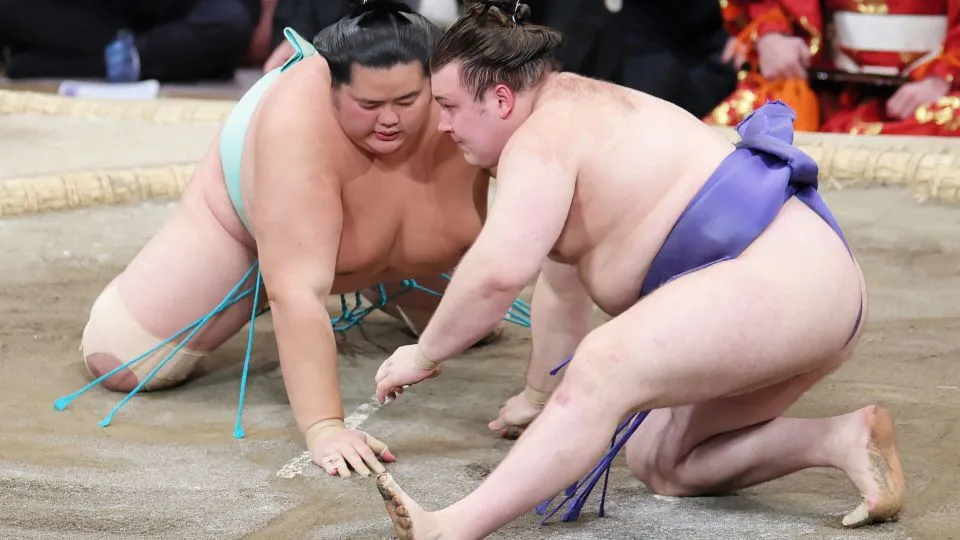
Despite being lighter than many top-division wrestlers at approximately 140 kilograms, he quickly began overpowering university-level opponents, demonstrating exceptional technique, agility and control. His success attracted wider attention, and he eventually joined the Ajigawa stable in Tokyo, transitioning into the demanding lifestyle of a professional rikishi. Life in a stable requires intense discipline: early-morning training, communal chores, strict hierarchy and constant evaluation. Aonishiki not only adapted but thrived.
His progression through the ranks was exceptionally fast. In the world of sumo, promotion and demotion depend entirely on tournament performance, and rapid advancement is rare. Yet Aonishiki moved through the divisions with record speed, reaching the rank of Sekiwake—third-highest in professional sumo—after just 13 tournaments. This pace placed him among a small group of wrestlers able to rise so swiftly, and it signaled to experts that he possessed the qualities of an athlete capable of contending for the sport’s highest titles.
Breakthrough Victory and the Path Toward Sumo’s Elite Ranks
The November Grand Sumo Tournament marked the turning point that introduced Aonishiki to a global audience. Facing some of the strongest wrestlers in the division, he demonstrated a style characterized by explosive force, precise timing and strong defensive positioning. His final match against Hoshoryu, one of the sport’s top athletes, was a test not only of physical capacity but also of composure under pressure. Emerging victorious, he secured an elite-level tournament win at an age when many wrestlers are still navigating the lower divisions.
Following his victory, Japan’s national sumo governing body convened an extraordinary meeting to consider his potential promotion to Ozeki, the second-highest rank in the sport. Ozeki status is not granted lightly; it requires consistent excellence, demonstrated resilience and conduct that embodies the sport’s values. That such a discussion occurred immediately after the tournament underscores the magnitude of Aonishiki’s achievement and his standing within the sumo community.

But for Aonishiki himself, the ambition extends even further. He has already spoken about aiming for the Yokozuna rank, the pinnacle of sumo and a title held by only a select few in history. Achieving Yokozuna status demands not only repeated tournament victories but also long-term demonstration of dominance and dignity. It is a goal few openly pursue so early in their careers, yet his performance thus far lends credibility to the aspiration.
His story has also resonated beyond the boundaries of the sport. As a Ukrainian athlete who fled war, rebuilt his life in a foreign country and achieved success in one of Japan’s most culturally significant institutions, he has become a symbol of perseverance and adaptability. His victory arrives at a time when global audiences are increasingly attuned to themes of displacement and resilience, making his accomplishments both a personal triumph and a narrative of broader human endurance.
Within Japan, his ascent has been met with admiration. Sumo fans, typically deeply connected to the sport’s traditions, have embraced his discipline, humility and seamless integration into the sumo lifestyle. Coaches and analysts have noted his commitment to mastering not only the physical aspects of the sport but also the rituals, etiquette and philosophy that define sumo’s identity.
As he looks ahead, the path toward the highest ranks will require sustained performance under increasingly intense scrutiny. Opponents will study his technique closely, and the expectations placed upon him will grow. Yet the combination of his early foundation in Ukraine, the adversity he faced during displacement, and the determination he showed upon arriving in Japan suggests he is equipped to navigate the challenges ahead.
Danylo Yavhusishyn’s rise is not simply a sports story. It is a testament to the possibilities that emerge when talent meets opportunity, even in the shadow of conflict. From a young boy discovering sumo in a judo hall in Ukraine to a 21-year-old champion celebrated across Japan, his journey traces a path shaped by resilience, community support and extraordinary skill. With his sights set on sumo’s highest honors, Aonishiki now stands as one of the most compelling figures in contemporary sport, carrying both personal ambition and the symbolic weight of a nation that continues to endure profound hardship.