
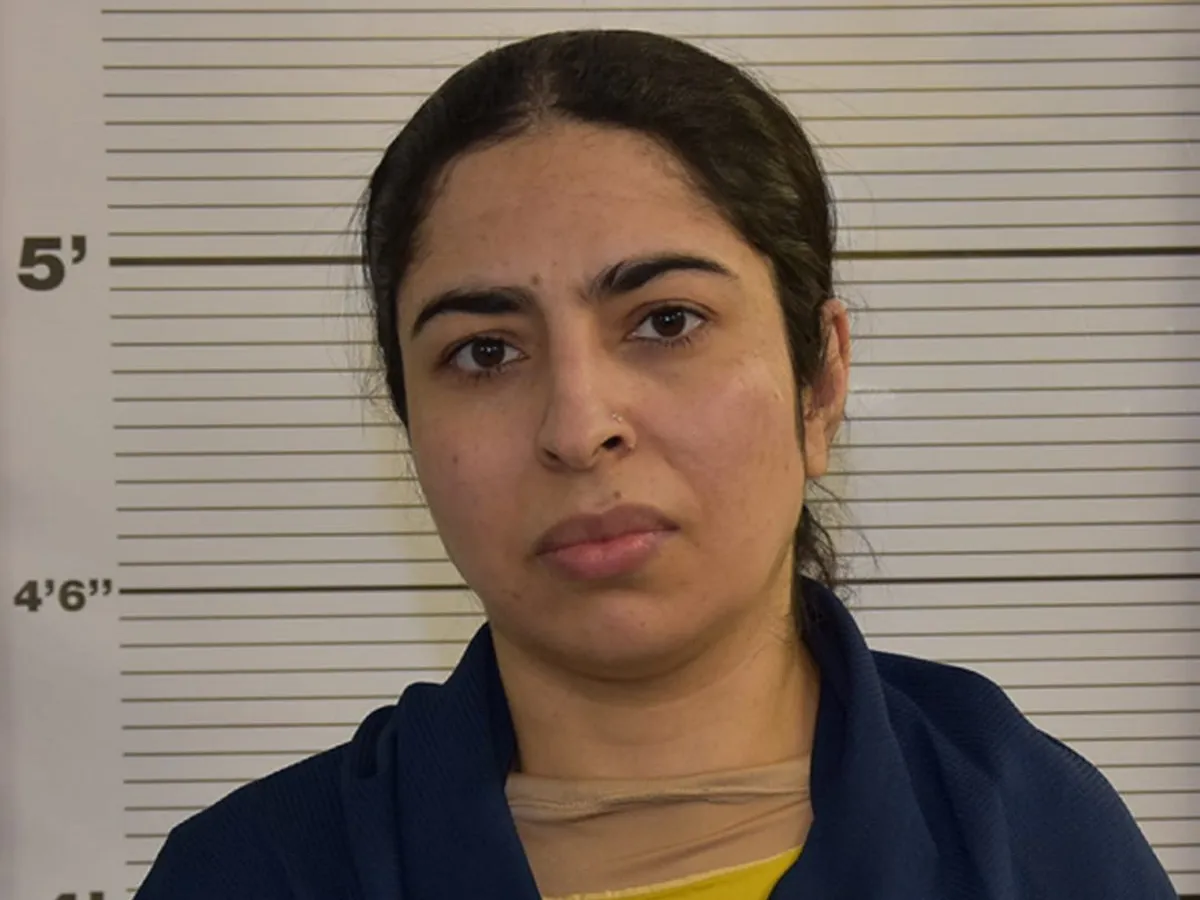
The case of Farishta Jami, a former school dinner lady from Stratford-upon-Avon, has sent ripples of shock across the UK and beyond. Jami, a 36-year-old woman of Afghan origin, was recently sentenced to life imprisonment with a minimum term of 17 years after it was revealed that she had made concrete plans to travel to Afghanistan to commit a terrorist act and martyr herself for the so-called Islamic State (IS).
Her conviction has highlighted the persistent threat posed by radicalized individuals operating under the influence of online extremist propaganda, and the critical role played by counter-terrorism units in preventing such attacks before they occur.
The case came to light when detectives from the West Midlands Counter Terrorism Unit raided Farishta Jami’s home in November 2023, uncovering a trove of incriminating evidence. What they found was alarming: numerous electronic devices, at least 20 sim cards hidden inside a bag tucked down the side of her bed, and extensive digital footprints that connected her to extremist material and pro-IS networks.
Her trial, which lasted four weeks at Leicester Crown Court, concluded in February with a jury finding her guilty of two counts of engaging in conduct in preparation for terrorism under Section 5 of the Terrorism Act 2006.
Radicalization behind closed doors
Farishta Jami’s transformation from a seemingly ordinary dinner lady to a radicalized supporter of a terrorist organization reveals the complexity of modern-day radicalization. Jami had been living in the UK since 2008, after moving from Afghanistan. Initially, she maintained a low profile, working in a school and integrating into society. However, beneath the surface, she was steadily being drawn into the dark web of extremist ideology.
Over a period extending from September 2022 to January 2024, Jami became increasingly involved in online activities that supported and spread IS propaganda.
She joined multiple pro-IS social media groups, some of which had hundreds of members, and became an administrator for several of them. Her role in these groups was far from passive—she actively translated official IS propaganda, disseminated it across platforms, and even taught others how to do the same.
Farishta Jami’s digital activity included sharing graphic content involving children engaged in terrorist activities, distributing manuals on making explosive devices, and offering lessons on using firearms like Kalashnikov rifles.

She reportedly shared documents detailing how to create grenade detonators and chemical explosives. This wasn’t the work of a misguided individual simply consuming extremist content; she was deeply involved in its dissemination and tactical education, solidifying her role as an active propagator of violent jihadist ideology.
Read : Mansuri Manuchekhri From Brooklyn Arrested For Sending Money to ISIS
The judge in her case, Mrs Justice Cheema-Grubb, remarked that the jury had rightly concluded that Farishta Jami intended to travel to Afghanistan to physically join IS and commit a terrorist act, potentially through a suicide bombing.
Read : Divine Journeys: Ten Must-Visit Hindu Temples Around the Globe
Such was her conviction that she had already saved £1,200 for a one-way ticket and was searching for flights to Afghanistan in October 2023. She told an acquaintance that she was “restless” to go, was “100% confident” in her plans, and had discussed the transfer of her online groups to others before her departure.
A persistent and deliberate threat
Judge Cheema-Grubb did not mince words in describing Jami’s mindset. Far from being a person momentarily swayed by extremist narratives, she was deemed to have an “entrenched extremist mindset,” one that was persistent, sophisticated, and unwavering. The judge emphasized that her intent was not fleeting or spontaneous but the result of careful planning over several months.
What makes Farishta Jami’s case particularly troubling is that, according to the court, she showed no signs of remorse or deradicalization, even during her trial. The judge noted that she appeared intelligent and articulate while giving evidence and that her belief in IS’s cause remained steadfast.
There was no indication that she had moved away from her radical ideology, nor had she offered any “cogent evidence” to suggest a genuine disavowal of terrorism. Moreover, Jami had received some form of approval from IS for her travel and plans.

Though she had not yet obtained a visa or purchased her flight ticket, her preparations were concrete and viable, only thwarted by timely intervention from law enforcement. The court heard how she asked an acquaintance whether she needed to bring many clothes with her—an eerie detail suggesting she never planned to return.
Even though Farishta Jami claimed in police interviews that her allegiance to IS was not genuine, the court did not accept her denials. Given the scope of her actions, her involvement in numerous extremist groups, and the instructional content she shared, her assertions of innocence were swiftly dismissed. The evidence pointed overwhelmingly to someone not only inspired by but fully committed to the ideology of the Islamic State.
The consequences of online extremism
The case of Farishta Jami is a sobering reminder of how online spaces can become fertile grounds for extremist recruitment and radicalization. Her journey into extremism did not occur in training camps or war zones but from behind closed doors in a quiet British town.
With access to encrypted messaging platforms, extremist forums, and propaganda channels, individuals like Jami are able to immerse themselves in violent ideologies and engage with like-minded individuals across the globe.
It also highlights how the spread of IS ideology continues long after the group’s territorial defeat in Iraq and Syria. Digital networks allow supporters to remain active, organize, and plan attacks from remote locations.
Farishta Jami’s role as a content distributor and online educator points to an evolved form of terrorism—one that depends heavily on virtual networks rather than physical locations.

Police and security services played a crucial role in intercepting her plans. Their search and seizure of her devices and communication records provided the necessary evidence to dismantle her plot before it came to fruition. But the challenge remains significant, as online anonymity and encryption make detection and monitoring increasingly difficult.
Her conviction and sentencing serve as both a deterrent and a warning. For those who might be tempted to tread a similar path, the message is clear: engaging in preparation for terrorism, even without executing an attack, carries severe consequences. For society, the case reinforces the need for vigilance, community support, mental health awareness, and de-radicalization programs.
Though the court acknowledged that Jami had suffered from depression and isolation after being rehoused in an area without a Muslim community, the judge stated firmly that this context did not excuse or mitigate her actions. “You adopted the ISIS philosophy of hatred and violence,” said Justice Cheema-Grubb. “It is a great shame that even now I cannot find that you are less than committed to the cause.”
The chilling reality is that Jami had transitioned from being a seemingly ordinary figure within her community to someone prepared to die for an extremist ideology. Her story underscores the need for early intervention and the importance of counter-radicalization efforts both online and within vulnerable communities. Only through proactive strategies can similar plots be prevented in the future and the threat of lone-wolf terrorism mitigated.