

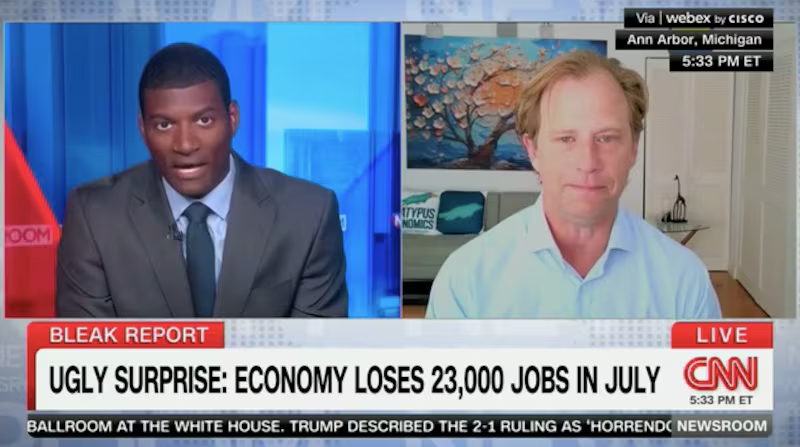
Justin Wolfers, a University of Michigan economist and prominent commentator on economic issues, unexpectedly became the center of attention during a live CNN interview after an insect flew into his mouth while he was discussing the U.S. economy. Wolfers had been speaking with CNN anchor Omar Jimenez about labor market conditions, economic resilience and the Federal Reserve when he suddenly began coughing and struggled to continue speaking. What initially appeared to be an unexplained interruption quickly turned into an unusual live television moment when Wolfers revealed that he had accidentally swallowed a fly.
The incident occurred while Wolfers was explaining his assessment of the American labor market and comparing its performance to “The Little Engine That Could.” He described the economy as resilient despite failing to receive an “A+” from everyone evaluating it, but then cautioned that resilience could disappear unexpectedly. Moments later, his delivery was interrupted as he began coughing and trying to clear his throat. Jimenez, apparently unaware of what had happened, continued with a question about the Federal Reserve and interest rates, giving Wolfers time to recover. Wolfers eventually managed to explain the bizarre reason for his coughing, turning an awkward interruption into an exchange that quickly spread across social media.
Who Is Justin Wolfers and What Does He Do at the University of Michigan?
Justin Wolfers is an economist and professor at the University of Michigan who is known for his work and commentary on economic policy, labor markets, business cycles and broader questions surrounding the U.S. economy. His academic career has included research into how economic conditions affect people’s lives and how economists can interpret data when assessing the health of the economy. Beyond his university work, Wolfers has also become a familiar voice in public discussions about economic developments, frequently appearing in media interviews and contributing commentary on issues that affect workers, businesses, consumers and policymakers.
Wolfers’ background has helped make him a useful commentator when major economic indicators are released or when markets and policymakers are facing uncertainty. Economists are often asked to interpret numbers such as employment growth, unemployment, inflation and interest rates for a general audience, and Wolfers has regularly participated in that kind of public discussion. His role as an academic economist means that his commentary is generally focused on explaining what economic data may indicate rather than simply reacting to individual market movements. That combination of academic expertise and public communication has also placed him in situations where complicated economic subjects have to be explained quickly and clearly during television interviews.
During the CNN interview, Wolfers was discussing the U.S. labor market and its ability to withstand economic pressures. His description of the labor market as “The Little Engine That Could” was intended to convey the idea that the economy had continued performing relatively well despite concerns about its condition. He acknowledged that the labor market was not necessarily receiving top marks from everyone examining it, but he emphasized its apparent resilience. He then made an important qualification: an economy can remain resilient for an extended period while still being vulnerable to a sudden deterioration. It was while making that point that the unexpected interruption occurred.
The timing made the incident particularly memorable because Wolfers had been discussing the very kind of uncertainty that economists regularly examine. He was in the middle of a serious conversation about economic indicators when his own physical reaction suddenly disrupted the discussion. Instead of immediately being able to explain what had happened, Wolfers simply began coughing and struggling to speak. Viewers could see that something had gone wrong, but the reason was not immediately clear.
CNN anchor Omar Jimenez responded by attempting to keep the interview moving. Rather than focusing on the interruption, Jimenez asked Wolfers about the Federal Reserve and how policymakers might interpret the latest economic information. The question centered on the possibility that the labor market was becoming somewhat softer and how that might influence the Fed’s thinking, particularly after the central bank had decided not to raise interest rates at its previous meeting. It was a conventional economic-policy question, but under the circumstances it gave Wolfers a few additional moments to recover.
This guy swallowed a fly live on CNN pic.twitter.com/weU5fbve6k
— Karli Bonne’ 🇺🇸 (@KarluskaP) August 10, 2026
Wolfers then delivered the line that transformed the incident from an unexplained coughing fit into a viral television moment. After managing to clear his throat, he told Jimenez, “Mate, I just swallowed a fly on live television!” The revelation immediately explained why he had been struggling to speak. Rather than allowing the incident to derail the interview, both men continued with the conversation and treated the mishap with humor.
How Did Justin Wolfers Swallow a Fly During the CNN Interview?
The incident appears to have happened completely by accident while Wolfers was speaking. During a live television interview, guests generally have to continue talking while cameras remain focused on them, and there is no opportunity to stop the broadcast every time an unexpected distraction occurs. In Wolfers’ case, an insect apparently flew directly into his mouth as he was speaking. He accidentally swallowed it, which caused him to cough and struggle to continue his explanation.
What made the situation unusual was that Wolfers initially tried to keep talking instead of immediately stopping the interview. Jimenez noticed that Wolfers was coughing but continued asking his question, apparently attempting to give the economist enough time to regain his composure. Wolfers later explained that he had been trying to continue speaking while dealing with the fly. Once he was able to speak clearly enough, he revealed exactly what had happened.
The exchange could easily have become an embarrassing moment, but Wolfers approached it with humor. As an Australian native, he joked that “Aussies love eating flies!” The comment turned an awkward incident into a lighthearted part of the discussion. He then went even further by connecting the fly incident to the economic subject that had brought him onto CNN in the first place: the Federal Reserve.
Wolfers compared his difficulty speaking after swallowing the fly with the communication challenges surrounding Kevin Warsh, whom he referenced while discussing the Federal Reserve. He suggested that the situation could be viewed as a metaphor, saying that Warsh felt like he did at that moment because Warsh did not like talking about what was going on. Wolfers continued coughing during the comparison but managed to turn the strange situation into an economic joke.
He then extended the metaphor by saying he might “swallow a horse” because that would also take care of the fly. The unusual sequence demonstrated how quickly a serious television discussion could shift into comedy when something completely unexpected happened. Instead of abandoning the interview, Wolfers used the incident to maintain the conversation and eventually returned to the economic topic.
Jimenez also handled the situation calmly. After Wolfers explained what had happened, the anchor reassured him that everything was fine. His earlier decision to continue with the interview question while Wolfers recovered helped prevent the moment from becoming even more disruptive. The interaction between the two men ultimately made the incident more entertaining because neither treated it as a major crisis.
Live television is particularly vulnerable to moments like this because there is no editing process to remove unexpected events. A guest can cough, lose their train of thought, experience a technical problem or encounter something completely outside the control of the production team. In this case, the interruption was caused by something as ordinary as a flying insect, but because it happened during a nationally televised economic interview, it immediately attracted attention.
Wolfers later addressed the incident himself on X, adding another layer of humor to what had happened. He wrote that a fly had “zipped into” his mouth while he was talking on CNN. He then joked about the fact that the next question concerned the Federal Reserve, saying he did what Kevin Warsh would not: he swallowed hard and kept talking. He explained that he figured viewers deserved some clarity about the economy, turning the incident into another opportunity for an economic joke.
His follow-up post also included a second humorous remark about the fly. Wolfers wrote that the fly was dead and jokingly added that he was “no longer a vegetarian.” The comment was clearly intended as humor following an incident that could otherwise have been uncomfortable. His decision to publicly joke about it also helped the clip gain further attention online.
Why Did the Justin Wolfers Fly Incident Go Viral?
The reason the incident attracted so much attention is largely because of the contrast between the seriousness of the subject and the absurdity of what happened. Wolfers was not appearing on CNN to discuss entertainment or unusual stories. He was there as an economist discussing the U.S. labor market, interest rates and Federal Reserve policy. The conversation involved important economic questions, but suddenly the guest was coughing because an insect had flown into his mouth.
That contrast made the moment particularly memorable. Viewers watching an economist analyze employment data were suddenly confronted with an entirely unexpected problem that Wolfers had to handle in real time. His decision to acknowledge the situation directly, rather than pretending nothing had happened, made the exchange even more distinctive.
Read : Explosive Device Thrown at Gladis Aurora López’s Head During On-Camera Interview
The incident also demonstrated Wolfers’ ability to improvise under pressure. After accidentally swallowing the fly, he could have simply asked for a moment to recover or ended the discussion temporarily. Instead, he continued participating in the interview and eventually incorporated the incident into his explanation of Federal Reserve policy. His jokes about Australians eating flies and about swallowing a horse transformed an uncomfortable situation into something that could be laughed about.

The reaction also benefited from the fact that Wolfers himself continued the joke after the broadcast. His posts on X ensured that the moment did not remain confined to the original CNN segment. By acknowledging the incident and making additional jokes about it, he effectively gave viewers another reason to share and discuss the clip.
At the same time, the unusual moment should not overshadow who Wolfers is professionally. The fly incident was an unexpected interruption in a much broader career as an economist and academic. His appearance on CNN was connected to his expertise in economic issues, particularly the labor market and monetary policy, rather than anything related to the bizarre incident that ultimately attracted public attention.
The interview itself also reflected the type of economic uncertainty that Wolfers regularly discusses. Labor market data can provide important information about the health of the economy, but economists and policymakers must interpret multiple indicators before reaching conclusions. A labor market can remain relatively strong while showing signs of weakening, and Federal Reserve officials have to consider those developments when making decisions about interest rates and monetary policy.
That was the serious subject Wolfers was addressing before the fly interrupted him. His central point about resilience was that an economy can continue performing better than expected even when concerns exist about its future. Yet resilience does not guarantee that conditions will remain unchanged. Economic conditions can shift, and policymakers have to respond to new information as it becomes available.
Ironically, the fly incident itself became a demonstration of how quickly circumstances can change. One moment Wolfers was calmly explaining economic data, and the next he was struggling to speak because an insect had flown into his mouth. Although the comparison is obviously humorous rather than economic, it helped make the interview memorable precisely because the interruption was so unexpected.
For Justin Wolfers, the incident is likely to remain one of the strangest moments of his many public appearances. His professional reputation comes from economics, academic research and public commentary, but the CNN interview gave viewers something entirely different to remember. Rather than allowing the mishap to derail the conversation, Wolfers recovered, joked about swallowing the fly and returned to discussing the Federal Reserve.
The incident also showed why live television can produce moments that cannot be recreated through scripted programming. There was no warning that an insect would fly into Wolfers’ mouth, no opportunity for producers to edit it out and no prepared response for the situation. Everything happened in real time, with Jimenez attempting to continue the interview while Wolfers tried to recover. His later explanation confirmed what viewers had witnessed and turned a strange interruption into one of the more memorable live television moments involving an economist.
Ultimately, Justin Wolfers remains known primarily for his work as a University of Michigan economist and his public analysis of economic conditions, not for the unfortunate insect encounter. But after accidentally swallowing a fly while discussing the U.S. economy on CNN, the economist demonstrated an unusual ability to keep talking, keep joking and eventually connect even the most bizarre interruption back to the subject he had been discussing.
For short social hooks, marketing AI video generator workspace keeps text-to-video and image-to-video in one desk, when you need a sound-ready clip instead of a silent fragment.
I have been absent for some time, but now I remember why I used to love this blog. Thank you, I will try and check back more frequently. How frequently you update your site?
The VIP treatment here is real. I feel valued as a player and the rewards are generous. If you want a premium experience check out idrpvip4.
[4348]mostbet login করুন ও অ্যাপ ডাউনলোড | বিকাশ ক্যাসিনো ডিপোজিট,mostbet-এ লগইন করে অনলাইন স্লট গেম খেলার নিয়ম জানুন। বিকাশ দিয়ে ক্যাসিনো ডিপোজিট এবং লাইভ ক্যাসিনো বোনাস অফার পেতে আজই জয়েন করুন। visit: mostbet
I really appreciate the customer support here, they answered my questions almost instantly. It makes the whole experience feel very secure. Shoutout to bd88xbajee!
Such a chill vibe on this site. I love how easy it is to navigate through the different sections. Keep up the good work guys! ph22niceph
Had a great run last night! The winning streaks are real on this platform. br5win5 is officially my new favorite spot.
[1772]NBA odds login at live dealer casino sa Pilipinas,Tingnan ang nba odds at mag-login para sa live dealer casino. May nba odds app download at online slots gcash deposit din. Sali na at maglaro ngayon! visit: nba odds
Using Skrill for deposits here makes everything so much easier. Fast transactions and a wide selection of slots. onlinecasinoskrill is awesome.
Everything is very professional and the customer support team is helpful. I feel safe playing on bd8777but knowing the site is secure.
obviously like your web site but you need to test the spelling on several of your posts. A number of them are rife with spelling issues and I to find it very troublesome to inform the truth nevertheless I’ll certainly come back again.