

Two Zookeepers at the Smithsonian’s National Zoo in Washington, D.C., were taken to hospital after being bitten by a binturong, also known as a bear cat, during a routine animal care session. The incident occurred in a non-public area of the zoo’s Great Cats exhibit and involved a 12-year-old female binturong named Lola. Zoo officials confirmed that the injuries were not life-threatening and that the staff members were transported to hospital as a precautionary measure.
While the episode prompted understandable concern, the zoo emphasized that such incidents are rare and that safety protocols for both animals and staff remain in place. The case has drawn attention to an animal that is unfamiliar to many visitors and readers.
Binturongs are not commonly encountered outside zoological collections or their native habitats in South and Southeast Asia. Despite their compact size, roughly comparable to that of a small dog, they possess sharp teeth and claws and can react unpredictably under stress or during handling. The incident has therefore renewed discussion around animal behavior, occupational safety in zoological institutions, and the balance between close-contact care and risk management.
Details of the Incident and Immediate Response
According to a statement released by the Smithsonian’s National Zoo, the incident took place on a Friday morning during a routine training and care session. One of the zookeepers was obtaining Lola’s weight, a standard procedure that allows staff to monitor an animal’s health over time. During this process, the binturong bit the staff member and did not immediately release her grip. A second zookeeper rushed in to assist and was also bitten in the process of helping their colleague.
Zoo officials stated that both staff members were transported to a hospital “out of an abundance of caution.” While the nature of the injuries was not publicly detailed, the wording suggested that the zoo did not believe the injuries to be severe. Nonetheless, bites from mammals, even relatively small ones, can pose risks of infection and therefore often warrant medical evaluation and treatment.
The zoo confirmed that the incident occurred in a non-public area, meaning no visitors were present or at risk. This distinction is significant, as it underscores that the situation arose during behind-the-scenes animal care rather than during a public interaction. Zoos typically restrict direct animal handling to trained professionals who are familiar with individual animals’ behaviors and warning signs, though even experienced staff can encounter unexpected reactions.
Read : 19-Year-Old Ohio Influencer Noah Thomas Charged After Jumping Into Pittsburgh Zoo Elephant Enclosure
In its statement, the zoo emphasized that staff training and safety procedures are ongoing and that animal welfare remains a priority. While investigations into such incidents are standard practice, the zoo did not indicate that Lola would be removed from public view or subjected to punitive measures. Instead, institutions generally review protocols, assess contributing factors such as environmental stressors or changes in routine, and make adjustments as necessary.
Understanding the Binturong and Its Behavior
Binturongs, scientifically known as Arctictis binturong, are members of the Viverridae family, which also includes civets and genets. Despite the common nickname “bear cat,” they are neither bears nor cats. The name reflects their physical appearance rather than their biological classification. Binturongs have a stocky body reminiscent of a bear and facial features, including large eyes and prominent whiskers, that evoke a cat-like expression.
Native to tropical forests across South and Southeast Asia, including India, Thailand, and the Philippines, binturongs are primarily arboreal and nocturnal. In the wild, they spend much of their time in trees, using their strong limbs and prehensile tail to move among branches. Their diet is omnivorous, consisting of fruits, small animals, birds, and eggs. Figs are a particularly important food source, and binturongs play a role in seed dispersal within their ecosystems.
Read : Lions Mauls Zookeeper Jian Rangkharasamee To Death In Front Of Visitors at Safari World zoo
One of the most widely noted characteristics of binturongs is their distinctive scent. They are often described as smelling like buttered popcorn, a result of a chemical compound found in their urine. This unusual trait has made them memorable to zoo visitors and researchers alike, but it also highlights their reliance on scent for communication. In the wild, scent marking helps define territory and convey information to other animals.
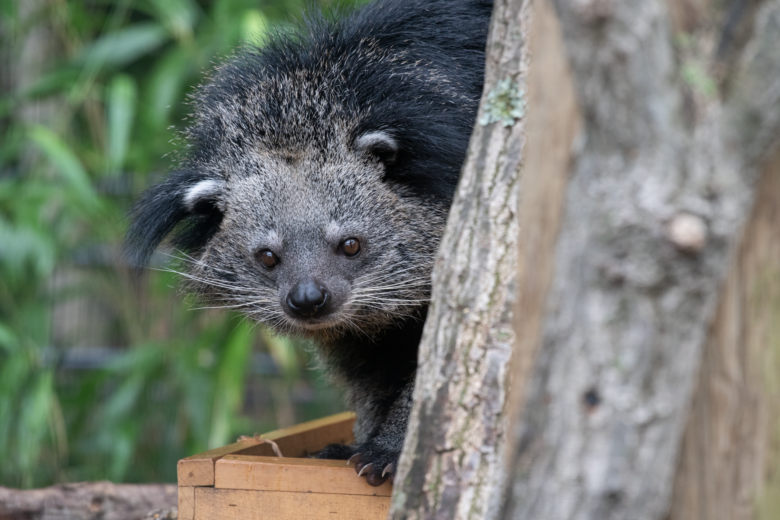
Behaviorally, binturongs are known to be vocal and expressive. According to the National Zoo, they can snort, chuckle, or purr when content, while displeasure or fear may be signaled through hisses, screams, low grunts, or howls. These vocalizations, combined with body language, usually provide cues about an animal’s emotional state. However, during close interactions such as training or medical checks, even a well-understood animal may react defensively if startled or uncomfortable.
Captive binturongs, like other wild animals in zoos, undergo training that allows keepers to conduct routine health checks with minimal stress. Positive reinforcement techniques are commonly used to encourage animals to participate voluntarily. Despite these measures, the inherent unpredictability of wild animals means that risk can never be entirely eliminated.
Zoo Safety, Training, and Broader Context
Incidents involving animal bites or injuries to zookeepers are relatively uncommon but not unheard of. Zoos operate in a complex environment where staff must balance close contact with animals against the need for safety. Keepers often work with animals that retain their natural instincts, regardless of how accustomed they may be to human presence.
Read : Zookeepers At Prague Zoo Turn to Puppets to Parent Baby Vultures
Occupational safety protocols in modern zoos typically include extensive training, protective equipment when appropriate, and clearly defined procedures for routine and emergency situations. Staff are trained to recognize signs of stress or agitation in animals and to modify or halt interactions if necessary. When incidents occur, they are usually followed by internal reviews to identify whether changes in procedure, environment, or staffing could reduce the likelihood of recurrence.

The National Zoo incident also comes amid heightened public attention to zoo safety following other high-profile cases involving animal attacks. In recent years, incidents such as visitors entering enclosures or animals escaping confined spaces have sparked debate about zoo design, visitor behavior, and animal management. While the binturong incident did not involve visitors and was contained within staff-only areas, it nonetheless contributes to broader conversations about the risks faced by animal care professionals.
Animal welfare advocates often emphasize that such incidents should be viewed within the context of working with wild animals rather than as evidence of negligence or aggression. Even animals that appear calm or familiar can respond defensively under certain conditions. The goal of modern zoological practice is not to eliminate all risk, which is impossible, but to reduce it through informed handling, continuous training, and respect for animal behavior.
For the Smithsonian’s National Zoo, which operates as part of a major public institution, transparency and adherence to best practices are central to maintaining public trust. The zoo’s prompt acknowledgment of the incident and its emphasis on staff care and safety reflect standard procedures in accredited zoological organizations. While the injuries were reportedly not severe, the incident serves as a reminder of the realities of animal care work and the professionalism required of those who perform it daily.
At the same time, the event has drawn renewed attention to binturongs themselves, animals that are often overlooked in favor of more iconic species. Classified as vulnerable by conservation organizations due to habitat loss and hunting pressures, binturongs face significant challenges in the wild. Zoos play a role in educating the public about such lesser-known species and in supporting conservation efforts through research and awareness.
The incident involving Lola highlights both the fascination and the risks associated with caring for wild animals in captivity. It underscores the need for ongoing investment in staff training, animal welfare science, and public understanding of what it means to work closely with species that are not domesticated. While the immediate focus remains on the recovery of the injured staff members, the broader implications extend to how zoos communicate about safety, conservation, and the complex relationships between humans and animals.
Yo guys, check this out! I’ve been messing around with FortuneGodsvn. The games are actually pretty fun. Have a look: fortunegodsvn.