
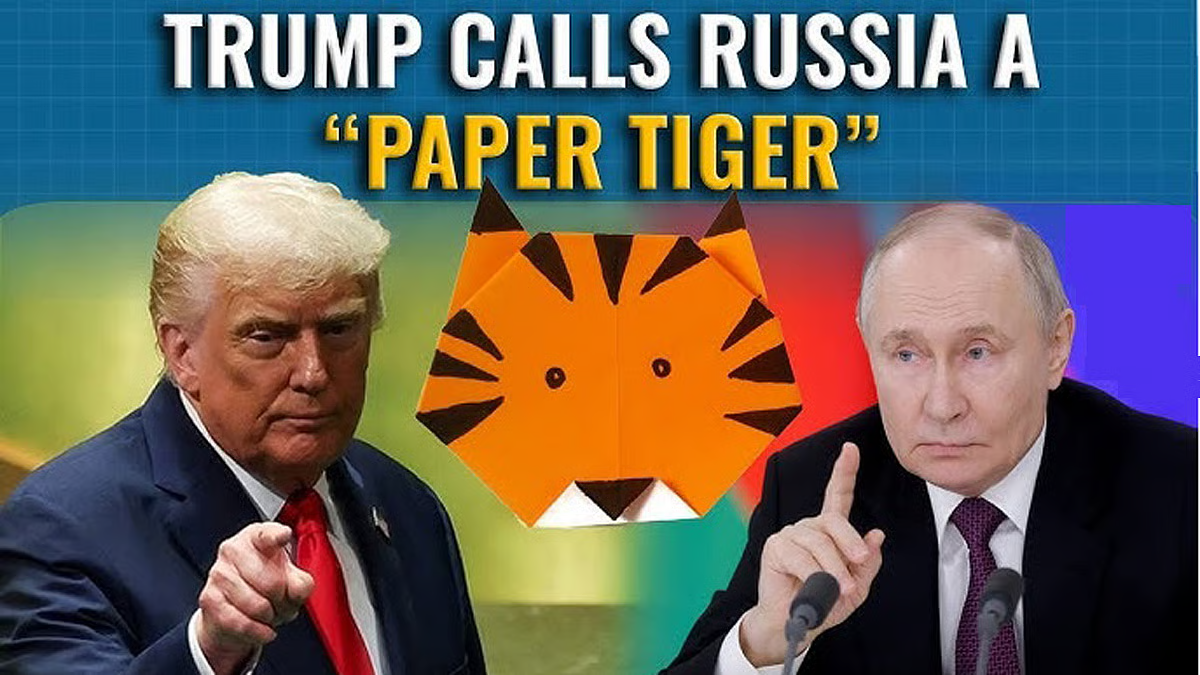
In a bold escalation of rhetorical firepower amid the ongoing Ukraine conflict, President Donald Trump has revived the term “paper tiger” to deride Russia’s military posture. Deployed in a September 2025 social media post and subsequent interviews, the phrase paints Moscow as a hollow threat—fierce in appearance but feeble in substance.
This verbal salvo, timed as U.S. intelligence reports highlight Russia’s mounting economic strains and stalled battlefield gains, has ignited a fierce backlash from the Kremlin. As the war enters its fourth year, Trump’s mockery underscores shifting U.S. policy tones under his administration, signaling a tougher stance on Vladimir Putin’s prolonged invasion. Drawing from Cold War-era lexicon, the expression revives historical barbs while amplifying current geopolitical tensions.
Origins of the “Paper Tiger” Idiom
The phrase “paper tiger” traces its roots to mid-20th-century geopolitics, originating as a metaphor for deceptive power. Coined by Chinese Communist leader Mao Zedong in a 1956 speech, it described entities that roar loudly but lack real claws—specifically targeting the United States during the early Cold War. Mao argued that American imperialism, despite its nuclear arsenal and global reach, was ultimately toothless against determined revolutionary forces, much like a tiger crafted from paper that could be torn apart.
This imagery quickly permeated international discourse. By the 1960s, it appeared in anti-colonial rhetoric across Asia and Africa, where leaders invoked it to dismiss Western interventions as bluffs. In the U.S., the term gained traction during the Vietnam War era, with critics like Noam Chomsky flipping it back to critique American overreach. Declassified documents from the era show U.S. policymakers grappling with the label, viewing it as propaganda that eroded domestic support for foreign engagements.
Fast-forward to contemporary usage, and “paper tiger” has evolved into a staple of political invective. It surfaced in analyses of authoritarian regimes, from North Korea’s missile tests to Iran’s proxy militias, always implying a facade of strength masking internal rot. Linguists note its enduring appeal lies in its vividness: a single image encapsulating bluff, fragility, and eventual collapse. In Trump’s lexicon, it fits seamlessly with his preference for punchy, memorable taunts—echoing his past characterizations of adversaries as “losers” or “weak.”
Read : What is Love Bombing? Signs, Impact, and Everything You Need to Know
Applied to Russia, the phrase carries layered historical weight. Mao originally wielded it against the West, but Soviet leaders at the time dismissed it as Chinese posturing. Today, Trump’s adoption flips the script, positioning the U.S. as the unyielding force exposing Moscow’s vulnerabilities. Intelligence assessments leaked in late September 2025 bolster this narrative, detailing how sanctions have crippled Russia’s energy exports, inflating military spending to 40% of the federal budget while consumer goods shortages bite into public morale. These reports, sourced from CIA and Treasury analyses, portray a nation bleeding resources in Ukraine without decisive victories, lending empirical bite to the metaphorical swipe.
Trump’s Deployment and Strategic Context
President Trump’s invocation of “paper tiger” occurred on September 24, 2025, via a Truth Social post that quickly amassed millions of views. “Putin doesn’t look so tough anymore,” Trump wrote. “Four years into a war that should’ve ended in a week—paper tiger! Our intel shows they’re crumbling economically and on the front lines. Time for real peace, not this endless mess.” The post, accompanied by a graphic of a snarling tiger dissolving into confetti, was framed as a direct response to a private White House briefing on Russia’s war footing.
In follow-up remarks to reporters at Mar-a-Lago, Trump elaborated, recounting a hypothetical exchange with Putin: “I said to him, you know, you don’t look good. You’re dragging this out. Are you a paper tiger? And it’s a shame.” This personal anecdote, delivered with Trump’s signature blend of bravado and disdain, amplified the insult’s sting. It aligned with his administration’s pivot toward aggressive Ukraine support, including a $60 billion aid package signed earlier that month, which funneled advanced drones and artillery to Kyiv.
Read : What Is the Pentagon Pizza Index and Its Connection to Israel’s Bombing of Iranian Nuclear Sites?
Strategically, the remark serves multiple aims. Domestically, it rallies Trump’s base by projecting strength against a foe long vilified in Republican circles. Polling from Pew Research in early October 2025 shows 62% of GOP voters approving of the tough talk, viewing it as a rebuke to perceived Biden-era appeasement. Internationally, it pressures Moscow at a juncture when Russian advances in Donetsk have slowed amid Ukrainian counteroffensives bolstered by Western arms. U.S. officials, speaking anonymously, indicate the phrasing was deliberate—echoing Mao to subtly nod at China’s growing unease with Russia’s war prolongation, which disrupts Beijing’s economic ties to Europe.

Critics, however, caution against overinterpretation. Democratic leaders like Senate Minority Leader Chuck Schumer labeled it “reckless bluster” that risks escalating hybrid threats, such as cyberattacks on U.S. infrastructure. Yet Trump’s allies counter that the “paper tiger” label is grounded in hard data: Russia’s GDP contracted 2.1% in 2025 per IMF estimates, with inflation hovering at 9%, fueled by ruble devaluation. Battlefield metrics are equally grim—Ukrainian forces reclaimed 15% of occupied territory in the past quarter, per Pentagon trackers, exposing Russian logistical frailties like depleted tank reserves and conscript desertions numbering over 50,000 annually.
The phrase also ties into Trump’s broader Ukraine endgame: a negotiated settlement favoring Kyiv’s territorial integrity while extracting concessions from Moscow, such as demilitarization zones. In a Fox News interview on September 28, he reiterated, “Russia’s a paper tiger because they’ve shown their hand—weak economy, tired troops. We’ll make a deal that sticks.” This positions the U.S. as the indispensable broker, leveraging intelligence dominance to dictate terms.
Kremlin’s Retort and Broader Repercussions
Moscow’s reaction was swift and seething, confirming the barb’s penetration. President Putin, in a September 29 address to the Valdai Discussion Club, fired back: “They call us a paper tiger? Then what’s NATO—a cardboard alliance?” He claimed Russia was battling the full might of the 32-nation bloc in Ukraine, not a single neighbor, and mocked Trump’s grasp of the conflict’s scale. “Four years? We’ve barely begun securing our interests,” Putin added, alluding to annexed regions as irreversible gains.
Kremlin mouthpiece Dmitry Medvedev amplified the fury on Telegram, posting a meme of a roaring bear shredding paper effigies of Western leaders. “Paper tiger? Try iron bear,” he wrote, vowing escalated strikes on Ukrainian energy grids. State media host Vladimir Solovyov, on his evening broadcast, decried Trump’s “kindness misinterpreted as weakness,” accusing the U.S. of hypocrisy given its own stalled forever wars in Afghanistan and Iraq.

The backlash extends beyond rhetoric. Russian diplomats lodged formal protests with the State Department, while cyber units—linked to GRU—probed U.S. election systems, per cybersecurity firm Mandiant alerts issued October 2. Economically, Moscow accelerated pivot to BRICS partners, inking a $20 billion oil deal with India to offset lost European markets. Yet these moves underscore the “paper tiger” critique: Russia’s war chest, once bolstered by $300 billion in frozen assets, now relies on wartime borrowing projected to hit 5% of GDP by year’s end.
Implications ripple globally. Ukrainian President Volodymyr Zelenskyy hailed Trump’s words as a “game-changer,” crediting them for unlocking F-16 deliveries that tilted air superiority. European allies, wary of U.S. isolationism, breathed relief at the firmness, with NATO Secretary-General Jens Stoltenberg noting in Brussels that it “reaffirms transatlantic resolve.” China, Mao’s ideological heir, stayed mum publicly but privately urged restraint via backchannels, fearing spillover into Taiwan straits tensions.
As winter looms over Ukraine’s trenches, Trump’s “paper tiger” gambit tests Moscow’s endurance. Will it provoke a desperate escalation, like tactical nuclear saber-rattling, or hasten negotiations? Intelligence circles lean toward the latter, citing Russia’s 2025 mobilization failures—only 60% of draft targets met—and ammunition shortages projected to halve artillery output by spring. For now, the phrase hangs as a gauntlet: a reminder that in great-power contests, perception can precede reality. With U.S. midterms approaching and Putin’s re-election optics in play, this verbal thrust may yet reshape the war’s trajectory, exposing fractures in the bear’s hide.