
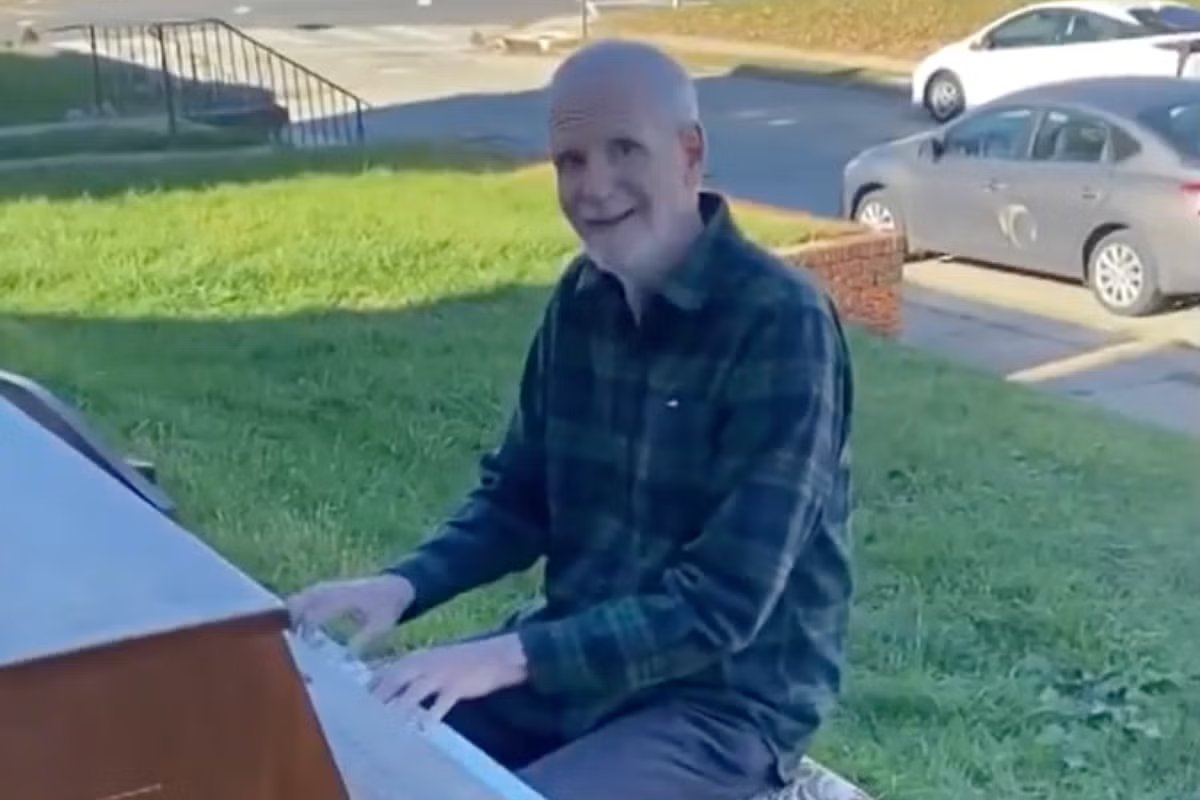
Frank Grow, a 78-year-old former musician from Maryland, became the subject of a remarkable missing-person search after disappearing from his home in Bowie. His sudden disappearance left his family frightened and uncertain about where he had gone, particularly because Grow had been living with Alzheimer’s disease for approximately six years. What began as an ordinary moment at home quickly turned into an unexpected journey that took him more than 100 miles away, across state lines, and into Philadelphia, Pennsylvania. However, an extraordinary connection to music helped bring the situation to a safe and emotional conclusion.
Grow was eventually discovered by Philadelphia resident Angelo Torres, who noticed the elderly man looking confused on his street. When Torres approached him, he realised that something was wrong and tried to help. The situation took an unexpected turn when Grow noticed an old piano sitting outside Torres’ home. Despite his memory difficulties, the 78-year-old immediately connected with the instrument and began playing it with remarkable confidence. The unexpected musical moment helped establish a connection between the two strangers and became an important part of the story that eventually reunited Grow with his family.
His daughter, Maggie Henkin, described the reunion as a miracle and expressed deep gratitude towards Torres for helping her father. The incident also highlighted how memories connected to familiar activities, including music, can sometimes remain meaningful for people living with Alzheimer’s disease, even when other aspects of their memory become difficult to access.
Who Is Frank Grow and What Happened Before His Disappearance?
Frank Grow is a 78-year-old former musician from Maryland who has been living with Alzheimer’s disease for around six years. Although details about his musical career and personal life have not been widely disclosed, his remarkable ability to play the piano demonstrated that his connection to music remained strong despite the challenges associated with his condition. Grow lives in Bowie, Maryland, where his daughter, Maggie Henkin, helps care for him. His family is familiar with the difficulties of managing his condition, but nothing could have prepared them for the frightening experience that unfolded when he suddenly disappeared in a car.
According to the information released by Bowie Police, Grow left his residence in the 2800 block of Bosworth Lane in a Nissan Sentra. The disappearance prompted authorities to issue a critical missing-person report because of concerns about his safety and his medical condition. His daughter later explained that the incident happened during a brief moment when she stepped away from the vehicle to get a cup of coffee from inside the house. She had left the car running, expecting to return almost immediately. However, when she came back outside, both her father and the vehicle were gone. The entire situation unfolded within approximately two minutes, leaving Henkin shocked by how quickly everything had happened.
Speaking to NBC Philadelphia and NBC Washington, Henkin described the frightening moment when she realised her father had driven away. She explained that she had only been inside the house for a couple of minutes and immediately panicked when she discovered that the car was missing. She had no idea which direction he had taken or how far he might travel. Because Grow had Alzheimer’s disease, the possibility of him becoming disoriented while driving was especially concerning. His family had to deal with the uncertainty of not knowing where he was, whether he could find his way around unfamiliar surroundings, or whether he might encounter difficulties during the journey.
During one of the interviews following his safe recovery, Grow was also asked about his journey. Sitting beside his daughter, he offered a brief but revealing explanation, saying, “I was headed away from where I was.” His response reflected the confusion surrounding his unexpected departure, although it later became clear that he had a particular destination in mind. Grow eventually explained that he had been attempting to visit the house where he spent his childhood in Norristown, Pennsylvania. The journey was therefore connected to a place from his earlier life, suggesting that memories of his childhood home had influenced his decision to leave Maryland.
Read : Body of Missing 20-Year-Old James “Weston” Higginbotham Found in Kyoto
The distance between his home in Bowie and the Philadelphia area made the situation particularly worrying. Rather than remaining somewhere nearby, Grow had travelled more than 100 miles before being discovered. For his family, every passing moment without information about his whereabouts increased the uncertainty. His daughter had no way of knowing that her father would eventually be found in another state, sitting beside an old piano and playing music that connected him to his earlier life.
Read : Yellowstone National Park: Exploring Nature’s Wonderland
Alzheimer’s disease is a progressive neurological condition that affects memory, thinking, reasoning and the ability to carry out everyday activities. According to the Alzheimer’s Association, the condition damages nerve cells in the brain and gradually interferes with a person’s ability to function independently. Its effects vary from person to person, and people living with the disease may experience difficulties recognising familiar surroundings, remembering information or making decisions. For families and caregivers, these changes can create significant challenges, particularly when a loved one unexpectedly becomes separated from them.
Grow’s disappearance demonstrated how quickly an ordinary situation can become an emergency for families caring for someone with Alzheimer’s. His daughter had stepped away for only a brief moment, but that was enough time for him to leave the property and begin a journey that eventually took him far beyond his neighbourhood. Fortunately, the circumstances surrounding his discovery would bring an unexpected connection between his past and present into the story.
How Angelo Torres Found Frank Grow Playing Piano More Than 100 Miles Away
While Grow’s family was dealing with his disappearance in Maryland, a completely different situation was unfolding in Philadelphia. Angelo Torres, a local resident, noticed an elderly man on his street who appeared confused and disoriented. The man was later identified as Frank Grow, although Torres initially had no idea who he was or where he had come from. Recognising that the stranger might need assistance, Torres approached him and asked whether he was all right.
Speaking to NBC Washington, Torres recalled the conversation. He said that he pulled up beside Grow and asked, “Sir, are you okay?” The elderly man responded honestly, telling him, “No, I’m not okay.” That short exchange made Torres realise that the man was experiencing some kind of difficulty. Rather than ignoring the situation, he decided to stay involved and see whether he could help identify the stranger or find someone who knew him.
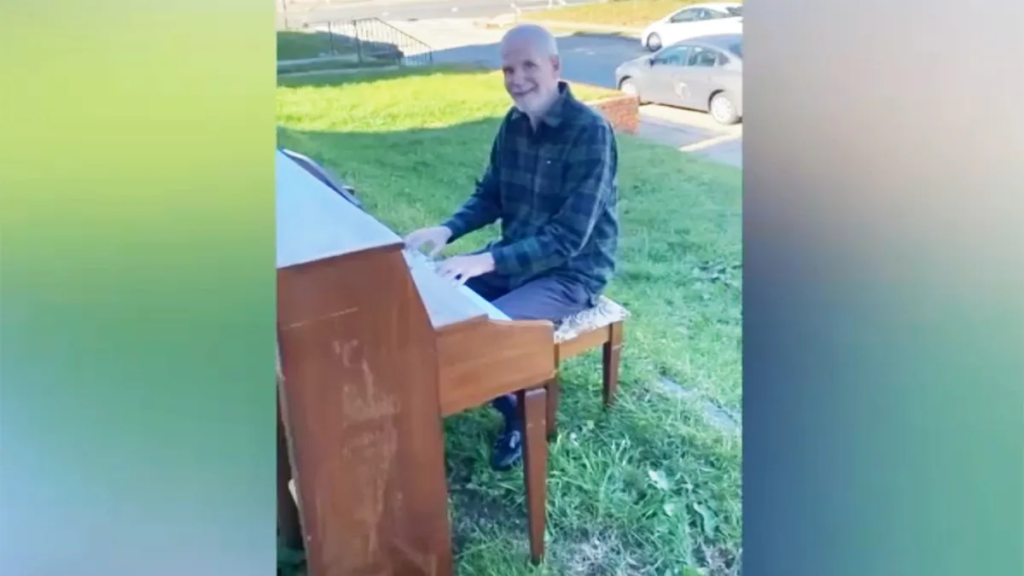
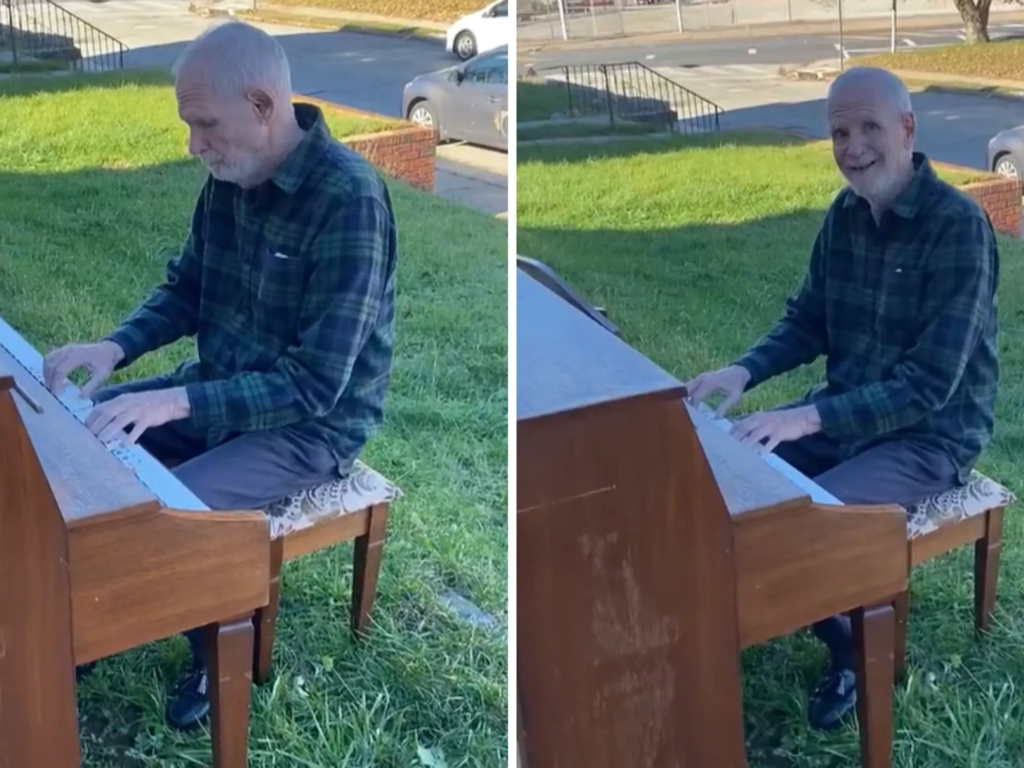
What happened next turned an ordinary encounter into an extraordinary moment. An old piano had been sitting outside on Torres’ lawn, and Grow appeared to recognise the instrument. The former musician approached it, sat down and began playing. Despite his apparent confusion and the difficulties associated with Alzheimer’s disease, he demonstrated an impressive ability to play the piano. His performance immediately caught Torres’ attention because it revealed a completely different side of the elderly man he had just encountered.
For Torres, the moment was especially surprising because Grow had initially appeared unable to explain his situation. Yet, when he encountered the piano, his musical abilities became immediately apparent. The instrument seemed to provide a familiar connection that words alone had not been able to establish. Torres recorded a video of Grow playing the piano on his lawn, capturing the unusual encounter between two strangers who had met under unexpected circumstances.
In the video, Torres introduced the elderly musician with the words, “That’s my friend, Frank.” He then added that he had only just met him. Grow could be seen smiling towards the camera while playing the instrument. The footage offered a touching glimpse into the encounter and showed how a shared moment involving music helped create an immediate connection between the two men.
However, Torres still needed to establish the man’s identity and contact someone who could help him return home. He attempted to find identification on Grow but could not locate any obvious personal documents. With no immediate way to determine who the elderly man was, Torres decided to examine the Nissan Sentra in which he had arrived. He hoped that something inside the vehicle might provide information about its owner or help him locate a family member.
His search eventually led him to an old invoice in the trunk. The document contained a phone number belonging to Grow’s daughter, Maggie Henkin. This discovery provided the missing link between the elderly musician in Philadelphia and the worried family searching for him in Maryland. Torres used the number to contact Henkin, unaware that the call would bring an end to a frightening period of uncertainty for her family.
Henkin later described receiving the unexpected telephone call during an interview with NBC Philadelphia. She recalled that it was around 1 p.m. when her phone rang, displaying an unfamiliar Philadelphia number. When she answered, a man named Angelo asked whether she knew someone named Frank. Henkin immediately recognised that the caller was referring to her father and confirmed that Frank was indeed her dad.
The emotional significance of the call became even clearer when Henkin heard her father’s voice in the background. According to her account shared with NBC Washington, Grow could be heard saying, “Oh, I really did it this time.” The comment reflected his awareness that his unexpected journey had created a serious situation for his family.
For Henkin, hearing her father’s voice was an enormous relief. After the panic of discovering that he had disappeared, she finally had confirmation that he was alive and had been found by someone willing to help. Torres had not only noticed that something was wrong but had also taken the time to investigate the vehicle and search for a way to contact the family. Without that effort, identifying Grow could have been considerably more difficult.
The discovery also revealed the remarkable role that music had played in the encounter. Although Grow initially appeared confused and unable to explain his circumstances, his ability to recognise and play the piano provided a memorable moment that helped Torres connect with him. It was an unexpected reminder of the lasting significance that familiar activities and experiences can hold for people living with neurological conditions.
Frank Grow Reunited With His Family as Daughter Calls the Discovery a Miracle
After Torres successfully contacted Henkin, the immediate priority was to ensure that Frank Grow could be reunited with his family. His daughter had spent a frightening period wondering where he had gone, and the news that he had been located in Philadelphia brought enormous relief. The 78-year-old had travelled more than 100 miles from his Maryland residence, but he had ultimately been found safe through the intervention of a stranger who decided to help.
When Grow was reunited with his family, he explained why he had left home. According to Henkin, her father had been trying to visit his childhood home in Norristown, Pennsylvania. This revelation offered an explanation for his unexpected journey and suggested that memories of his earlier years had influenced where he wanted to go. Norristown was a place connected to his childhood, and despite the difficulties he experienced because of Alzheimer’s disease, the desire to return to a familiar location had remained significant enough to motivate his journey.
His explanation also added another emotional dimension to an already unusual incident. Grow had not simply driven away without any apparent destination. Instead, he had been attempting to revisit a place associated with his past. For his family, understanding this motivation provided some context for what had happened, although the experience remained a serious reminder of the challenges that can accompany Alzheimer’s disease.
Read : Missing Northern Kentucky University Student Murry Foust Found Dead
Henkin expressed heartfelt gratitude towards Torres for finding her father and helping him get back to his family. Reflecting on the experience, she said, “I’m just so grateful and thankful. It was truly a miracle, and I’m so grateful for Angelo, and there are still good people out there.” Her words reflected the relief of a daughter who had feared for her father’s safety and was fortunate to encounter someone who went beyond simply checking whether a stranger was all right.
Torres also found the experience deeply meaningful, although for a different personal reason. He revealed that his own father had passed away around the same period when Grow was diagnosed with Alzheimer’s disease. The encounter therefore brought back memories of his father and created an emotional connection that extended beyond the immediate circumstances of helping a missing elderly man.
Speaking to NBC Philadelphia, Torres explained that he had been thinking about his father throughout the week. When Grow suddenly appeared on his street, he felt that the encounter carried a special meaning. He described his thoughts by saying, “I’m thinking my dad came in this form.” His statement revealed how the unexpected meeting had affected him personally. Helping Grow was not just an act of kindness towards a stranger; it also became an experience that reminded him of his own father.
The story eventually brought together two families through an unexpected chain of events. Henkin had been searching for her missing father, while Torres had encountered an elderly stranger who needed assistance. An old piano on a residential lawn became the centre of their connection, and an old invoice in the trunk of a car provided the information needed to reunite Grow with his daughter.
For people living with Alzheimer’s disease and their families, the incident also highlights the importance of understanding that memory does not necessarily disappear in the same way across every aspect of a person’s life. The condition can affect different abilities, and familiar activities may continue to hold meaning even when remembering recent events or navigating unfamiliar surroundings becomes difficult. Grow’s ability to play the piano was particularly striking because it demonstrated how strongly music remained connected to his earlier experiences as a working musician.
Music has long been recognised as an important part of many people’s lives, connecting them with experiences, emotions and familiar routines. In Grow’s case, the piano offered a moment of recognition during an otherwise confusing situation. Although the instrument did not explain where he had come from or how he had travelled so far, it created an opportunity for Torres to engage with him and capture a moment that would later become central to the story.
The incident also served as a reminder of the difficulties faced by caregivers. Henkin was looking after her father when the unexpected disappearance occurred, and the entire situation developed during a very brief absence. Families caring for people with Alzheimer’s often have to remain aware of changes in memory, judgement and orientation. Unexpected departures can create serious safety concerns, particularly when someone travels alone or becomes unfamiliar with their surroundings.
Ultimately, Frank Grow’s disappearance ended with a safe reunion rather than the tragedy his family had feared. His journey from Bowie, Maryland, to the Philadelphia area was unexpected, but the kindness of Angelo Torres helped turn a frightening experience into a remarkable story of compassion and human connection. Torres’ decision to approach a confused stranger, his patience in searching for identification and his determination to contact the man’s family made a crucial difference.
For Henkin, the experience reinforced her belief that good people are still willing to help others when they need it most. For Torres, the encounter became an emotional reminder of his late father. And for Grow, the old piano provided an unexpected connection to the musical life he once knew. What began as a missing-person emergency ultimately became a story about family, memory, music and the extraordinary kindness of a stranger who refused to walk away.