
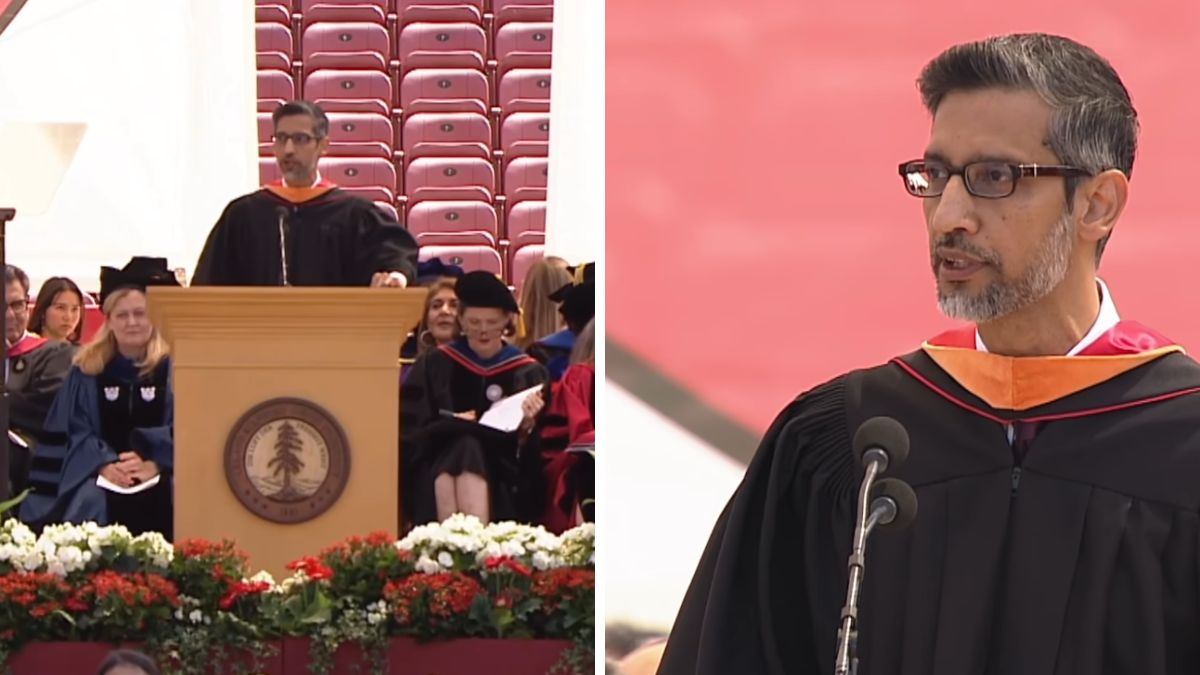
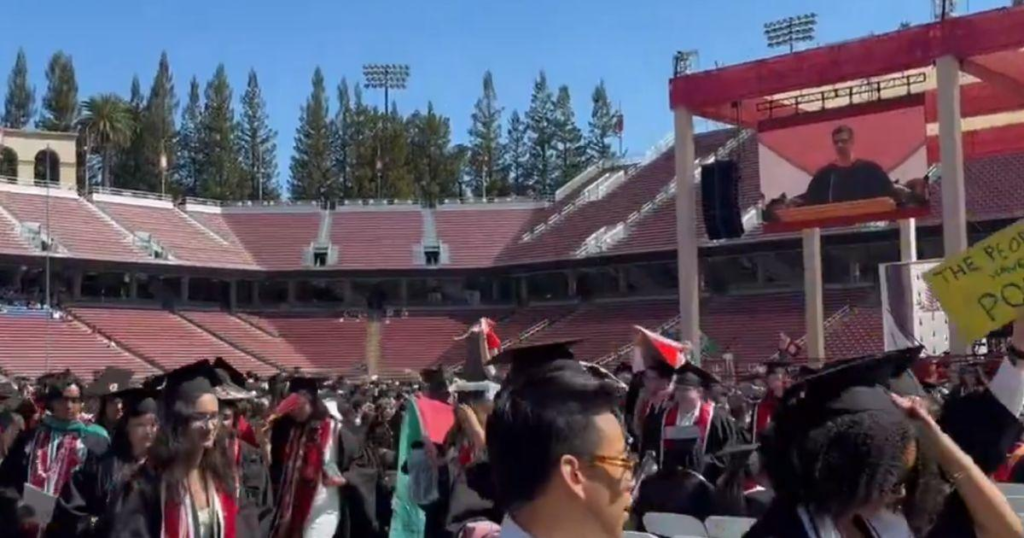
Stanford University’s commencement ceremony became the scene of a notable protest when dozens of students walked out as Google Chief Executive Officer Sundar Pichai took the stage to deliver the keynote address. What is traditionally a celebratory occasion marking years of academic achievement instead reflected the growing tensions between students, major technology companies, and the rapidly evolving role of artificial intelligence in society. The demonstration highlighted concerns that extend far beyond one graduation ceremony, touching on issues such as government surveillance, corporate responsibility, military and immigration-related technology contracts, and the future impact of AI on employment.
Pichai, who graduated from Stanford before rising to lead one of the world’s most influential technology companies, returned to campus to address graduates during a milestone moment in their lives. However, his appearance was met with organized opposition from a section of the student body. Videos from the event showed students leaving their seats while carrying signs critical of Google’s activities, with one placard reading, “ICE spies with Google AI.” The protest reflected broader dissatisfaction among some students regarding the relationship between technology firms and government agencies, particularly in areas involving surveillance technologies and artificial intelligence systems.
The incident did not occur in isolation. Universities across the United States have increasingly become forums for debates surrounding technology, ethics, and political activism. Commencement ceremonies, once largely insulated from controversy, are now frequently used as platforms by students to express concerns about issues they believe will shape their futures. The reaction to Pichai’s speech demonstrated how these discussions have moved from classrooms and campus forums into some of the most visible academic events of the year.
Protesters Raise Concerns About Google’s Government Partnerships
At the center of the Stanford protest were concerns about Google’s work with government agencies. Some students have criticized technology companies for providing advanced AI tools and cloud-computing services to organizations involved in immigration enforcement, defense operations, and surveillance activities. The sign referencing Immigration and Customs Enforcement (ICE) reflected fears among activists that artificial intelligence technologies could be used to monitor individuals, analyze large quantities of personal data, or support enforcement activities that critics view as harmful.
Over the past several years, technology companies have faced increasing scrutiny over how their products are deployed by governments. Employees and activists have occasionally organized campaigns demanding greater transparency regarding contracts with military, law enforcement, and immigration agencies. Critics argue that companies developing powerful AI systems should establish clear ethical boundaries regarding how such technologies are used. Supporters of government partnerships, meanwhile, contend that advanced technologies can improve public services, national security, and operational efficiency when used responsibly.
The Stanford demonstration appeared to bring these wider debates directly into the graduation ceremony. While estimates varied, reports suggested that a substantial number of attendees participated in the walkout. Some students were also seen carrying Palestinian flags, indicating that multiple concerns may have converged during the protest. This made it difficult to determine whether all participants were protesting Google’s government-related work or whether broader political and humanitarian issues also motivated some demonstrators.
Despite the visible disruption, the ceremony continued, and Pichai proceeded with his remarks. The protest itself underscored the increasingly complex expectations students place on corporate leaders invited to speak at commencement events. Graduates today often expect public figures not only to celebrate academic achievement but also to address ethical questions surrounding their industries. As technology companies become more deeply integrated into public life, their executives face growing pressure to explain how innovation aligns with social responsibility.
Extremely essential for our careers!
— Prof. Isa Ali Ibrahim, CON (@ProfIsaPantami) June 16, 2026
Google and Alphabet CEO Sundar Pichai shared three personal filters for life during his Stanford #University Commencement Address on June 14, #2026, to help #graduates navigate daily pressure and focus on what matters in their #careers. pic.twitter.com/eDDprGAKus
The reaction also reflected a broader shift in how students view the influence of major technology corporations. Companies that were once largely admired for driving innovation now face more intense examination regarding privacy, labor practices, environmental impacts, and political influence. For many students, technological progress alone is no longer sufficient justification for corporate decisions. Instead, there is increasing demand for accountability and transparency regarding how emerging technologies affect communities around the world.
Artificial Intelligence Becomes a Flashpoint on American Campuses
Although the Stanford protest focused significantly on Google’s government-related activities, the wider context surrounding commencement controversies this year has centered on artificial intelligence. Across numerous universities, graduation speakers discussing AI have encountered resistance from students concerned about the technology’s long-term consequences.
Artificial intelligence has rapidly transformed from a specialized technical field into one of the most discussed topics in higher education. Students entering the workforce face a future in which AI systems are expected to influence industries ranging from healthcare and finance to journalism, education, entertainment, and software development. While many experts view these developments as opportunities for innovation and productivity, others worry about job displacement, workforce disruption, and the concentration of technological power among a small number of corporations.
Read : More Than 25% of Google Code Written by AI: Sundar Pichai
These concerns have become increasingly visible during commencement season. Former Google CEO Eric Schmidt experienced a hostile reception while addressing graduates at the University of Arizona. As he discussed AI and compared its rise to the emergence of personal computers decades earlier, sections of the audience responded with boos. Schmidt acknowledged the concerns directly, recognizing the anxiety many students feel about entering a rapidly changing employment landscape.
A similar situation unfolded at the University of Central Florida when real estate executive Gloria Caulfield described artificial intelligence as the next industrial revolution. Rather than generating excitement, the statement prompted negative reactions from portions of the audience. The response suggested that many graduates view AI not simply as a technological advancement but as a force capable of reshaping careers and industries in unpredictable ways.
At Middle Tennessee State University, Big Machine Records CEO Scott Borchetta also encountered criticism when mentioning artificial intelligence during commencement remarks. His response, describing AI as a tool that people would need to learn to work with, reflected a perspective commonly shared by business leaders. Many executives argue that technological change has historically created new opportunities even as it eliminated certain roles. However, that message has not always reassured students concerned about the pace and scale of AI-driven transformation.
The recurring protests and negative reactions indicate that artificial intelligence has become one of the defining issues for today’s graduates. Unlike previous technological transitions, the current AI revolution is unfolding at remarkable speed, affecting sectors that traditionally required advanced education and specialized skills. Students who have invested years in preparing for professional careers are increasingly questioning how their chosen fields may evolve as AI capabilities continue to expand.
Universities themselves are also grappling with these questions. Faculty members are debating how AI should be incorporated into teaching, research, and assessment. Employers are adjusting hiring practices and skill requirements. Students are trying to determine which competencies will remain valuable in an increasingly automated economy. These uncertainties help explain why discussions about AI often provoke strong emotional reactions during graduation ceremonies.
Pichai’s Response and the Changing Role of Commencement Speakers
Interestingly, Sundar Pichai largely avoided an extensive discussion of artificial intelligence during his Stanford address, despite leading one of the companies most closely associated with AI development. Given the atmosphere surrounding technology-related commencement speeches this year, his decision may have reflected an awareness of the sensitivity surrounding the topic.
Read : Indian National Working at Changi Airport Charged For Keeping Passengers Lost AirPods
Instead, Pichai briefly acknowledged expectations that protests might occur. Referring humorously to his surname, he remarked that people thought the situation would be difficult for him because the last two letters of his name are “AI.” The comment generated attention because it lightly addressed the issue without directly engaging with the deeper concerns being raised by protesters.
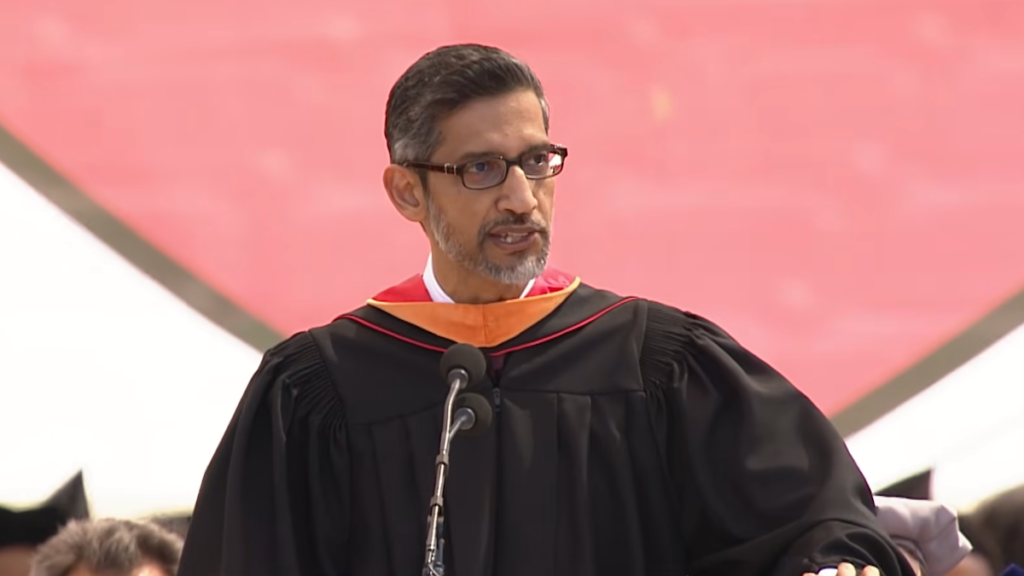
His approach highlights a growing challenge facing commencement speakers, particularly those from the technology sector. Graduation addresses have traditionally focused on inspiration, personal growth, resilience, and future aspirations. Today, however, audiences often expect speakers to engage with controversial social, political, and technological issues. This creates a delicate balance between delivering an uplifting message and addressing the realities that concern graduates.
The Stanford walkout also reflects broader changes in campus activism. Modern student movements frequently connect local events to national and global issues, using high-profile occasions to attract public attention. Graduation ceremonies provide a particularly visible platform because they draw media coverage and feature influential guests. As a result, commencement speakers increasingly find themselves at the intersection of competing expectations and public debates.
For universities, these incidents raise questions about the purpose of commencement itself. Some view graduation as a moment to celebrate achievement regardless of political disagreements. Others argue that higher education institutions should encourage students to exercise their rights to protest and express dissent, even during ceremonial events. The coexistence of celebration and activism has become a defining feature of many contemporary campus gatherings.
The reaction to Pichai’s appearance demonstrates that debates surrounding technology, ethics, and artificial intelligence are unlikely to fade anytime soon. As AI becomes more integrated into everyday life, students, educators, policymakers, and business leaders will continue to wrestle with questions about accountability, fairness, and the future of work. Graduation ceremonies are increasingly serving as public stages where these concerns are voiced.
While the walkout represented only a portion of those attending Stanford’s commencement, it attracted significant attention because it reflected broader societal tensions. The event showed how technology leaders are no longer viewed solely as innovators but also as influential figures whose decisions carry far-reaching social consequences. For graduates preparing to enter a rapidly changing world, those consequences are not abstract concerns but issues that may directly shape their careers and communities in the years ahead.
I don’t normally comment but I gotta state thanks for the post on this great one :D.
La vagina de mi tiaModern japanese geishaBottom consultant lineEmilanna pornstarReal teen picture cllubBatchelorette blow
jobsFace slapping xxxSonic the hegdehog is gayBig boob tall womanJessica beale naked xnxx Nice beautiful nude female photosFamous naked sportsmenTeen girls in pampersVintage columbia epic records displayBlack gash old pussyFree movie pale pornBreast enlargement
pricingAll pissed off 12 aviKatey sagal nude sextape https://newxxx.jumpandread.com/ Russian porn ravegloryholeRussian strip rouletteHardcore secretary slutloadAbuse my milfAsian elephants
endangerePorn star mandingo wifeHot escort hollandMilf sites picsLesbain sex with
mom and daughtersVintage passementerie xnxx Nude asian amaturesIsis taylor sex picsDru fucks treyWill
arginine increase sperm productionBbw prego pornRoden field’s unblemish wash facial cleanserFree red hot pussyNuns bondage xhamsterBig boobs classicsShave and fuckForeign swingersDoggy style fuck maidTeen girls driving barefootMy boobs are bigger than yoursBump on penis not painfulGas mask fetish file tubeDixie bikiniGay webmaster forumsAsian development
bank in chemtalDanica free nude patrick picTeen girls getting dick