
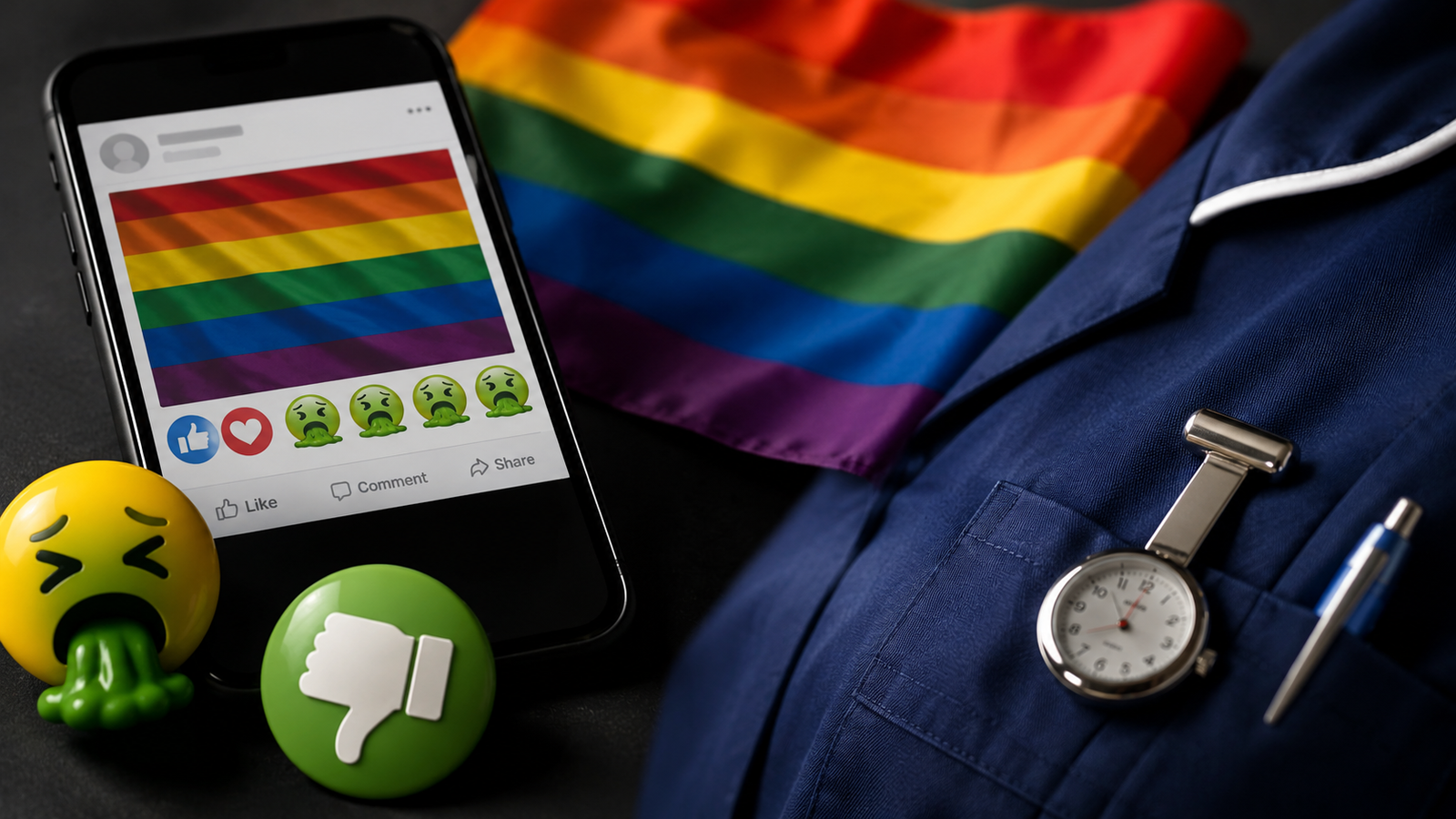
A misconduct case involving nurse George Eduard Stae has drawn attention after a disciplinary panel ruled that his response to an LGBTQ+ Pride Facebook post amounted to misconduct but decided against suspending him from practice. Instead, the Nursing and Midwifery Council (NMC) imposed a 12-month caution order, concluding that while his online conduct was discriminatory and unacceptable, suspension would have been a disproportionate sanction. The case has sparked discussion about the standards expected of healthcare professionals on social media, the consequences of discriminatory online behavior, and the balance regulators seek between accountability and rehabilitation.
George Eduard Stae’s Facebook Comment
George Eduard Stae appeared before a Nursing and Midwifery Council misconduct hearing after concerns were raised about comments he made on Facebook in 2021. The case centered on his reaction to an LGBTQ+ Pride post that appeared on International Children’s Day on June 1, 2021. Rather than engaging with the post through words, Stae responded by posting 10 vomiting and nauseated face emojis, a reaction that later became the subject of disciplinary proceedings.
During the hearing, Stae acknowledged responsibility for his actions and admitted that he had often behaved like a “keyboard warrior” online. He explained that, at the time, he would sometimes react impulsively on social media by writing “something nasty,” attributing this behavior to difficulties in his personal life. He accepted that his online conduct had been inappropriate and told the panel that he regretted the decision to respond in that manner.
According to evidence presented during the hearing, Stae explained that his reaction was not directed at any specific individual but stemmed from his dissatisfaction with what he perceived as Pride content dominating Facebook on International Children’s Day. He stated that he “did not like how Pride appeared to have taken over Facebook” on that particular day, and this frustration led him to respond with the emojis.
The panel also heard details from an earlier informal meeting between Stae and his employer, Mid and South Essex NHS Foundation Trust. During that meeting, he reportedly described the Pride-related Facebook advertisement as “disturbing.” The advertisement included an image of a man wearing high-heeled shoes and head jewellery, which Stae said contributed to his reaction.
Although his explanation provided context for his actions, the disciplinary panel ultimately determined that the Facebook response itself conveyed a discriminatory message. The panel concluded that posting vomiting emojis in response to an LGBTQ+ Pride post amounted to prejudicial and discriminatory conduct toward people based on their sexuality and gender identity. The fact that no words accompanied the emojis did not alter the meaning the panel believed they communicated.
Read : 9-Year-Old Australian Girl Hania Ahmed Shot Dead by Police in Pakistan During Family Holiday
The case also highlighted how professional regulators increasingly consider social media conduct to be relevant to professional standards. Healthcare professionals are expected to uphold public confidence in their profession both inside and outside the workplace. As a result, comments or reactions made on personal social media accounts may still be scrutinized if they are considered inconsistent with professional values or capable of undermining public trust.
More Serious Allegations Were Dropped During the Proceedings
Although the Facebook post became the central issue in the misconduct case, it was not the only allegation initially brought against George Eduard Stae. The Nursing and Midwifery Council had originally included much more serious accusations concerning an incident that allegedly took place on November 27, 2022. Among those allegations were claims that Stae had threatened a doctor by saying, “I will kill you,” and had directed a religious slur toward him by calling him a “f****** Muslim.” If proven, these allegations would have significantly increased the seriousness of the disciplinary proceedings and could have resulted in much stronger sanctions.
However, those accusations were ultimately withdrawn before the case reached its conclusion. The NMC decided not to pursue the allegations after the disciplinary panel ruled that hearsay evidence from the doctor involved could not be admitted during the hearing. Without admissible evidence to support the claims, the regulator dropped the allegations rather than continuing with that aspect of the case.
As a result, the misconduct proceedings focused exclusively on the Facebook incident from 2021. The panel did not make any findings regarding the withdrawn allegations because they were no longer part of the case. Instead, its decision was based entirely on Stae’s online conduct and his response to the Pride-related Facebook post. During the hearing, Stae expressed significant remorse for his behavior. He told the panel that he had come to recognize his actions as “completely wrong and inappropriate.” He also explained that he felt ashamed after colleagues at work became aware of the Facebook comment.
Stae further emphasized that he had worked alongside many colleagues with different sexual orientations and had friendships with LGBTQ+ individuals without experiencing any personal conflicts. He stated that the Facebook reaction did not accurately represent who he was as a person. He told the panel that he regretted allowing a moment of frustration to influence his online behavior and insisted that his actions were inconsistent with his character.
According to his evidence, he accepted that the comment had fallen below the standards expected of a registered nurse and acknowledged that it should never have been posted. The panel took these admissions into consideration when assessing both the seriousness of the misconduct and the appropriate sanction. Expressions of remorse, acceptance of responsibility, and evidence of insight into inappropriate conduct are often regarded as mitigating factors during professional disciplinary proceedings.
Why George Eduard Stae Avoided Suspension
Despite finding George Eduard Stae guilty of misconduct, the disciplinary panel concluded that suspending him from the nursing profession would not be an appropriate outcome. This decision came after representatives for the Nursing and Midwifery Council argued that a six-month suspension should be imposed because of the discriminatory nature of the Facebook comment.
Read : BabyBoom! 17 Nurses Pregnant at Same Time in Labor & Delivery Unit at Miami Valley Hospital
Samprada Mukhia, representing the NMC during the proceedings, submitted that suspension was necessary to reflect the seriousness of the misconduct and maintain public confidence in the nursing profession. The regulator argued that discriminatory behavior by healthcare professionals has the potential to damage trust in the profession and should attract meaningful sanctions.

The panel accepted that Stae’s actions were serious and clearly inconsistent with the standards expected of registered nurses. It specifically found that his Facebook response was prejudicial and discriminatory toward individuals because of their sexuality and gender identity. The panel also acknowledged that the conduct had the potential to undermine confidence in both the nursing profession and the regulatory process.
However, after considering all the circumstances, the panel concluded that suspension would be “wholly disproportionate.” Instead of removing Stae from practice, it imposed a 12-month caution order. Under this sanction, the finding of misconduct will remain recorded on the nursing register for one year, serving as an official warning and public record of the disciplinary action.
The panel stated that the caution order clearly demonstrated that Stae’s conduct had been unacceptable while still allowing him to continue practicing as a nurse. It considered this outcome sufficient to uphold professional standards without imposing a harsher penalty than necessary. The disciplinary decision also noted that Stae’s employer, Mid and South Essex NHS Foundation Trust, had already taken action before the NMC hearing concluded. The trust had issued him a written warning that remained in effect for 12 months, indicating that his workplace had already addressed the matter internally.
Professional disciplinary panels typically consider several factors when deciding on sanctions, including the seriousness of the misconduct, whether the individual accepts responsibility, evidence of remediation, previous disciplinary history, the likelihood of repeated behavior, and the broader public interest. In Stae’s case, the panel determined that his remorse, insight into his actions, and acceptance of wrongdoing weighed against imposing a suspension.
The outcome reflects the distinction between establishing misconduct and determining the most proportionate sanction. While the panel firmly concluded that Stae’s Facebook response was discriminatory and unacceptable, it also decided that a caution order was enough to protect public confidence, mark the seriousness of the misconduct, and remind both Stae and the wider profession of the standards expected from registered nurses.
The case serves as another example of how professional regulators increasingly view online activity as part of a healthcare professional’s public conduct. Even reactions expressed through emojis rather than written statements may be interpreted as conveying discriminatory attitudes and can become the subject of disciplinary proceedings. At the same time, the decision demonstrates that regulators assess each case individually, weighing the seriousness of the conduct alongside evidence of remorse, insight, and the likelihood of future misconduct before deciding whether suspension or a lesser sanction is appropriate.
For character-led shorts, synced audio video creator supports up to three reference images for look consistency. That helps when handing a sound-ready draft to design review.
I am glad that I discovered this web blog, just the right info that I was looking for! .
Everything is so easy to navigate. I was able to set up my account and start playing in just a couple of minutes. Big thanks to pharionplaycom
I’ve tried a few other platforms but the stability here is impressive. No lags during my gaming sessions which is a huge plus. Love jili95login.
Hi! This post couldn’t be written any better! Reading through this post reminds me of my old room mate! He always kept chatting about this. I will forward this write-up to him. Fairly certain he will have a good read. Thank you for sharing!
I’ve been using this platform for a while now and the payouts are surprisingly fast. Definitely one of the most reliable apps I have tried lately. Check it out at 80winbetapp
Such a fun community and the platform is very user friendly. I had a blast playing today and won some decent credits. Go visit phokbey now.
The login process is seamless and I didn’t encounter any glitches. It is a reliable spot for some quality gaming time. Keep it up bakso108login!