
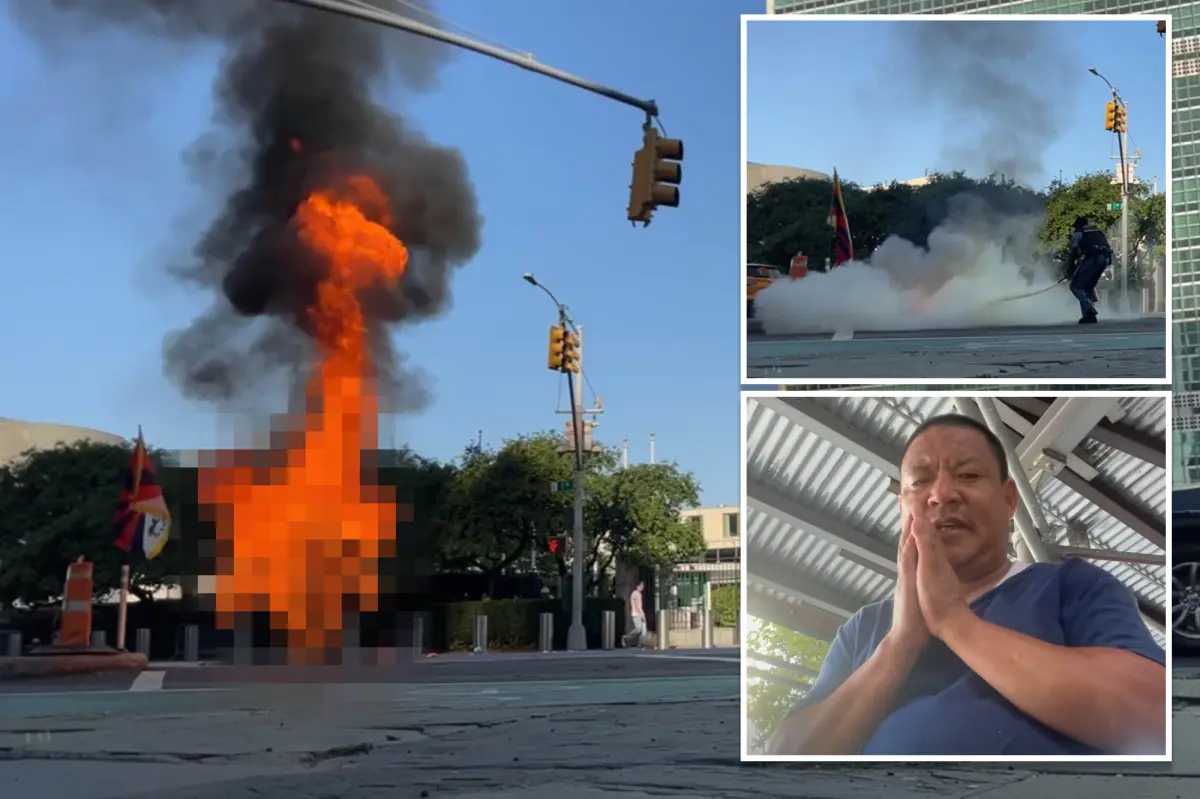
The death of Lobga Rangzen outside the United Nations headquarters in New York City has drawn international attention after he carried out a fatal act of self-immolation during what appeared to be a political protest over Tibet. The 42-year-old Tibetan man died after setting himself on fire on the evening of July 2, 2026, near the busy intersection of 42nd Street and First Avenue in Manhattan.
The incident unfolded during rush hour and was captured on livestream footage, showing Rangzen planting a Tibetan flag on the sidewalk before igniting himself. As flames engulfed him, he scattered leaflets bearing political messages, including the slogan “China Out of Tibet,” before collapsing less than a minute later. Emergency responders extinguished the flames and transported him to Bellevue Hospital, where he was pronounced dead.
The shocking protest has renewed global discussion about Tibet’s political status, the long history of Tibetan resistance, and the extreme measures some activists have taken to draw international attention to their cause. Friends who knew Rangzen described him as a peaceful individual who strongly believed in advocating for Tibetan freedom, making the incident particularly devastating for those within New York City’s Tibetan community.
Who Was Lobga Rangzen and What Is Known About His Life?
Lobga Rangzen was identified by friends as a member of the Tibetan community living in the United States, where he had reportedly resided for approximately two decades. During that time, he built a life in America while working as an Uber driver in New York City. Those who knew him described him as someone deeply connected to Tibetan culture and committed to preserving awareness of Tibet’s political struggle. According to his friend and fellow Uber driver Lobsang Paljor, Rangzen consistently favored peaceful demonstrations and was never known to advocate violence. Instead, he believed in expressing his views through nonviolent protest and remained committed to the goal of a free Tibet throughout his life.
Paljor expressed shock after learning of his friend’s death, explaining that while Rangzen cared passionately about the Tibetan cause, he had always approached activism peacefully. Friends emphasized that he strongly opposed China’s control over Tibet and hoped one day to see what he believed would be a fully independent Tibet. Although the decision to carry out self-immolation stunned those close to him, they said his commitment to raising awareness about Tibet’s political situation had never been in doubt.
The protest itself appeared to have been carefully planned. Witnesses and video footage showed Rangzen dressed in full monastic robes despite not being publicly identified as a Buddhist monk. Before setting himself on fire, he placed a Tibetan national flag prominently on the sidewalk outside the United Nations headquarters, a location recognized worldwide as a symbol of international diplomacy and human rights discussions. He also distributed printed leaflets across the street before igniting the flames.
Some of the recovered papers reportedly carried the message “China Out of Tibet,” reflecting his political objective and the cause he wanted observers to associate with his final act. Witnesses described the horrifying moments that followed. A bystander from New Jersey recalled seeing a large column of smoke and flames before realizing someone had set himself on fire. Passing vehicles continued moving along First Avenue as drivers sounded their horns while nearby pedestrians watched in disbelief. Within seconds, United Nations security personnel carrying fire extinguishers rushed toward Rangzen and managed to put out the flames.
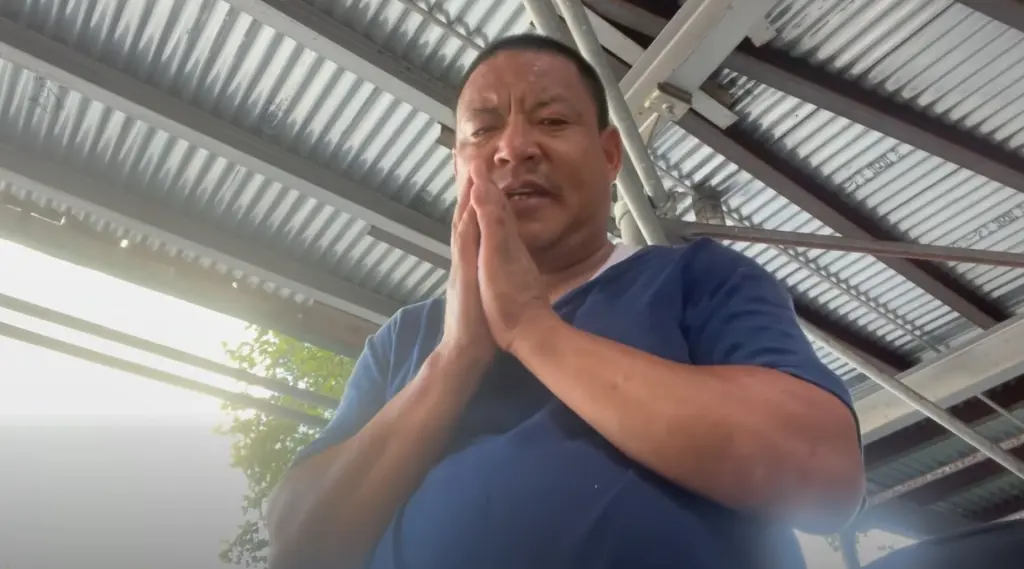
Before his final act of protest, Lobga Rangzen left a final message on Facebook, calling on Tibetans everywhere to unite and work for the freedom of their homeland.
— Bodpa Warriors (@BodpaW) July 3, 2026
In his message, he said that the lack of human rights in Tibet including the inability of Tibetans to freely keep… pic.twitter.com/ZpboyX1XtL
Despite their rapid response, witnesses said it quickly became apparent that he had suffered catastrophic injuries. Emergency medical personnel transported him to Bellevue Hospital, but doctors later pronounced him dead. The incident has left members of the Tibetan community grieving while also raising questions about the emotional and political motivations that drove Rangzen to choose such a dramatic form of protest. Those who knew him continue to remember him as someone dedicated to his beliefs, whose final act reflected the depth of his conviction regarding Tibet’s future.
The Protest Outside the United Nations and Why It Happened
The location of Rangzen’s protest was widely viewed as symbolic. The United Nations headquarters has long served as a destination for demonstrations concerning international conflicts, human rights, and political disputes. By staging his protest outside the UN complex, Rangzen appeared to be directing attention toward the international community, urging global institutions to recognize what he and many Tibetan activists describe as China’s occupation of Tibet.
Investigators found the Tibetan flag still standing near the scene even after police established a security perimeter. Officers also recovered numerous leaflets scattered across the pavement. Images from the aftermath showed police collecting the papers while one officer held a sign reading “China Out of Tibet,” echoing the central message of the protest. Authorities have not suggested that anyone else was involved, and there is no indication that the act posed a direct threat to others beyond the tragic consequences suffered by Rangzen himself.
The protest took place during one of Manhattan’s busiest periods, ensuring that hundreds of commuters, pedestrians, and motorists either witnessed the event directly or became aware of it almost immediately afterward. Livestream footage rapidly spread across social media, contributing to widespread public attention. Because of the graphic nature of the incident, many news organizations limited the footage they published while focusing instead on eyewitness accounts and the broader political context.
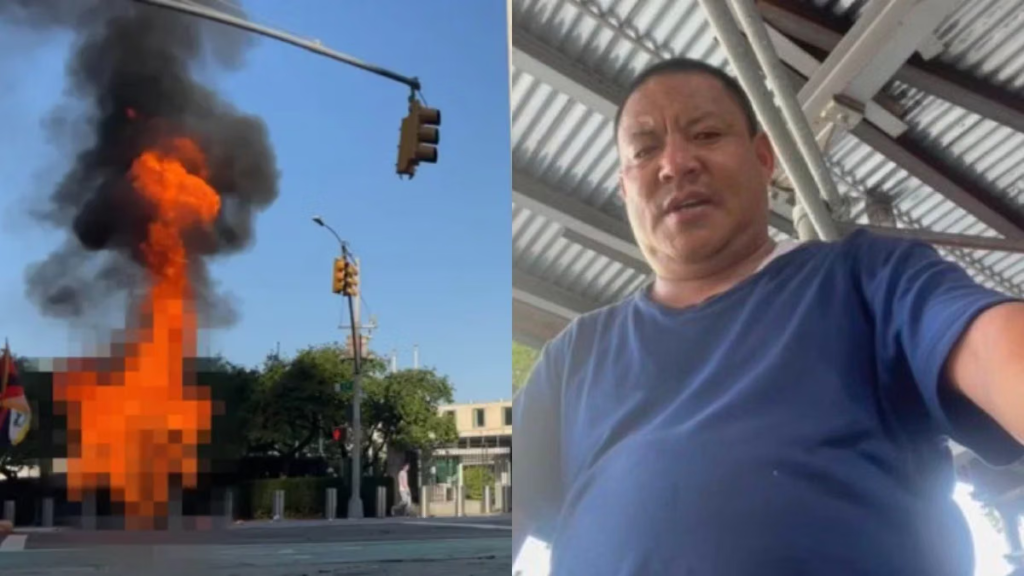
According to witnesses, Rangzen collapsed within moments after igniting himself. Emergency responders acted quickly, using fire extinguishers before transporting him to the hospital. One witness later remarked that although first responders arrived promptly, Rangzen’s injuries appeared so severe that survival seemed unlikely. Police later confirmed that the 42-year-old died at Bellevue Hospital after suffering extensive burns.
Friends believe the protest reflected Rangzen’s desire to draw international attention to Tibet rather than an act motivated by hostility toward individuals present at the scene. Lobsang Paljor stated that Rangzen had consistently embraced peaceful advocacy throughout his life and had never shown signs of aggression toward others. His final demonstration therefore represented an intensely personal political statement rather than violence directed at the public.
The incident has generated discussion among observers regarding the psychological, political, and humanitarian dimensions of self-immolation as a form of protest. Experts have long noted that such acts are intended to create powerful public symbolism by drawing attention to causes that protesters believe have been ignored. While governments and human rights organizations often discourage self-harm as a means of activism, these incidents continue to attract significant international attention because of their dramatic nature and profound human cost.
The Broader Tibet Movement and the History of Self-Immolation Protests
Lobga Rangzen’s death is part of a longer history of self-immolation associated with the Tibetan independence movement. According to advocacy organization Free Tibet, more than 150 Tibetans have carried out acts of self-immolation since 2009 in protest against Chinese rule in Tibet. Many of those individuals reportedly called for religious freedom, greater human rights protections, the return of the Dalai Lama, or the release of the Panchen Lama while carrying out their protests.
Read : Tony Carruthers’ Execution Stopped After Medics Couldn’t Set Up Backup IV Line
These incidents have become one of the most internationally recognized forms of political resistance linked to the Tibetan cause, although they remain deeply controversial because they involve deliberate acts of self-sacrifice. The modern political dispute surrounding Tibet dates back to the early years of the People’s Republic of China. In 1951, representatives signed the Seventeen Point Agreement following the entry of the People’s Liberation Army into Tibet. China maintains that the agreement formalized Tibet’s peaceful integration into the country and considers Tibet an inseparable part of Chinese territory.
Many Tibetan activists and supporters, however, argue that Tibet had previously exercised de facto autonomy and continue to challenge China’s governance of the region. These competing historical interpretations remain central to one of Asia’s longest-running political disputes. Over the decades, the Tibetan movement has evolved beyond demonstrations inside Tibet itself. Exiled Tibetan communities established around the world have organized rallies, educational campaigns, cultural events, and political advocacy aimed at maintaining international awareness of Tibet’s situation.
During the 1990s, high-profile events such as the Tibetan Freedom Concerts helped introduce the issue to wider global audiences through the participation of internationally recognized musicians and public figures. Human rights organizations have also continued documenting restrictions affecting religious practice, cultural expression, and political dissent within Tibet, while Chinese authorities maintain that their policies have brought economic development, infrastructure improvements, and stability to the region.
Acts of self-immolation have remained among the most emotionally powerful and widely reported forms of protest connected to the Tibetan movement. Advocacy groups say many participants have viewed these sacrifices as expressions of desperation after believing other methods failed to produce meaningful international action. At the same time, organizations focused on suicide prevention and mental health continue to emphasize the importance of protecting life and encouraging peaceful, non-lethal forms of advocacy.
The death of Lobga Rangzen has once again placed Tibet at the center of international discussion. For members of the Tibetan diaspora, his final protest has become another deeply emotional chapter in a decades-long struggle over identity, sovereignty, religion, and human rights. For others, it has prompted renewed reflection on the lengths to which some individuals are willing to go in pursuit of political recognition and global awareness.
As investigations into the incident conclude, Rangzen is being remembered by friends not only as an Uber driver and member of New York’s Tibetan community but also as a man whose lifelong commitment to the Tibetan cause ultimately culminated in a tragic act outside one of the world’s most prominent diplomatic institutions. His death has left behind grief among those who knew him while reigniting international conversations about Tibet, peaceful political advocacy, and the enduring complexities surrounding one of the world’s most contested geopolitical issues.
I really like your blog.. very nice colors & theme. Did you design this website yourself or did you hire someone to do it for you? Plz reply as I’m looking to design my own blog and would like to know where u got this from. kudos
[7926]Famousbet Login PH – Madaling Manalo na Slots via GCash,Mag-famousbet login ph para sa pinaka madaling manalo na slots. Casino gamit ang GCash at download apk para sa mabilis na laro. Sumali na at mag-register! visit: famousbet