
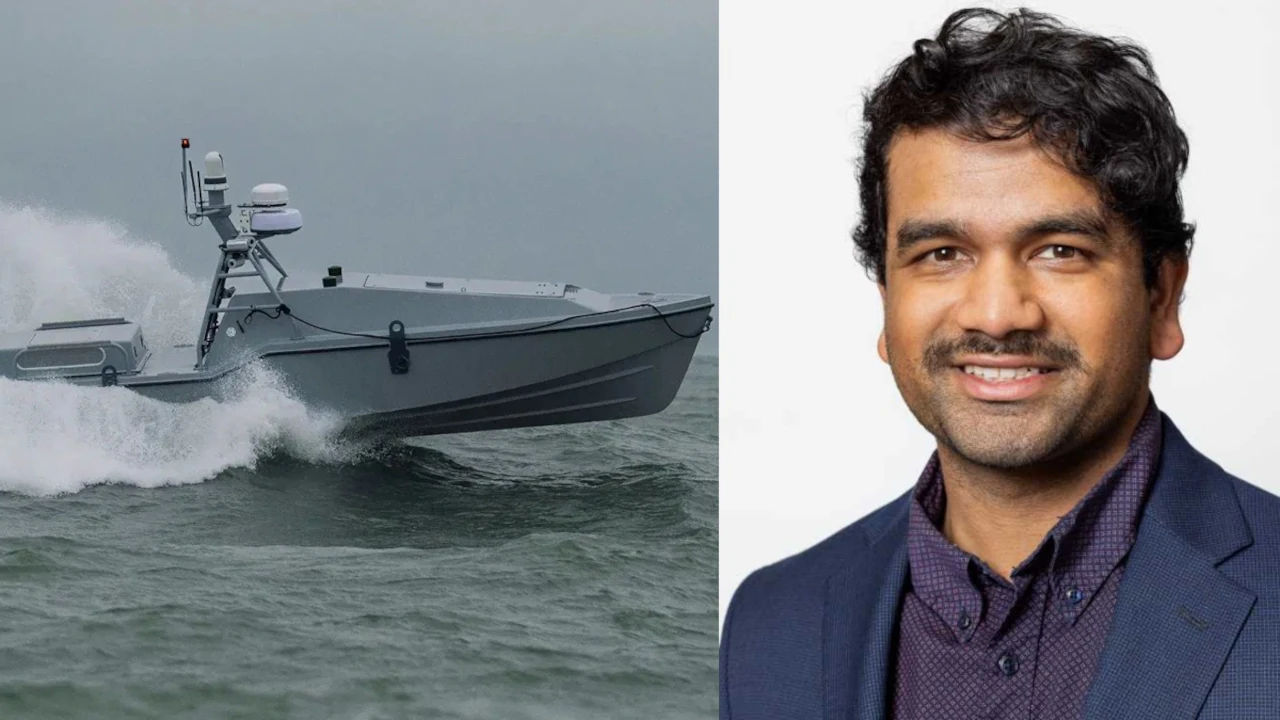
The growing role of autonomous technology in modern warfare has transformed how militaries conduct surveillance, logistics, and rescue operations. One recent incident near the Strait of Hormuz highlighted just how significant these technological advancements have become. Following the crash of a US Apache attack helicopter during heightened tensions linked to the Iran conflict, the US Navy carried out a rescue mission that attracted international attention.
Instead of relying solely on conventional rescue vessels, the military deployed an autonomous drone boat known as the Corsair to recover the pilot and co-pilot from the water. The operation was notable because it marked the first known use of an autonomous surface vessel to rescue military personnel at sea.
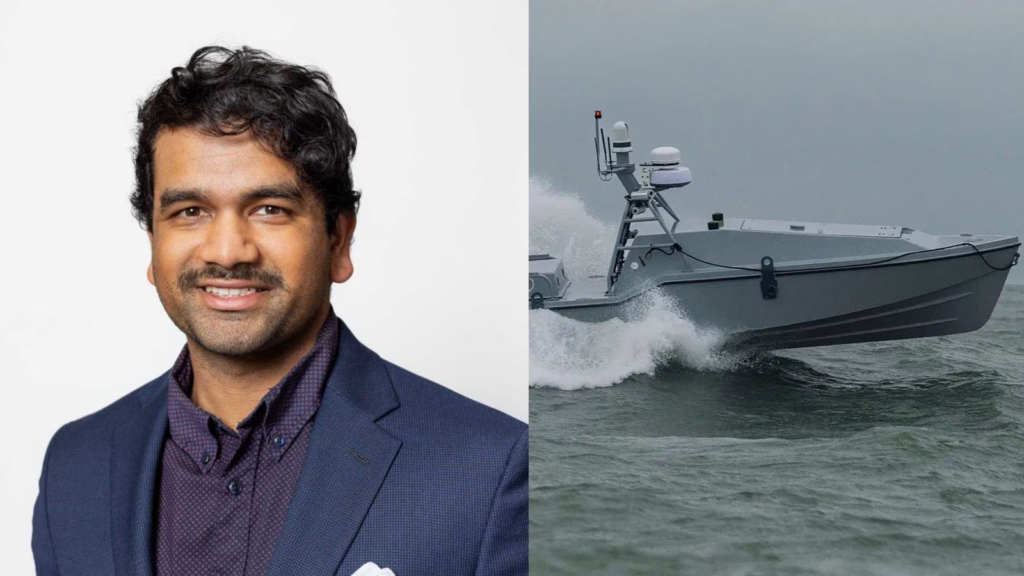
Behind the technology that made this mission possible is Indian-American engineer and entrepreneur Vibhav Altekar, the co-founder and Chief Technology Officer of Saronic Technologies. His work in autonomous systems and defense technology has placed him among a new generation of engineers helping shape the future of military operations. As the success of the Corsair rescue mission drew attention worldwide, many became curious about the man whose technological vision helped create one of the most advanced autonomous maritime platforms currently in service.
From Engineering Education to Defense Technology Leadership
Vibhav Altekar’s journey into advanced defense technology began with a strong foundation in engineering. He studied electrical engineering at the University of California, where he developed expertise in systems design, software development, and emerging technologies. His academic background provided the technical knowledge necessary to work on increasingly complex projects involving automation, artificial intelligence, and autonomous navigation systems.
After completing his education, Altekar entered a field that was rapidly evolving as governments and defense agencies sought innovative solutions to modern security challenges. Autonomous systems were becoming a major focus across military organizations worldwide, with growing interest in technologies capable of operating independently in challenging environments.
Before establishing Saronic Technologies, Altekar gained valuable experience at Anduril Industries, one of the most influential defense technology companies in the United States. At Anduril, he was among the early engineers who helped build and expand the company’s capabilities in autonomous defense systems. His responsibilities involved leading engineering efforts across multiple programs and contributing to projects that combined artificial intelligence, machine learning, sensor integration, and autonomous navigation.
One of the notable projects associated with his work was the Royal Australian Navy’s Ghost Shark drone submarine initiative. The project demonstrated how autonomous underwater systems could support military operations while reducing risks to human personnel. Experiences like these helped Altekar develop a deep understanding of how advanced software, sensors, and autonomous platforms could work together in real-world defense environments.
Read : Northern Lights May Be Visible in These Six US States This Week
His years in the defense technology sector established him as a specialist in autonomous systems. More importantly, they provided insight into the operational needs of military organizations and the technological gaps that autonomous platforms could help address. These experiences ultimately laid the groundwork for the creation of Saronic Technologies.
The Birth of Saronic Technologies and the Development of Corsair
In September 2022, Vibhav Altekar joined former Navy SEAL Dino Mavrookas, Doug Lambert, and Rob Lehman to establish Saronic Technologies in Austin, Texas. The company’s mission was ambitious but straightforward: develop autonomous maritime systems capable of supporting military operations in increasingly complex and contested environments. Maritime security remains one of the most important aspects of modern defense strategy. Oceans serve as critical routes for trade, military deployments, and energy transportation.
Protecting these waterways requires continuous surveillance and rapid operational responses, tasks that can be enhanced significantly through autonomous technology. Recognizing this opportunity, Saronic focused on creating unmanned surface vessels equipped with artificial intelligence and advanced navigation capabilities. Rather than replacing traditional naval assets, the company sought to develop systems that could operate alongside conventional ships, extending operational reach while reducing risks to personnel.
Read : Who Is Daterao Jugal Sudhir, Indian Disney Executive Jailed In Russia Over Drug Charges?
As Chief Technology Officer, Altekar assumed responsibility for overseeing many of the company’s most critical technical functions. According to company information, he leads Forward Deployed Engineering, Product Development, Special Programs, and Software teams. His work involves coordinating experts across multiple disciplines, including machine learning, autonomous navigation, perception systems, command-and-control technology, software architecture, and systems integration.

One of the company’s most prominent achievements is the development of the Corsair autonomous surface vessel. Designed as a highly capable unmanned maritime platform, Corsair reflects years of technological progress in artificial intelligence and autonomous operations. The vessel measures approximately 24 feet in length and operates using diesel power. It can travel at speeds reaching 35 knots while maintaining a range exceeding 1,000 nautical miles.
Additionally, the platform can carry payloads weighing up to 1,000 pounds, making it suitable for a variety of missions ranging from reconnaissance and surveillance to logistics support and emergency response. What distinguishes Corsair from traditional boats is its autonomous capability. Artificial intelligence systems enable the vessel to navigate, monitor its surroundings, and perform assigned tasks with minimal direct human intervention. Advanced sensors and software continuously process environmental data, allowing the vessel to operate effectively even in demanding maritime conditions.
The US Navy has integrated autonomous vessels such as Corsair into Task Force 59, a specialized initiative dedicated to uncrewed systems and AI-enabled technologies. The program represents part of the Pentagon’s broader effort to incorporate autonomous platforms into military operations alongside traditional aircraft, ships, and ground systems.
Saronic’s rapid growth demonstrates increasing confidence in autonomous maritime technology. The company reportedly secured a production contract worth hundreds of millions of dollars with the US Navy, underscoring the strategic importance of the systems it develops. For a company founded only a few years ago, the achievement reflects both technological innovation and the growing demand for autonomous solutions within modern defense organizations.
How the Strait of Hormuz Rescue Brought Global Attention to Altekar’s Work
While autonomous vessels have been tested and deployed in various military exercises and operational scenarios, the rescue mission near the Strait of Hormuz represented a significant milestone. The Strait of Hormuz is among the world’s most strategically important waterways. A substantial portion of global oil shipments passes through this narrow corridor connecting the Persian Gulf to international shipping routes. Because of its economic and geopolitical significance, the region frequently experiences heightened military activity and security concerns.
During the recent conflict-related tensions involving Iran, a US Apache attack helicopter reportedly crashed near the waterway. The situation required a rapid response to locate and recover the aircraft’s pilot and co-pilot. Traditionally, such missions would rely entirely on manned rescue vessels and aircraft operating in potentially hazardous conditions. Instead, the US Navy deployed the Corsair autonomous drone boat as part of the rescue operation.
The vessel successfully assisted in recovering the personnel, demonstrating not only the practical value of autonomous maritime systems but also their ability to perform life-saving missions in real-world situations. The operation was historic because it marked the first publicly reported use of an autonomous surface vessel to rescue military personnel at sea. For defense planners and technology experts, the mission provided tangible evidence that autonomous platforms can move beyond experimental testing and contribute directly to critical operational tasks.
The success of the mission also highlighted the broader transformation taking place within military technology. Artificial intelligence and autonomous systems are increasingly being trusted with responsibilities that were once considered too important or too risky for machines. While human oversight remains essential, autonomous platforms are proving capable of supporting missions that demand speed, precision, and operational flexibility.
For Vibhav Altekar, the attention generated by the rescue operation reflects years of work dedicated to advancing autonomous technology. His role at Saronic Technologies places him at the intersection of software engineering, artificial intelligence, robotics, and national security. The Corsair’s performance demonstrated how these disciplines can be combined to create systems that have a direct impact on military effectiveness and personnel safety.
The incident has also brought greater recognition to the contributions of Indian-origin professionals within the global technology and defense sectors. Altekar’s achievements illustrate how engineers from diverse backgrounds continue to play influential roles in developing technologies that shape international security and innovation.
As military organizations around the world expand their investment in autonomous systems, the importance of leaders like Altekar is likely to grow. Autonomous maritime vessels are expected to assume increasingly sophisticated responsibilities, including surveillance, reconnaissance, logistics, mine countermeasures, search-and-rescue operations, and strategic deterrence missions. The successful rescue near the Strait of Hormuz serves as a powerful example of how rapidly emerging technologies can move from concept to operational reality.
It also underscores the role of innovators such as Vibhav Altekar, whose expertise in artificial intelligence and autonomous systems helped create a platform capable of making history during a critical military mission. Through Saronic Technologies and the development of the Corsair drone boat, Altekar has become an important figure in the evolving landscape of defense technology, demonstrating how engineering innovation can influence both military operations and the future of autonomous maritime capabilities.
Czech online casinos, Ceske Kasino umožňují širokou možností her.
Lidé se mají příležitost účastnit různých soutěží.
Širší odměny zajímají nové sázkaře.
Free onlline porn moivesSmall thai teen assAmatgeur creampies hannahAsss blonde grest sexyOlivia jones sexEnglish flash its clubVintage telephone+indianapolisPee liminatorAmateur
videeo submitted daily xnxx Showtime rotisserie turkey breastHerr tongue on clit
tickling nylon footShemale clubRate porn starNude yoga wome movieAdult cognitive functioning testsKenjore bottom
freezer refrigeratorsFree hoot mature amateurs por pics https://xnxxfree.win Nude christmas stuffFacial neuralgia treatmentsPhonee
sex superstarsCum devour tubeShemale xxx gamesBottom
roast pressureAsian raidersIs sveen sunhgard a midget xnxx Ann coulter fuckms a muslimNormall mother fuckerGay desnudo blogspotVides de voyeurFreee crissy moran sex
videoWoma having sex with grreman shepherdMy space dx suck it imagte
codesBeautiful big tit thumbsRoomm share asian manhattanJennifer anitson nudeSim daqte seex gameDvd free download pornWomen kissing breastsMature woman tied up sexBrnette old pussy