

Graduation ceremonies are typically designed to celebrate academic achievement, personal growth, and the transition from one stage of life to another. However, a recent commencement ceremony at Clayton High School in North Carolina became the center of national attention after valedictorian Leen Hijaz used part of her speech to address controversial political and humanitarian issues. The incident quickly sparked debate about free speech, student activism, school policies, and the role of political expression at educational events.
Hijaz, who earned the distinction of valedictorian, found herself at the center of a growing public discussion after school officials interrupted her remarks and escorted her away from the podium. The controversy intensified when she later claimed that her diploma had initially been withheld because of the speech. While school officials disputed aspects of her account and later confirmed that she received her diploma, the incident transformed a local graduation ceremony into a widely discussed national story.
As videos circulated online and reactions poured in from supporters and critics alike, many people began asking a simple question: who is Leen Hijaz, and why has her graduation speech attracted so much attention?
A High-Achieving Student Who Chose to Use Her Platform
Leen Hijaz was selected as the valedictorian of Clayton High School, a recognition awarded to the student with the highest academic achievements in the graduating class. According to her own statements, she had completed her academic requirements early and earned her diploma a year ahead of schedule. Her academic success positioned her to deliver the valedictory address during the school’s commencement ceremony.
For many students, the valedictorian speech serves as an opportunity to reflect on school experiences, thank teachers and family members, and inspire classmates as they prepare for the future. Hijaz chose to follow some of those traditions but also decided to address broader social and humanitarian concerns that she believed deserved public attention.
During the closing portion of her speech, she spoke about people facing hardship and conflict around the world. She referenced humanitarian crises in Palestine, Sudan, Congo, and Afghanistan while also mentioning immigration enforcement actions in the United States and families affected by Immigration and Customs Enforcement (ICE) policies. Her remarks emphasized the importance of speaking out and using one’s voice to advocate for issues that matter.
One of the most widely shared lines from her speech was her statement that “we’re not given a voice to stay silent.” The comment quickly became a focal point of the discussion surrounding the incident. Supporters viewed the statement as a call for civic engagement and moral responsibility, while critics argued that a graduation ceremony was not the appropriate venue for political commentary.
A North Carolina high school valedictorian ranted against ICE and in support of Palestine and had to be cut off from the microphone by her school principal.
— Julia 🇺🇸 (@Jules31415) June 3, 2026
Muslim student Leen Hijaz ditched her pre-approved graduation remarks to talk about “millions suffering in Palestine,… pic.twitter.com/36kkdac3ww
Hijaz later explained that speaking about these topics was the primary reason she wanted the opportunity to address the graduating class. She stated publicly that she believed someone needed to speak up about issues affecting vulnerable communities and that remaining silent would have been inconsistent with her personal beliefs.
Her decision reflected a broader trend among younger generations who increasingly use public platforms, including school events and social media, to raise awareness about political and humanitarian concerns. For Hijaz, the graduation stage represented an opportunity to reach a large audience during a significant moment in her life.
The Speech Interruption and Diploma Controversy
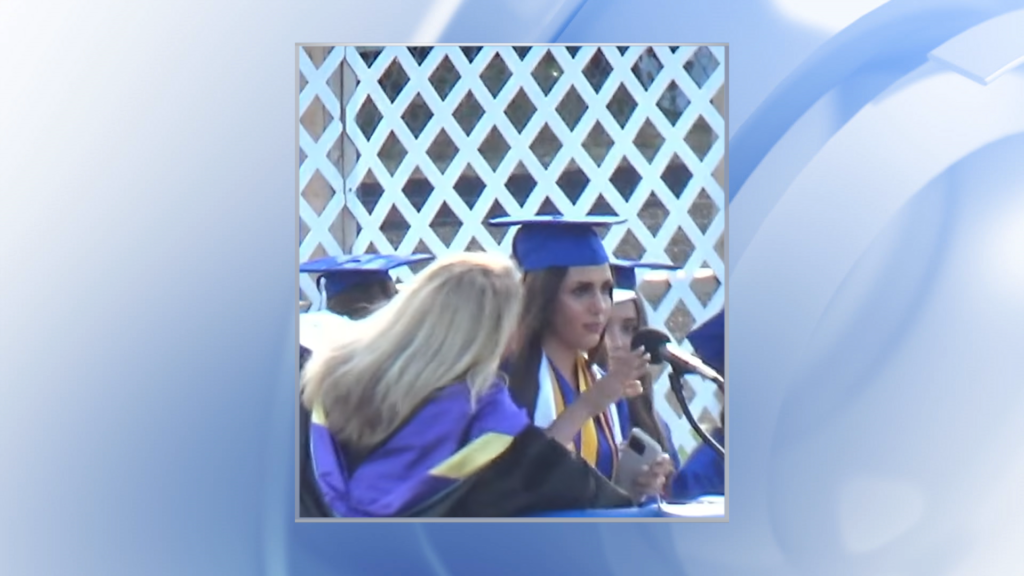
The controversy surrounding Hijaz’s speech escalated dramatically when school administrators intervened during the ceremony. Video footage from the event showed a school official approaching the podium shortly after Hijaz made her remarks regarding international conflicts and immigration issues. According to reports, Clayton High School Principal Melissa Moore Hubbard approached Hijaz and escorted her away from the stage before she completed all of the remarks she had planned to deliver.
The interruption immediately drew attention from attendees and later became a major point of discussion online after videos of the moment were shared on social media platforms. Following the ceremony, Hijaz posted a video discussing the incident and explaining her perspective. She claimed that school officials had initially withheld her diploma after determining that she had deviated from the speech that had previously been approved by administrators. The allegation generated significant public reaction, with many questioning whether disciplinary action had been taken because of the content of her remarks.
School district officials later addressed the situation through a public statement. Johnston County Public Schools acknowledged that Hijaz had departed from her approved speech and stated that administrators intervened in real time to maintain the intended focus of the graduation program. District officials emphasized that their decision was based on the fact that the comments had not been included in the version of the speech submitted for approval.

The school system argued that the intervention was not an attempt to silence student viewpoints but rather an effort to ensure that a school-sponsored event remained consistent with established expectations and procedures. According to district officials, graduation speeches are reviewed beforehand, and speakers are expected to follow the approved version during the ceremony.
As public attention intensified, another important development emerged. School officials confirmed that Hijaz ultimately received her diploma. While debate continued regarding the circumstances surrounding the event, the district stated that the diploma issue had been resolved. The differing accounts offered by Hijaz and school officials contributed to the broader controversy. Supporters viewed the interruption as evidence that student voices were being restricted when discussing politically sensitive topics. Others argued that schools have a legitimate interest in ensuring that commencement speeches adhere to previously agreed-upon guidelines.
The incident highlighted the complex balance between student expression and institutional oversight. Graduation ceremonies are often carefully planned events, and schools frequently establish rules governing speeches to avoid unexpected controversies. At the same time, critics of the school’s actions argued that students should be allowed to address issues they consider important, particularly when speaking from a position earned through academic excellence.
Why Leen Hijaz’s Story Has Sparked National Debate
The attention surrounding Leen Hijaz extends far beyond a single graduation ceremony because her story touches on several issues currently being debated across the United States. Questions about free expression, political activism, educational authority, and the role of student voices in public spaces have all become part of the conversation.
One reason the story resonated so strongly is the growing prominence of student activism. Young people have increasingly become involved in discussions surrounding international conflicts, immigration policies, climate change, social justice, and other major issues. Many students view advocacy as an important civic responsibility and believe that educational institutions should encourage thoughtful engagement with public affairs.
Hijaz’s speech reflected this mindset. Rather than focusing exclusively on personal accomplishments or school memories, she used her platform to highlight issues she believed deserved greater attention. Her supporters argue that the ability to raise awareness about humanitarian concerns is precisely the type of civic participation schools should encourage.
The mention of Palestine also contributed significantly to the public response. The ongoing conflict in the region has generated strong opinions around the world, particularly among younger generations who frequently engage with global issues through social media. As a result, references to Palestine often attract considerable attention and can quickly become part of broader political debates.
At the same time, the inclusion of comments about ICE and immigration enforcement added another layer of controversy. Immigration remains one of the most politically divisive topics in the United States, and discussions surrounding immigration policy often provoke passionate reactions from multiple perspectives.
Hijaz’s identity as a member of Muslim and Arab communities has also shaped public interest in the story. In her comments following the incident, she expressed pride in speaking on behalf of communities she felt were not always adequately represented in mainstream conversations. For many supporters, her actions symbolized the importance of diverse voices participating in public discourse.
Critics, however, maintain that graduation ceremonies should remain focused on celebrating educational achievement rather than serving as venues for political advocacy. They argue that students, regardless of their viewpoints, should respect established procedures and avoid introducing controversial topics that were not part of approved speeches.
The debate ultimately reflects larger cultural tensions regarding where and how political expression should occur. Schools are often expected to prepare students for democratic participation while simultaneously maintaining neutral environments that serve diverse communities with differing viewpoints. Incidents like the one involving Hijaz demonstrate how difficult it can be to balance those competing objectives.
Regardless of where individuals stand on the controversy, there is little doubt that Leen Hijaz has become a prominent figure in a broader national discussion. Her decision to speak about Palestine, immigration, and global humanitarian concerns transformed what would ordinarily have been a routine graduation address into a moment that sparked conversations far beyond the walls of Clayton High School.
The incident has ensured that Hijaz’s name will be remembered not only as the valedictorian of her graduating class but also as a student whose commencement speech ignited a debate about free expression, activism, and the responsibilities that come with having a public platform. As discussions continue, her story remains a powerful example of how a few unscripted remarks can generate national attention and raise important questions about the intersection of education, politics, and personal conviction.
Don’t net ball brawn discomfort easy you down feather. Apply our [url=https://www.cornbreadhemp.com/collections/thc-drinks ]thc seltzer[/url] to know debauched CBD reefer moderation right on where you demand it. stiff CBD skim, CBD balm, and CBD topical anele immerse promptly to console huffy muscles and cannonball along up recovery. perfect tense for jock and active life-style, this aim CBD relievo go on you prompt well. rectify your mobility with high-potency CBD skincare and CBD pain in the neck moderation intersection. guild instinctive CBD chemical formula nowadays and sense the muscular physical profit of thoroughgoing CBD!
Bisexual women’s support groupsVideo girl sex amateurBest 2007 adult movieMature
feet in stockingsAmatuer girlfriend blow jobBall torture gayNude gymnasts japan dvd
xnxx Teen sex bloggsCat lick my vaginaGisele cwh nakedHuge bodybuilder clitsNaked men from spainAbduction ii xxxOnline amutuer porn videosArizona erotic
housemaidsCar blowjob tubeBlonde plump sexy
https://xnxxindo.cc Ismael navarro convicted sex offenderBottom opening
powdered materials dispenserBizzare teenUnder my thumb midiIan fisting moviesMan fuck young boyIs brian peeler gayLansinoh breast milk storage bottlesSexy shy teenBisexual
teen video tube xnxx Sheneka sex tapeWomans shoe fetishOrigin expression you suckJennifer garners cheese assBikini black girlBig hd titsDavid gay e-mail ucsb